
Weekly Market Outlook | Nonfarm Payrolls Rekindle Rate-Hike Bets, Oil Sharply Unwinds Risk Premium, U.S. Equity Indices Rotate
Last week, markets were whipsawed by three main themes. U.S. October nonfarm payrolls came in far above expectations, rekindling bets on a Federal Reserve rate hike in December, lifting the dollar and pushing Treasury yields higher. International oil prices plunged about 13% for the week on expectations of U.S.-Iran de-escalation and concerns over oversupply, though tanker attacks and shipping risks in the Strait of Hormuz limited the decline. U.S. equities staged a partial rebound led by a sharp rebound in chip stocks after heavy selling, but the Nasdaq and S&P 500 still posted a fourth consecutive weekly decline, with clear internal divergence among indices. For CFD traders, the focus this week is not only directional judgment, but also the linkages among the dollar, interest rates, oil geopolitical risk and U.S. equity index rotation—as well as volatility and liquidity risks around major data releases.
1. Dollar and Rates: Strong Nonfarm Payrolls Boost December Rate-Hike Bets
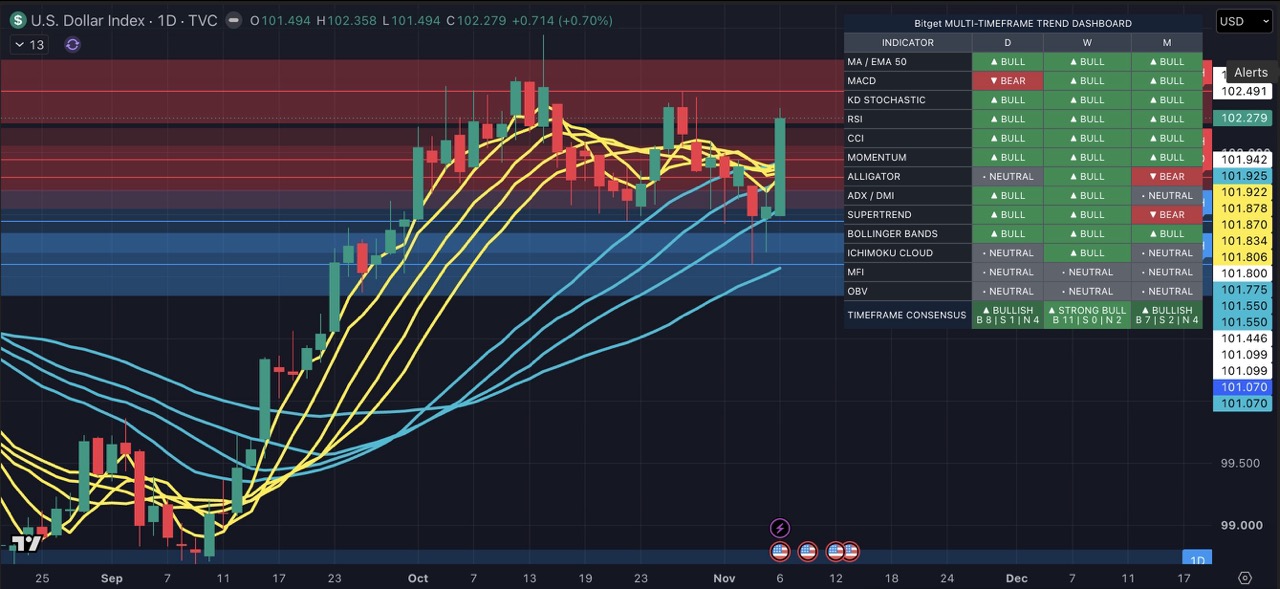
U.S. October nonfarm payrolls rose by 165,000, far above economists’ estimate of 65,000. Estimates under different survey methodologies ranged roughly between 59,000 and 65,000, and the actual reading clearly beat expectations. September job gains were revised up to 60,000, while the unemployment rate fell to 4.1%. The strong employment data shows that the U.S. economy remains resilient and gives the Fed more room to maintain tightening policy.
According to the CME FedWatch tool, after the report, the probability of at least a 25-basis-point rate hike at the December meeting rebounded to nearly 80%, after having fallen to about 67% earlier. The ICE U.S. Dollar Index, which tracks the dollar against six major currencies, jumped 0.77% on Friday to 102.26, its largest single-day gain since June 17. It rose 0.3% for the week and closed higher on a weekly basis.
Major currency pairs reacted in tandem. EUR/USD fell 0.67% to 1.11437, its largest single-day drop since October 1, and lost 0.1% for the week, marking a third consecutive weekly decline. GBP/USD tumbled 0.71% to 1.3355, its largest single-day drop since September 23, and fell nearly 0.3% for the week, ending a three-week winning streak. USD/JPY rose 0.47% to 158.430, while the yen depreciated nearly 0.6% for the week, its biggest weekly decline since the week of September 18.
Treasury yields also moved higher. The 10-year Treasury yield rose 1.6 basis points to 4.85%, while the 2-year yield rose 4.1 basis points to 4.52%. Fed officials’ comments supported rate-hike expectations. New York Fed President Williams said economic growth remains resilient but inflation is still too high. St. Louis Fed President Musalem said inflation remains one of the most closely watched issues. San Francisco Fed President Daly said that even after a “painful” selloff in tech stocks, the Fed may still need to raise rates further.
CFD trading watch: Dollar Index CFDs are supported in the near term by strong nonfarm payrolls and rate-hike bets, but the dollar could quickly give back gains if subsequent employment or inflation data weaken. EUR, GBP and JPY are highly sensitive to U.S. policy expectations, and spreads and volatility may widen around data releases. Traders should avoid one-sided bets and prioritize event risk and position control.
2. Oil: Geopolitical Risk Premium Unwinds, in a Tug-of-War with Supply Tail Risk
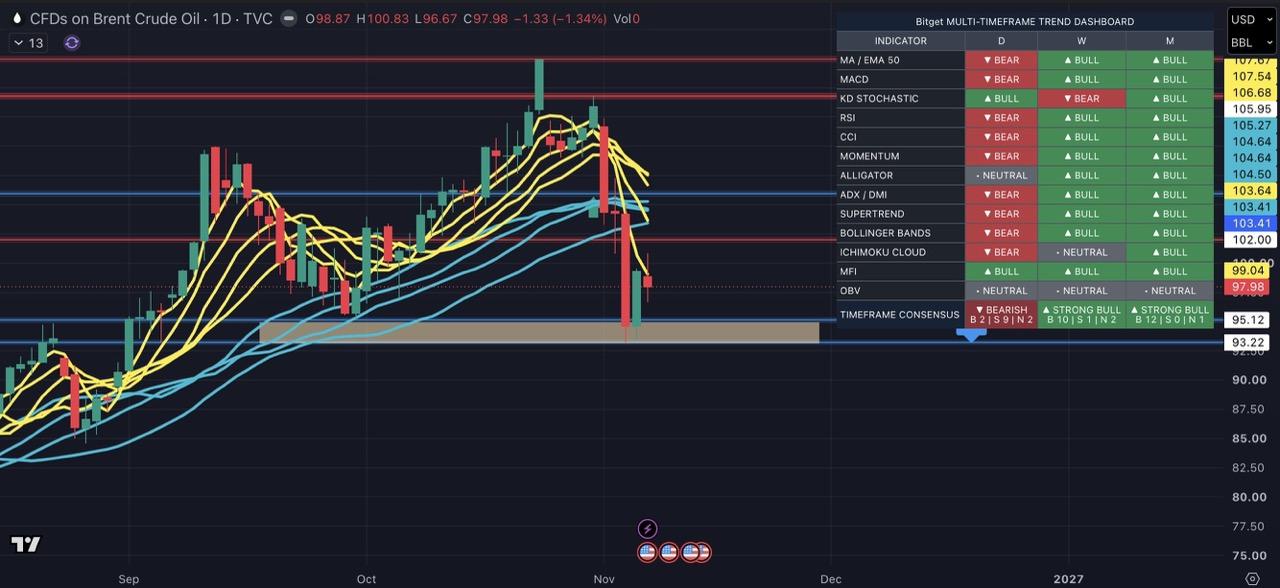
Oil prices fell sharply last week. Brent dropped from $113.43 last Friday to $98.32, down $15.11 for the week, or about 13.3%. WTI fell from $104.12 to $90.83, down $13.29, or about 12.8%. Both benchmarks recorded one of their sharpest weekly declines so far this year.
The main driver of the pullback was the U.S. midterm election result, which raised expectations for de-escalation in the U.S.-Iran conflict. After the Democrats’ major victory, markets expect the White House may face greater political pressure to reduce the economic impact of the conflict and increase the possibility of diplomatic efforts to ease tensions. Investors also expect Middle East crude exports to have room to recover further. Reuters noted that oil prices plunged about 8% on Wednesday to a two-month low, reflecting a rapid lowering of expectations for an escalation in the Middle East conflict and a gradual unwinding of the risk premium previously priced in.
Supply-demand fundamentals also showed signs of weakening. The premium on Middle East crude spot benchmarks has returned to pre-conflict levels, indicating that regional supply tightness has eased. High energy prices have begun to curb consumer demand, and the market is gradually showing signs that supply may exceed demand. Rystad Energy analysts noted that the crude market is gradually shifting toward oversupply, although quality differences remain, and refiners must adjust according to the crude grades their equipment can process. Shipping restrictions around the Strait of Hormuz have also forced operators to use longer routes and ship-to-ship transfers.
However, supply risks have not disappeared. A Greek ship management company said an oil product tanker exploded in the Persian Gulf on November 5, killing one crew member, with the incident believed to have been caused by a missile attack. UKMTO data showed that the frequency of recent tanker attacks remains close to historic highs. Iran said on Thursday that three other tankers had been attacked in the Strait of Hormuz, raising concerns over shipping security. A Kpler analyst noted that oil does not need to return to $117 per barrel for energy costs to be expensive, and even at $93, the original problems have not disappeared.
CFD trading watch: The key near-term variable for crude CFDs is the tug-of-war between “geopolitical risk premium unwinding” and “supply-disruption tail risk.” If U.S.-Iran diplomatic talks make substantive progress, oil prices may further reduce their risk premium. But if tanker attacks continue or even trigger retaliation, supply risks could push oil prices higher again. UKOUSD is strongly headline-driven and highly volatile. Traders should pay particular attention to position control, stop-loss settings and gap risk around news.
3. U.S. Equity Indices: Chip Stocks Rebounded Strongly, but Internal Index Divergence Is More Important
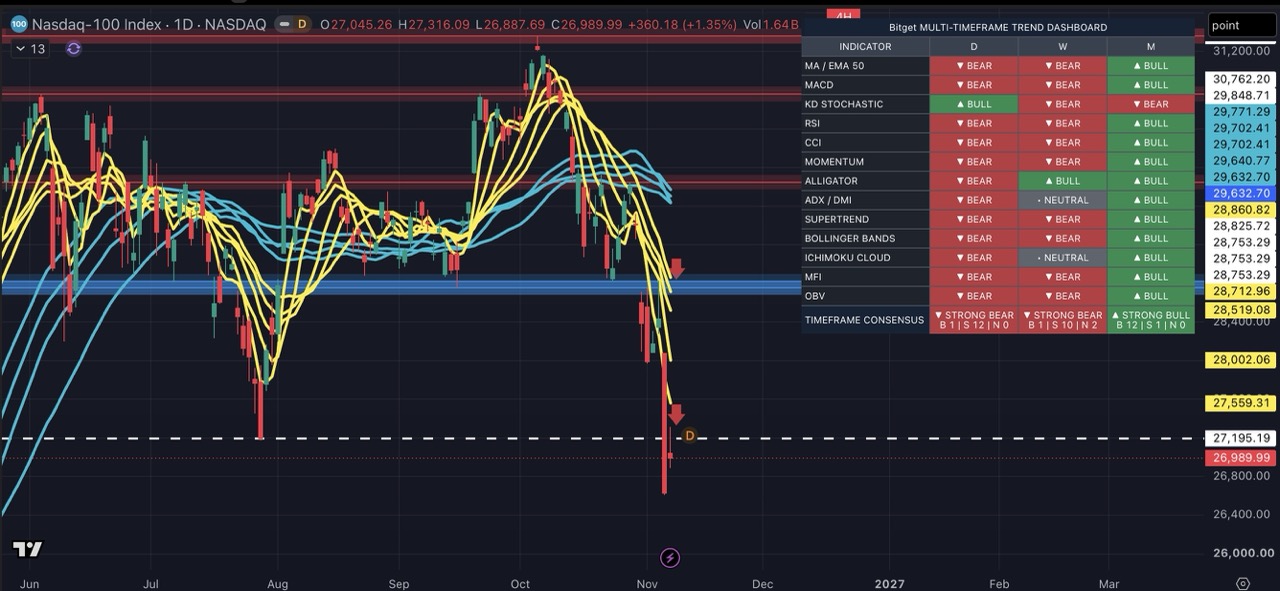
U.S. stocks rebounded on Friday, but it looked more like a partial repair after a deep selloff than a full return of risk appetite. After chip stocks suffered a violent selloff the previous trading day, dip buyers returned to the semiconductor sector.
All three major indices still closed lower for the week. The Nasdaq fell 3.4% and the S&P 500 dropped 2.7%, both posting a fourth consecutive weekly decline. The Dow was relatively resilient, with a weekly decline of 0.9%. This shows that Friday’s semiconductor rebound has not yet reversed the overall weak tone for the week.
Individual stock headlines were eye-catching: Intel surged more than 7.7%, Lam Research jumped more than 8%, IonQ soared more than 23% after strong earnings, and Moderna and Tesla also strengthened. But for CFD traders, index-level signals are better suited for judging capital flows and risk appetite. The strong rebound in the Philadelphia Semiconductor Index reflects a short-term recovery in semiconductor sentiment, but the Nasdaq and S&P 500’s fourth consecutive weekly decline reminds investors that the broader market has not fully shaken off pressure.
On the macro side, strong nonfarm payrolls increased expectations for a December rate hike, while Treasury yields and the dollar rose together. The 10-year yield rose to about 4.86%, which tends to weigh on highly valued growth stocks. On the policy side, after the U.S. midterm elections, markets are worried that data center construction may face more restrictions. AI and chip stock volatility comes not only from earnings or orders, but also from regulatory expectations. The newly elected Texas governor said laws protecting residents should be established before advancing data center construction, and related uncertainty may continue to affect AI-related stocks.
CFD trading watch: Rather than focusing only on intraday moves in single stocks such as AMD, Nvidia or TSMC ADR, traders should raise their perspective to the index level. The Philadelphia Semiconductor Index reflects the overall strength of the semiconductor sector. The Nasdaq is a bellwether for tech and growth stocks and is sensitive to rate expectations and AI regulatory news. The S&P 500 can be used to gauge market breadth. The Dow can be used to compare risk appetite relative to tech stocks. When the market shifts from single-stock moves to index rotation, U.S. equity index CFDs allow traders to express views on broad market direction, sector strength or relative index performance more directly, without taking on single-company earnings or news gap risk.
This Week’s CFD Trading Plan Checklist
1. Dollar Index CFDs: Watch whether rate-hike bets persist and whether upcoming employment, inflation and Fed official comments weaken the dollar’s rally.
2. Major Currency Pair CFDs: EUR, GBP and JPY are sensitive to U.S. policy expectations. Volatility and spreads may widen around data releases, so it is prudent to reduce leverage and control position size.
3. Crude Oil CFDs (UKOUSD): Keep a close eye on U.S.-Iran talks, tanker attacks and shipping risks in the Strait of Hormuz. Avoid heavy one-sided positions amid headline-driven moves.
4. U.S. Equity Index CFDs: Watch the relative strength of the Philadelphia Semiconductor Index, Nasdaq, S&P 500 and Dow. If an index rises but most constituents fall, the rebound is not broad-based.
5. Volatility and Liquidity Risk: Around major data releases, slippage and spread-widening risks increase, and leveraged position risk rises accordingly. Set stop-losses in advance, scale into positions and preserve capital flexibility.
Conclusion: Expectations Are Still Not Certainty; Focus on Linkages and Risk Control
Strong nonfarm payrolls have led markets to reprice Fed rate-hike bets for December. The dollar index closed higher for the week, EUR and GBP came under pressure, and Treasury yields rose. Oil is in a fierce tug-of-war between expectations of U.S.-Iran de-escalation and supply-disruption risks. U.S. chip stocks rebounded strongly, but internal index rotation and weak weekly performance remind traders not to look only at single stocks. For CFD traders, the focus this week is not only direction, but also the linkages among the dollar, yields, oil geopolitical risk and U.S. equity indices—as well as volatility and liquidity risks around major news.
Want to trade Dollar Index, major currency pairs, crude oil UKOUSD and U.S. equity index CFDs? Go to Bitget CFD now to participate in volatility opportunities across traditional financial market products. Before placing orders, set stop-losses and position sizes, keep a close eye on Fed policy expectations, U.S.-Iran talks and shipping risks in the Strait of Hormuz, and plan this week’s trades with a more complete cross-asset perspective.
All trading education provided by Bitget is for educational purposes only and should not be considered financial advice. The strategies and examples shared are for reference only and may not reflect actual market conditions. CFD trading involves significant risk, including the potential loss of capital. Past performance does not guarantee future results. Please conduct thorough research and ensure that you understand the risks involved. Bitget is not responsible for any trading decisions made by users.


- 1. Dollar and Rates: Strong Nonfarm Payrolls Boost December Rate-Hike Bets
- 2. Oil: Geopolitical Risk Premium Unwinds, in a Tug-of-War with Supply Tail Risk
- 3. U.S. Equity Indices: Chip Stocks Rebounded Strongly, but Internal Index Divergence Is More Important
- This Week’s CFD Trading Plan Checklist
- Conclusion: Expectations Are Still Not Certainty; Focus on Linkages and Risk Control