
Fed Meeting October 28: What Crypto Traders Need to Know
The Federal Reserve's October 28, 2026, interest-rate decision is approaching, and Bitcoin is once again struggling to hold the $80,000 level. After falling below $80,000 during Asian trading on October 27, BTC recovered toward $80,500 as investors assessed the possibility of another interest-rate increase, persistent U.S. inflation, and the outlook for monetary policy through the end of the year.
The market largely expects the Fed to leave interest rates unchanged at 3.75%–4.00%, but the decision itself may not be the biggest driver of cryptocurrency prices. Traders will also be watching Fed Chair Kevin Warsh's comments on inflation, economic growth, and future rate increases. With U.S. GDP and PCE inflation data scheduled for October 29, Bitcoin, Ethereum, and other cryptocurrencies face several potential volatility triggers within just 48 hours. Here's what crypto traders need to know before the announcement.
Key Takeaways
-
The Fed will announce its interest-rate decision on October 28, 2026, at 2:00 p.m. ET (18:00 UTC), followed by a press conference at 2:30 p.m. ET (18:30 UTC).
-
The current federal funds target range is 3.75%–4.00%. Markets widely expect the Fed to hold rates steady, with recent futures-based estimates suggesting approximately an 88%–90% probability of no change.
-
Bitcoin is trading around $80,000 ahead of the meeting. BTC briefly fell toward $79,700 on October 27 before recovering, reflecting cautious positioning ahead of the announcement.
-
Inflation remains a key concern. September's U.S. Consumer Price Index rose 3.7% year over year, up from 3.4% in August, strengthening the case for restrictive monetary policy.
-
The Fed's guidance could matter more than the rate decision. Even if rates remain unchanged, comments about another potential hike in December could influence Bitcoin, Ethereum, altcoins, and broader financial markets.
When Is the Next Fed Meeting? October 28, 2026 Schedule
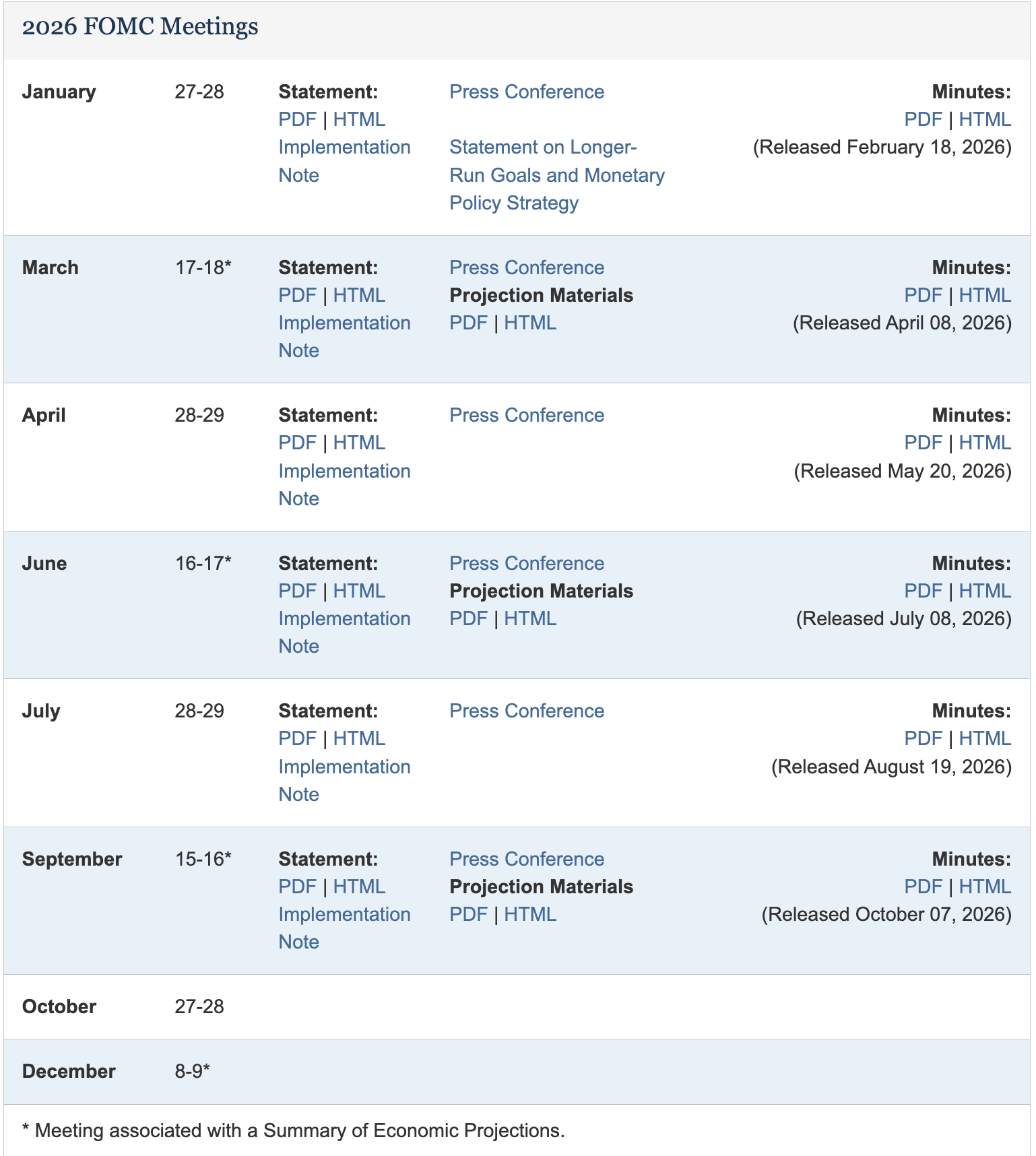
The Federal Open Market Committee (FOMC) is holding its two-day policy meeting on October 27–28, 2026. The interest-rate decision will be announced on Wednesday, October 28, at 2:00 p.m. Eastern Time.
The announcement will be followed by a press conference led by Fed Chair Kevin Warsh, beginning at 2:30 p.m. ET.
October 2026 Fed Meeting Schedule
| Event |
Date |
U.S. Eastern Time |
UTC |
| FOMC meeting begins |
October 27 |
— |
— |
| Fed interest-rate decision |
October 28 |
2:00 p.m. |
18:00 |
| Fed press conference |
October 28 |
2:30 p.m. |
18:30 |
| Next scheduled FOMC meeting |
December 8–9 |
— |
— |
Source: Federal Reserve — FOMC Calendars. All times are based on the published U.S. Eastern Time schedule.
For crypto traders in Asia, the decision arrives early on October 29. It will be announced at 2:00 a.m. in Singapore and Hong Kong, and 3:00 a.m. in Japan and South Korea.
The FOMC normally holds eight scheduled meetings each year to assess economic conditions and decide whether interest rates should rise, fall, or remain unchanged.
These decisions influence borrowing costs, financial-market liquidity, and investment sentiment. Although Bitcoin does not operate under the Federal Reserve's monetary system, changes in U.S. interest-rate expectations can influence demand for cryptocurrencies.
Will the Fed Cut, Hold, or Raise Interest Rates on October 28?
As of October 27, financial markets largely expect the Federal Reserve to hold its benchmark interest rate at 3.75%–4.00%.
According to futures-market expectations reported ahead of the meeting, the probability of an unchanged rate is approximately 88%–90%, leaving a smaller probability of an increase. These probabilities can change as traders adjust their positions.
The Fed's latest policy decision came on September 16, 2026, when the FOMC raised its benchmark interest rate by 25 basis points, bringing the target range from 3.50%–3.75% to 3.75%–4.00%.
The September decision was unanimous, with all 12 voting members supporting the increase. The committee explained that inflation remained elevated despite continued economic expansion and resilient consumer spending.
The full statement is available from the Federal Reserve's September 16 announcement.
Why Markets Expect the Fed to Hold Rates
The Fed has already tightened monetary policy, and investors are now assessing whether another immediate increase is necessary.
Recent U.S. inflation figures remain above the central bank's 2% long-term target. However, policymakers also need to consider economic activity, employment, and the effects of previous rate increases.
The latest inflation report illustrates the challenge.
| U.S. inflation indicator |
August 2026 |
September 2026 |
| Headline CPI, year over year |
3.4% |
3.7% |
| Headline CPI, monthly |
0.4% |
0.6% |
| Core CPI, year over year |
2.4% |
2.6% |
| Core CPI, monthly |
0.3% |
0.3% |
Source: U.S. Bureau of Labor Statistics, September 2026 CPI report, published October 14, 2026.
Headline inflation accelerated to 3.7% in September, its highest reading of the two months shown. The monthly increase of 0.6% was partly driven by energy prices, with gasoline prices rising 9.1% during September.
Core CPI, which excludes food and energy, increased 2.6% over the previous 12 months, compared with 2.4% in August.
These numbers indicate that inflation pressure has not disappeared. At the same time, the Fed may prefer to assess additional economic data before raising rates again.
Why the Fed's December Outlook Matters
Even if the Fed holds rates on October 28, traders will pay close attention to what policymakers say about the December 8–9 meeting.
The market's main question is whether the Fed believes additional tightening will be necessary to bring inflation closer to its 2% target.
For example, the Fed could maintain rates while emphasizing that inflation remains too high and further increases may be appropriate. Such guidance would generally be considered hawkish because it signals that restrictive monetary policy could continue.
Alternatively, the Fed could acknowledge progress toward its inflation goal and indicate that current rates are sufficiently restrictive. That would be interpreted as a softer policy stance.
For cryptocurrency markets, the difference matters. A rate hold accompanied by a hawkish message could produce a very different reaction from a hold accompanied by more supportive guidance.
Why Is Bitcoin Struggling Ahead of the Fed Meeting?
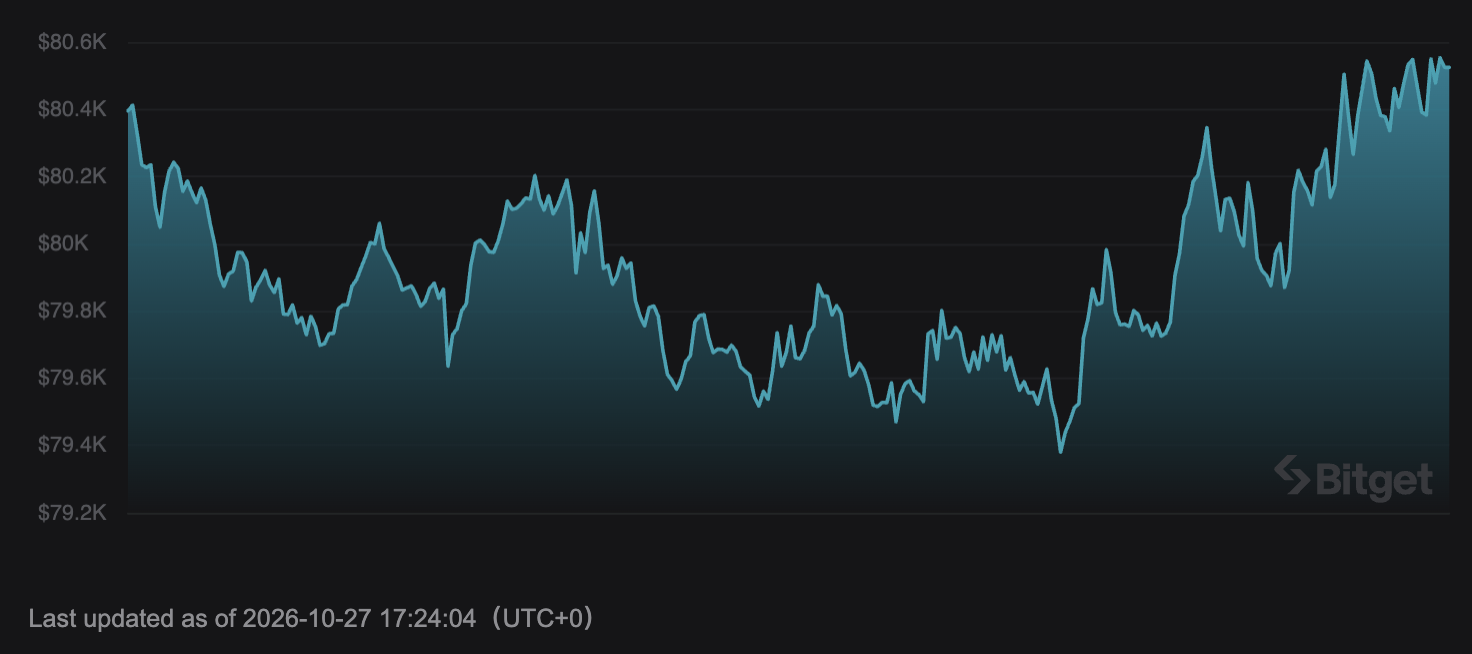
Bitcoin entered the Fed meeting week under pressure after failing to sustain its recent recovery toward $85,000.
On October 26, BTC was trading near $80,400. The following day, it slipped below $80,000 to approximately $79,700 during Asian trading, even as several Asian technology stocks advanced.
According to CoinDesk's October 26 market report, the market was already showing caution ahead of the Fed announcement. Crypto trading remained subdued relative to the strength observed in some equity markets.
By the afternoon of October 27, Bitcoin had recovered toward $80,500, although the broader market remained sensitive to interest-rate expectations.
Bitcoin Price Levels to Watch
Based on market activity through October 27, several levels are worth monitoring.
| BTC price level |
Market significance |
| 79,300–79,400 |
Nearby support reference based on recent lows |
| $80,000 |
Important psychological level |
| 80,500–80,600 |
Immediate upside trading area |
| $82,000 |
Wider resistance reference |
| 84,000–85,000 |
Area near the previous week's recovery high |
These are analytical reference levels, not guaranteed support or resistance. Prices may move through them rapidly during major announcements.
A sustained recovery above $80,000 could help stabilize short-term sentiment. However, a renewed move below recent lows could expose Bitcoin to additional selling pressure, particularly if the Fed's message proves more restrictive than markets expect.
Traders should also consider that price movements around major announcements are often driven by changes in liquidity and leveraged positioning rather than long-term changes in Bitcoin's fundamentals.
How Inflation, Treasury Yields, and the Dollar Affect Bitcoin
The relationship between interest rates and Bitcoin is not always straightforward, but several channels are particularly important.
First, higher interest rates can make short-term government debt and other interest-bearing assets more attractive relative to assets that do not generate contractual interest payments.
Second, expectations of tighter U.S. monetary policy can support Treasury yields and the U.S. dollar. A stronger dollar may create additional pressure on dollar-denominated assets, including cryptocurrencies, although this relationship is not consistent in every market environment.
Third, higher borrowing costs can reduce the willingness of investors to take risks, especially in leveraged or highly volatile markets.
For Bitcoin, these forces can become particularly noticeable when traders are already uncertain about the direction of the broader economy.
However, interest rates are not the only factor affecting cryptocurrency prices. ETF demand, exchange liquidity, regulatory developments, and changes in derivatives positioning can all influence the market independently.
Bitcoin and Ethereum ETF Flows Show Mixed Institutional Demand
Institutional investment flows provide another useful indicator of market sentiment ahead of the Fed meeting.
On October 26, U.S. spot Bitcoin ETFs recorded approximately $110.3 million in net inflows, according to Farside Investors.
The inflow came entirely from BlackRock's iShares Bitcoin Trust (IBIT), while the other tracked U.S. spot Bitcoin ETFs reported no net flows for the session.
Ethereum ETFs moved in the opposite direction, recording approximately $88.6 million in net outflows.
| ETF category |
October 26 net flow |
| U.S. spot Bitcoin ETFs |
+$110.3 million |
| U.S. spot Ethereum ETFs |
−$88.6 million |
Sources: Farside Bitcoin ETF data and Ethereum ETF data. Figures refer to the completed October 26 U.S. trading session.
The difference suggests that fund demand for Bitcoin was stronger than for Ethereum during that session, although one day's flows cannot establish a lasting trend.
For traders preparing for the Fed decision, the October 27 ETF figures and subsequent sessions will help show whether investors are increasing exposure or reducing risk following the announcement.
How Could the October 28 Fed Decision Affect Bitcoin and Crypto?
The cryptocurrency market's reaction will depend not only on the Fed's decision, but also on whether that decision matches what investors already expect.
With a rate hold widely anticipated, the central bank's language on future policy may become the main driver of short-term volatility.
Three scenarios are worth considering.
Scenario 1: Fed Holds Rates and Signals a Softer Policy Outlook
If the Fed maintains rates at 3.75%–4.00% and indicates that further increases are becoming less necessary, financial markets could interpret the announcement as relatively dovish.
A softer outlook could reduce expectations for future borrowing costs and improve sentiment toward risk assets.
For Bitcoin, this could support renewed buying interest, particularly if Treasury yields and the dollar weaken following the announcement.
Ethereum and higher-volatility altcoins could also benefit if investors become more comfortable taking risks.
However, a dovish interpretation would not guarantee a cryptocurrency rally. Traders would still need to assess market positioning, ETF flows, and broader economic conditions.
Scenario 2: Fed Holds Rates but Signals Further Tightening
This could be one of the most important scenarios for October 28.
The Fed might maintain the current rate while emphasizing that inflation remains elevated and additional increases may be necessary.
Such a decision would match the expected headline outcome but could still disappoint traders hoping for a more supportive monetary-policy outlook.
In that environment, U.S. Treasury yields could rise, the dollar could strengthen, and risk-sensitive assets could face selling pressure.
For Bitcoin, the market would likely focus on whether the $80,000 area remains intact. Ethereum and smaller altcoins could experience larger percentage swings as traders adjust their exposure.
Scenario 3: Fed Unexpectedly Raises Interest Rates
An unexpected 25-basis-point increase would bring the federal funds target range to 4.00%–4.25%.
Because markets have assigned a relatively low probability to this outcome, a surprise increase could trigger a more substantial repricing across financial markets.
Bitcoin, Ethereum, technology stocks, Treasury yields, and the dollar could all react rapidly as investors reassess the direction of monetary policy.
Crypto derivatives markets would deserve particular attention. Sharp price movements can force leveraged traders to close positions or trigger liquidations when their margin is insufficient.
Nevertheless, even an unexpected hike would not guarantee a sustained decline. Markets may react differently depending on the Fed's explanation and whether traders believe the tightening cycle is approaching its end.
Fed Rate Decision: Three Possible Crypto Market Scenarios
| Fed outcome |
Possible BTC reaction |
Broader crypto implications |
| Hold rates, dovish guidance |
Potential recovery |
Improved risk appetite |
| Hold rates, hawkish guidance |
Potential selling pressure |
More cautious altcoin positioning |
| Unexpected 25-bp hike |
Potential sharp volatility |
Greater liquidation and repricing risk |
These are conditional market scenarios, not forecasts of the Fed's decision or guaranteed price movements.
How Will the Fed Meeting Affect Bitcoin, Ethereum, and Altcoins?
Although the Fed decision affects financial conditions across markets, different cryptocurrencies can respond in different ways.
Bitcoin (BTC): The $80,000 Level Remains in Focus
Bitcoin is likely to remain a central focus because of its market capitalization, liquidity, and importance to the wider cryptocurrency market.
Ahead of the decision, BTC is trading near a level that investors have repeatedly tested over recent sessions.
If the Fed's guidance supports risk appetite, Bitcoin could attempt another recovery. If the announcement strengthens expectations for additional tightening, recent support levels may face renewed pressure.
Changes in spot ETF flows and futures positioning could influence the scale of either move.
Ethereum (ETH): ETF Flows and Risk Appetite Matter
Ethereum has shown weaker recent performance than Bitcoin, with ETH trading around 2,300–2,350 during October 27 market snapshots.
Its short-term outlook is influenced by the same macroeconomic factors affecting BTC, but Ethereum also has its own market drivers, including institutional demand, staking activity, on-chain usage, and derivatives positioning.
The $88.6 million in October 26 net ETF outflows illustrates why traders are monitoring Ethereum separately rather than assuming it will perform identically to Bitcoin.
A more supportive Fed outlook could improve sentiment across both assets. However, continued ETH ETF withdrawals or weak relative performance could limit Ethereum's recovery.
Solana (SOL), XRP, and Other Altcoins
Major altcoins such as Solana, XRP, BNB, and Dogecoin can also react strongly to shifts in macroeconomic sentiment.
Solana was trading around the psychologically important $100 level in October 27 market data, while XRP was also responding to project-specific developments, including Ripple's U.S. banking approval.
These examples show why macro news does not affect every cryptocurrency in the same way.
When Bitcoin becomes volatile, some altcoins may experience larger percentage moves because of their market liquidity, trading activity, and leveraged exposure.
At the same time, individual project announcements, exchange listings, and regulatory developments can create separate price trends that have little to do with the Fed.
What Should Crypto Traders Watch During the Fed Announcement?
The Fed decision itself is only one part of the event. Traders should also monitor how different financial markets interpret the announcement.
1. The Fed Statement and Press Conference
The policy statement will confirm whether rates remain unchanged and provide updated language about the economy, inflation, and monetary policy.
The press conference begins 30 minutes after the decision. Questions about inflation, employment, and potential December policy changes may influence the market's interpretation.
A price movement immediately after the statement can reverse during the press conference if new information changes expectations.
2. Bitcoin Price and Trading Volume
Monitor BTC's reaction around $80,000 and nearby support and resistance levels.
Trading volume can help indicate the level of participation during a price move, but high volume alone does not confirm that the movement will continue.
It is also useful to compare spot and derivatives markets rather than relying on a single price chart.
3. U.S. Treasury Yields and the Dollar Index
The U.S. 2-year Treasury yield is particularly sensitive to expectations for short-term interest rates.
The 10-year Treasury yield provides another perspective on longer-term growth, inflation, and interest-rate expectations.
Meanwhile, the U.S. Dollar Index (DXY) measures the dollar's performance against a basket of major currencies.
A rise in yields and the dollar following the decision could indicate that financial markets interpreted the Fed's message as more restrictive.
4. Crypto Funding Rates, Open Interest, and Liquidations
Funding rates, open interest, and liquidation data help traders understand positioning in perpetual futures markets.
-
Funding rates show the periodic payments exchanged between long and short perpetual futures positions.
-
Open interest measures the number or value of outstanding derivatives contracts.
-
Liquidations occur when leveraged positions can no longer meet margin requirements and are forcibly closed.
A sharp change in these indicators following the Fed's announcement can reveal how traders are responding to the new information.
However, none of these metrics should be treated as a reliable standalone predictor of future price direction.
5. Bitcoin and Ethereum ETF Flows
ETF flows can help identify changes in demand through U.S.-listed investment products.
The October 26 session showed positive Bitcoin flows but negative Ethereum flows. Watching whether that divergence continues may provide additional context for relative BTC and ETH performance.
Because ETF flows are reported by trading session, traders should distinguish completed daily figures from provisional intraday estimates.
How to Prepare for Fed Meeting Volatility on Bitget
Major economic announcements can create opportunities for traders, but they also introduce additional uncertainty. Prices may move sharply in both directions, and orders can execute at different prices from those expected during periods of low liquidity.
Bitget offers several trading features that can help users monitor cryptocurrency markets and manage their exposure.
1. Monitor Bitcoin and Ethereum Through Spot Trading
Spot trading allows users to buy or sell supported cryptocurrencies without the liquidation mechanics associated with leveraged futures positions.
On Bitget, users can monitor BTC/USDT, ETH/USDT, and other available trading pairs, review price charts, and follow trading activity as the Fed's decision approaches.
Spot positions remain exposed to market losses, even without leverage.
2. Understand the Risks of Perpetual Futures
Bitget's perpetual futures markets allow eligible traders to take long or short positions using margin.
These products may be useful for implementing directional strategies or managing existing exposure, but leverage magnifies both profits and losses.
For example, a 2% adverse price movement on a position using 10x leverage corresponds to approximately 20% of the initial margin before fees, funding, and other adjustments. Liquidation can occur before a position reaches a theoretical loss equal to its full initial margin.
During the Fed announcement, rapid changes in volatility, market depth, and funding conditions can increase these risks.
Traders should review contract specifications, margin requirements, liquidation rules, and current funding rates before opening a position.
3. Use Limit Orders and Available Risk-Management Tools
Limit orders allow traders to set a maximum purchase price or minimum sale price.
Stop-loss and take-profit orders, where supported, can help establish planned exit conditions.
However, stop orders do not guarantee execution at the trigger price. Slippage and liquidity gaps may still occur during fast markets.
Reducing leverage, avoiding oversized positions, and understanding potential losses are particularly important when scheduled news may cause sharp price movements.
Preparing for the October 28 Fed decision? Explore Bitcoin markets on Bitget and follow live prices, trading activity, and available order tools as the announcement approaches.
What Happens After the October Fed Meeting?
The Fed's October 28 decision will be followed by another important round of U.S. economic data.
On October 29, the Bureau of Economic Analysis is scheduled to publish two major reports: its advance estimate of third-quarter U.S. GDP and September's Personal Income and Outlays report, which includes the Personal Consumption Expenditures (PCE) Price Index.
Both releases are scheduled for 8:30 a.m. ET (12:30 UTC).
Important Economic Events After the Fed Meeting
| Date |
Event |
Time (ET) |
| October 28 |
Fed interest-rate decision |
2:00 p.m. |
| October 28 |
Fed press conference |
2:30 p.m. |
| October 29 |
U.S. Q3 GDP advance estimate |
8:30 a.m. |
| October 29 |
September PCE inflation |
8:30 a.m. |
| December 8–9 |
Next FOMC meeting |
Decision time to be confirmed |
Sources: Federal Reserve calendar and Bureau of Economic Analysis release schedule.
PCE inflation is particularly important because it is the Fed's preferred measure of inflation.
A higher-than-expected reading could strengthen expectations for restrictive monetary policy, while a softer reading might support expectations that the Fed has less need to raise rates.
The GDP report will provide a broader indication of U.S. economic growth during the third quarter.
Together, these releases could reinforce or challenge the market's initial interpretation of the October 28 Fed decision.
For crypto traders, this means volatility may not end when the press conference finishes.
Final Thoughts
The October 28 Fed meeting arrives at a sensitive moment for cryptocurrency markets. Bitcoin is struggling around $80,000, Ethereum has experienced weaker institutional fund flows, and September's 3.7% inflation reading continues to raise questions about the direction of U.S. monetary policy. Although the market largely expects interest rates to remain unchanged at 3.75%–4.00%, the Fed's comments on future tightening could be just as important as the decision itself.
For traders, the next 48 hours will provide several opportunities to reassess market conditions. The Fed announcement, press conference, October 29 GDP report, and PCE inflation data may all affect cryptocurrency prices. Explore crypto markets on Bitget to monitor the latest developments, review trading tools, and stay informed as the market responds.
Frequently Asked Questions
1. When is the next Fed meeting in October 2026?
The Federal Reserve is holding its FOMC meeting on October 27–28, 2026. The interest-rate decision is scheduled for Wednesday, October 28, at 2:00 p.m. Eastern Time, followed by a press conference at 2:30 p.m. ET.
2. What time is the Fed interest-rate decision on October 28?
The Fed will announce its decision at 2:00 p.m. ET, equivalent to 18:00 UTC on October 28. This is 2:00 a.m. on October 29 in Singapore and Hong Kong, and 3:00 a.m. in Japan and South Korea.
3. Will the Fed raise interest rates in October 2026?
As of October 27, futures markets largely expect the Fed to keep its target rate unchanged at 3.75%–4.00%, with reported hold probabilities around 88%–90%. However, a rate increase remains possible, and the actual decision will not be confirmed until October 28.
4. Why does the Fed interest-rate decision affect Bitcoin?
Federal Reserve decisions influence interest rates, borrowing costs, Treasury yields, the U.S. dollar, and investor risk appetite. These changes can affect demand for Bitcoin and other cryptocurrencies. The impact varies depending on market expectations, positioning, liquidity, and the Fed's guidance.
5. Will Bitcoin go up or down after the Fed meeting?
Bitcoin's direction after the announcement cannot be predicted reliably. A softer-than-expected Fed outlook could support risk appetite, while unexpectedly restrictive guidance could put pressure on cryptocurrency prices. Traders should monitor market reactions rather than assuming a particular outcome.
6. Why are crypto markets volatile during FOMC meetings?
FOMC meetings can change expectations for U.S. monetary policy and financial-market liquidity. When the outcome differs from what traders expect, asset prices may adjust quickly. Leverage, reduced order-book liquidity, and automatic liquidations can amplify volatility in cryptocurrency futures markets.
Disclaimer: This article is for informational and educational purposes only and does not constitute financial or investment advice. Cryptocurrency trading involves significant risk, particularly when using leverage. Market expectations and price levels may change rapidly. Always conduct your own research and assess your risk tolerance before making trading decisions.


- Key Takeaways
- When Is the Next Fed Meeting? October 28, 2026 Schedule
- Will the Fed Cut, Hold, or Raise Interest Rates on October 28?
- Why Is Bitcoin Struggling Ahead of the Fed Meeting?
- How Could the October 28 Fed Decision Affect Bitcoin and Crypto?
- How Will the Fed Meeting Affect Bitcoin, Ethereum, and Altcoins?
- What Should Crypto Traders Watch During the Fed Announcement?
- How to Prepare for Fed Meeting Volatility on Bitget
- What Happens After the October Fed Meeting?
- Final Thoughts
- Frequently Asked Questions