

NVIDIA Q3 Earnings Beat, but the Post-Huang Era Is Unpriced
NVIDIA's third-quarter report beat expectations on revenue, guidance and the fiscal 2028 outlook, yet most of the quarter was locked in before Jensen Huang resigned as CEO. Questions around capital discipline, succession and regulation remain open, and they will shape how the stock trades in the weeks ahead.
A Beat Across Every Key Metric
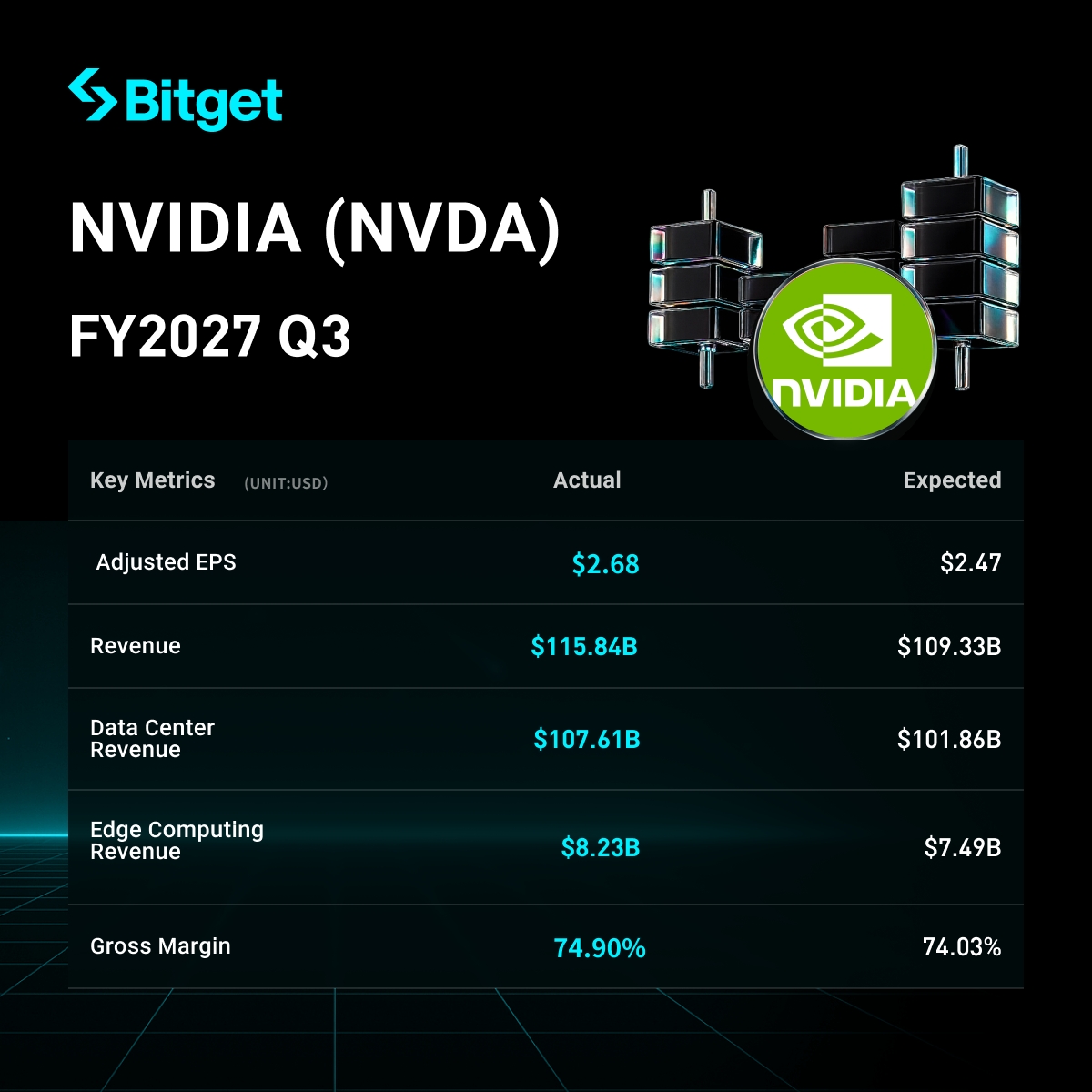
NVIDIA reported results for the quarter ended October 25, 2026, after the U.S. market close on November 17. Revenue, Data Center revenue, Edge Computing revenue, EPS and gross margin all exceeded consensus.
Guidance: About $130B for Q4 and a Higher Growth Outlook for FY2028
NVIDIA guided Q4 revenue to about $130B, plus or minus 3%, against a consensus of roughly $125B. Management also raised its fiscal 2028 growth expectation from about 70% to about 75%, and the board added $150B to the share repurchase authorization.
Analysis: Three Details Behind the Headline Beat
-
The Q4 guidance includes an extra week. Melius Research estimates that this extra week accounts for $9B to $10B of the roughly $14B sequential increase, which means underlying growth is considerably smaller than the headline figure suggests.
-
Gross margin is guided lower. Q4 gross margin is guided to 71% to 72%, about three percentage points below Q3. Which suggests that growth is being delivered at a lower margin.
-
Demand indicators remain strong. CFO Colette Kress said the cloud industry's backlog of undelivered orders reached $2.5 trillion, up $500B in three months, and that demand is expected to extend at least through 2028. Analysts also pointed to Vera Rubin, which has already contributed about $20B in revenue.
From Overnight Rally to Session Low: How the Market Reacted
After the report, NVDA rose more than 3% in extended trading and gained as much as about 4% in premarket trading on November 18. The move lifted the AI supply chain with it. Among neocloud providers, CoreWeave rose about 5% to 7% in premarket trading, Nebius about 7% to 8% and IREN about 7.6%. Among chipmakers, Micron gained about 3%, and AMD and Broadcom each gained about 3%. Nasdaq 100 futures rose by around 1%.
The gains did not survive the regular session. NVDA opened higher, turned negative by midday and closed down 2.89% at $150.96, its lowest close since June 2025 and a decline of about 13% over the five sessions since Huang's resignation. The reaction across chipmakers was split. AMD closed up 5.31% and Broadcom up 3.65%, while Qualcomm fell 4.12% and Micron fell 1.00%.
The major indexes also diverged. The S&P 500 fell 0.23%, its fifth consecutive lower close. The Nasdaq Composite rose 0.42%, as Anthropic's IPO priced. The macro backdrop added pressure. The 10-year Treasury yield has stayed above 5%, and the Federal Reserve's October minutes sent a hawkish signal. Strong earnings alone did not restore confidence in NVDA.
Unsettled Future: What the Beat Does Not Resolve
The quarter ended on October 25, more than two weeks before Huang's resignation on November 12. As analysts have noted, most of the quarter's performance had already been secured before the controversy escalated, so the report says little about how the company will operate without its founder. Four uncertainties stand out:
1. Capital discipline. CFO Colette Kress said NVIDIA will be "rigorously evaluating future investments, commitments, and guarantees." NVIDIA has provided credit support to some fast-growing customers for land, power and data center capacity. A tighter approach could raise financing costs for neocloud providers that rely on outside funding, such as CoreWeave and Nebius, and slow their expansion.
2. CEO succession. The board stated that it does not intend to reinstate Huang and has retained Heidrick & Struggles for a permanent search. It has set no timeline and says it will not rush the decision. Huang said earlier before the report that he would be willing to return.
3. New export rules. The U.S. Commerce Department now requires licenses for advanced chip exports to Singapore, Malaysia, Indonesia, Thailand and Brazil. NVIDIA's guidance already assumes no China data center revenue, so the direct impact is limited, but Melius expects sales to the affected countries to decline in fiscal 2028.
4. Regulatory scrutiny. U.S. agencies are investigating Megaspeed, a Singapore data center company under U.S. investigation over suspected diversion of advanced chips to China, and Congress will question Huang and NVIDIA's general counsel. Democrats, who take control of Congress, have also said they will continue to examine NVIDIA's compliance with export controls.
Overall, the balance between bulls and bears remains unclear. The bullish case rests on the upgraded fiscal 2028 outlook, $2.5 trillion order backlog and the start of Vera Rubin revenue. Several brokers have kept a positive view: Goldman Sachs maintained its Buy rating with a $220 target, and JPMorgan raised its target from $215 to $230. The bearish case rests on tighter capital support, the absence of a permanent CEO, and export and regulatory risks. Each side has data behind it, and most of the variables will only become clearer after the hearings and the CEO decision. The reversal from a premarket gain to a session low suggests the market is not yet willing to look past them. Until then, price moves around each new headline may be large in either direction.
What to Watch Next: The Hearings and the Search for a New CEO
The next developments in Huang's situation will come quickly. On December 1, Huang is scheduled to testify before three House committees, followed by NVIDIA General Counsel Tim Teter on December 2.
Beyond the hearings, the timing of two developments remains uncertain: the board's appointment of a permanent CEO, and NVIDIA's next earnings report for the fourth quarter of fiscal 2027, which will show whether the guidance of about $130B is on track. Any new disclosure on the Megaspeed investigation could also move the stock at short notice.
When the Direction Is Uncertain: Trading NVDA Both Ways with Perps
Because the outlook can be argued in either direction, an approach that does not depend on a fixed view is useful. Bitget's NVDAUSDT stock perpetual futures offer multiple advantages in this situation:
-
Two-way exposure. Traders can go long if they expect the fundamentals to prevail, or short if they expect governance and regulatory concerns to weigh on the stock.
-
24/7 trading. Hearing outcomes, CEO announcements and policy headlines may arrive outside the U.S. market hours, and positions can be adjusted when the news breaks rather than at the next session open.
-
Hedging. Investors who already hold NVDA shares can open a short position to offset potential losses if the stock keeps falling, without selling their holdings.
Turn your view into a trade now!
Disclaimer: This article is for informational purposes only and does not constitute financial or investment advice. Stock prices can move sharply around earnings, and past performance does not guarantee future results.


- A Beat Across Every Key Metric
- From Overnight Rally to Session Low: How the Market Reacted
- Unsettled Future: What the Beat Does Not Resolve
- What to Watch Next: The Hearings and the Search for a New CEO
- When the Direction Is Uncertain: Trading NVDA Both Ways with Perps
 Part 4 | How to Place Your First Options Trade2026-11-19 | 5m
 Part 3 | How to Read an Options Chain2026-11-19 | 5m
 Nvidia Beat. S&P 500 Still Fell. That's the Real Warning.2026-11-19 | 5m