
Sandisk Stock Outlook 2026–2027: How to Trade SNDK on Bitget
Sandisk Corporation (NASDAQ: SNDK) has become one of the most closely watched semiconductor stocks in 2026. Driven by surging demand for NAND flash memory, AI data center storage, and enterprise SSDs, the company has delivered extraordinary financial growth. Its latest quarterly revenue reached $11 billion, while profitability climbed to levels rarely seen in the memory industry. Yet Sandisk's stock has experienced an equally dramatic reversal, raising questions about whether the AI-driven storage boom can sustain its momentum into 2027.
As of November 6, 2026, Sandisk stock closed at $835.06, down approximately 64.5% from its June high of $2,354.39. Despite the sharp correction, SNDK remains up more than 250% year to date. Adding another development, Sandisk has announced an 8-for-1 stock split, with split-adjusted trading expected to begin on November 20, 2026.
Can Sandisk's strong earnings and growing AI storage demand support another recovery in 2027, or has the stock already experienced the best of the NAND memory cycle? This article examines Sandisk's latest stock performance, financial results, growth opportunities, analyst price targets, and major risks. It also explains how investors can trade Sandisk on Bitget through Stock+, rSNDK tokenized stocks, perpetual futures, stock options, structured investment products, and other trading tools.
Key Takeaways
-
Sandisk stock remains one of 2026's biggest semiconductor gainers despite a sharp correction. SNDK closed at $835.06 on November 6, up approximately 251.8% year to date but 64.5% below its June peak.
-
Sandisk's earnings growth has been exceptional. Fiscal Q1 2027 revenue surged 378% year over year to $11.03 billion, supported by strong NAND pricing and AI-related storage demand. Data center revenue increased 61% sequentially to $4.80 billion.
-
AI storage, next-generation NAND, and customer agreements are key growth drivers for 2027. Sandisk's BiCS10 technology, High Bandwidth Flash (HBF) initiative, and manufacturing partnership with Kioxia could strengthen its long-term position.
-
Wall Street remains bullish but sees significant risks. Analysts have an average 12-month SNDK price target of approximately $2,047, although forecasts vary widely and depend on sustained NAND profitability.
-
Bitget offers several ways to access Sandisk. Eligible users can explore real shares through Stock+, rSNDK tokenized stocks, SNDKUSDT perpetual futures, stock options, Dual Investment, FCNs, Auto-Invest, and supported collateral-based products.
Sandisk (SNDK) Stock Performance in 2026
Sandisk is a global provider of NAND flash memory, solid-state drives (SSDs), and data storage solutions used in consumer electronics, enterprise systems, cloud infrastructure, and AI data centers.
The company became an independent publicly traded business on February 24, 2025, following its separation from Western Digital. Since then, Sandisk has positioned itself as a major beneficiary of growing demand for high-performance storage and advanced memory technology.
Unlike NVIDIA, which focuses heavily on GPUs, or Intel and AMD, which compete in processors, Sandisk benefits from the increasing amount of data that modern computing systems must store and retrieve.
Its stock performance in 2026 shows just how much investor expectations have changed.
Sandisk Stock Price History: From a Record Rally to a Sharp Correction
Sandisk experienced an extraordinary rally during the first half of 2026 as NAND flash prices increased and demand from AI infrastructure customers accelerated.
On June 22, 2026, SNDK reached a 52-week high of $2,354.39. Investors were increasingly optimistic about the company's ability to benefit from higher memory prices, stronger enterprise SSD demand, and improving operating margins.
However, the stock began losing momentum as investors questioned how long the unusually favorable memory market could continue.
Selling pressure intensified in late October and early November, even after Sandisk reported exceptionally strong quarterly earnings.
By November 6, SNDK had fallen to $835.06, representing a decline of approximately 64.5% from its June peak.
Sandisk (SNDK) Stock Performance Snapshot
| Metric |
Value |
| Stock ticker |
NASDAQ: SNDK |
| Closing price (November 6, 2026) |
$835.06 |
| Daily price change |
+3.55% |
| 52-week high |
$2,354.39 |
| 52-week low |
$183.00 |
| 2026 YTD total return |
+251.78% |
| Decline from 52-week high |
Approximately 64.5% |
| Market capitalization |
Approximately $118.82 billion |
| Trailing P/E ratio |
Approximately 6.67 |
| Analyst consensus |
Strong Buy |
| Average 12-month price target |
$2,047.38 |
Sources: Yahoo Finance, Yahoo Finance Historical Prices, and Stock Analysis. Data as of November 6, 2026. Prices are shown before the upcoming 8-for-1 stock split.
The stock's recent price movements highlight the scale of the correction.
| Date |
SNDK closing price |
Daily change |
| October 28, 2026 |
$1,404.77 |
+7.66% |
| October 29, 2026 |
$1,330.05 |
-5.32% |
| October 30, 2026 |
$1,150.89 |
-13.47% |
| November 2, 2026 |
$1,075.08 |
-6.59% |
| November 3, 2026 |
$1,126.52 |
+4.78% |
| November 4, 2026 |
$1,037.40 |
-7.91% |
| November 5, 2026 |
$806.43 |
-22.26% |
| November 6, 2026 |
$835.06 |
+3.55% |
The November 5 decline was particularly significant, with SNDK losing more than 22% in a single session.
For investors, the correction illustrates an important characteristic of the memory industry: stock prices often move ahead of changes in earnings expectations.
Even when current profits are strong, investors may sell if they believe NAND prices, supply conditions, or margins could become less favorable.
That is why Sandisk's earnings outlook matters just as much as its latest results.
Sandisk Q1 Fiscal 2027 Earnings: What Do the Latest Results Show?
On October 29, Sandisk released its fiscal Q1 2027 financial results, reporting record revenue and profitability.
The quarter ended October 2, 2026, and represents the first quarter of Sandisk's fiscal year 2027.
| Financial metric |
Q1 FY2027 |
| Revenue |
$11.03 billion |
| Year-over-year revenue growth |
+378% |
| Sequential revenue growth |
+23% |
| GAAP net income |
$8.10 billion |
| GAAP diluted EPS |
$52.60 |
| Non-GAAP diluted EPS |
$49.51 |
| GAAP gross margin |
85.0% |
| Data center revenue |
$4.80 billion |
| Edge revenue |
$5.83 billion |
| Consumer revenue |
$397 million |
| Adjusted free cash flow |
$5.70 billion |
Source: Sandisk fiscal Q1 2027 earnings release. Per-share figures are presented on a pre-split basis.
The company's data center business was the standout performer.
Revenue from the segment reached $4.80 billion, increasing 61% sequentially from the previous quarter.
Higher NAND flash demand, strong enterprise storage requirements, and favorable pricing also helped Sandisk achieve an 85.0% GAAP gross margin.
The company generated approximately $5.70 billion in adjusted free cash flow and repurchased around $5 billion of its shares during the quarter.
Management's guidance was also encouraging.
For fiscal Q2 2027, Sandisk expects:
-
Revenue of $12.2 billion to $12.6 billion.
-
Non-GAAP gross margin of 84.5% to 85.5%.
-
Non-GAAP diluted EPS of $55 to $57, before the stock split.
These projections suggest management expects favorable NAND market conditions to continue in the near term.
However, investors must consider whether current prices and margins represent a sustainable improvement or an unusually profitable stage of the memory cycle.
Sandisk Announces an 8-for-1 Stock Split in November 2026
Another major development for Sandisk investors is its upcoming stock split.
On October 29, the company announced an 8-for-1 forward stock split, intended to make shares more accessible to investors and employees.
The schedule is as follows:
| Event |
Date |
| Stock split record date |
November 9, 2026 |
| Additional shares distributed |
November 19, 2026 |
| Split-adjusted trading begins |
November 20, 2026 |
| Split ratio |
8-for-1 |
Under the split, each existing share will become eight shares, while the price per share will be adjusted proportionately.
For example, using Sandisk's November 6 closing price:
| Before split |
After split (illustrative) |
| 1 SNDK share |
8 SNDK shares |
| $835.06 per share |
Approximately $104.38 per share |
| Total value: $835.06 |
Total value: Approximately $835.06 |
The stock split does not change Sandisk's underlying business value or an investor's percentage ownership.
However, the lower nominal share price could make SNDK more accessible to investors who prefer purchasing whole shares.
It may also attract additional trading activity, although a split does not guarantee stronger future returns.
Important: All stock prices, earnings-per-share figures, and analyst targets discussed in this article are on a pre-split basis unless otherwise stated.
Investors should use split-adjusted figures when comparing prices after November 20.
Sandisk Stock Outlook 2026–2027: Key Growth Drivers
Sandisk's long-term opportunities extend beyond the current NAND pricing cycle.
The company is investing in advanced flash memory, AI infrastructure storage, next-generation memory architectures, and manufacturing partnerships that could support growth through 2027 and beyond.
1. AI Data Center Demand Is Driving Enterprise SSD Growth
AI infrastructure has become one of Sandisk's most important growth markets.
Training and deploying AI models requires enormous amounts of data. While GPUs handle much of the computing, data centers also need high-capacity storage systems to store datasets, manage model checkpoints, and support inference applications.
This is where Sandisk's enterprise SSDs and NAND flash technology become important.
Its data center revenue reached $4.80 billion in fiscal Q1 2027, increasing 61% sequentially.
The rapid growth reflects higher storage demand from enterprise and hyperscale customers.
As AI applications become more complex, data centers may need greater storage capacity, faster data access, and more energy-efficient infrastructure.
Sandisk could benefit through increased enterprise SSD shipments, stronger NAND demand, and higher-value storage products.
However, future revenue growth will depend on customer spending, NAND pricing, and the company's ability to maintain its competitive position.
2. BiCS10 NAND Technology Could Improve Storage Capacity and Efficiency
Sandisk's next-generation NAND technology is another important growth opportunity.
In August 2026, Sandisk and Kioxia announced new 10th-generation QLC 3D flash memory technology.
The technology delivers up to 60% greater bit density than the companies' eighth-generation QLC flash memory.
It also uses a 332-layer architecture and supports a 4.8 Gb/s NAND interface.
These improvements could allow Sandisk to deliver more storage capacity while improving performance and energy efficiency.
That matters because AI data centers require storage solutions that balance capacity, speed, and power consumption.
Sandisk has also begun sampling BiCS10 TLC memory, expanding its technology roadmap across different performance and capacity requirements.
If these technologies scale successfully, they could strengthen Sandisk's competitiveness in enterprise storage.
The longer-term benefit will depend on production yields, manufacturing costs, and customer adoption.
3. High Bandwidth Flash (HBF) Opens a New AI Memory Opportunity
Sandisk is also developing High Bandwidth Flash, or HBF, a memory technology designed for next-generation AI inference systems.
HBF aims to provide a new memory layer that combines high capacity with performance characteristics suited to data-intensive AI workloads.
In August 2025, Sandisk announced a collaboration with SK hynix to establish HBF technology specifications.
The companies subsequently advanced standardization work through the Open Compute Project ecosystem in 2026.
Sandisk has targeted early 2027 for samples of AI inference devices incorporating HBF technology.
The opportunity is significant because AI inference increasingly requires access to large amounts of memory without relying exclusively on more expensive high-bandwidth memory architectures.
If HBF achieves commercial adoption, it could open another market for Sandisk beyond conventional SSDs and NAND flash products.
However, the technology remains in development, and meaningful commercial revenue is not guaranteed.
4. Kioxia Partnership Supports Long-Term Manufacturing Capacity
Sandisk's manufacturing partnership with Kioxia remains central to its business.
The two companies have collaborated for decades on NAND flash development and production in Japan.
On August 27, 2026, Sandisk and Kioxia announced plans to invest more than $31 billion in Japan through 2032, contingent on government support.
The planned investment is intended to support advanced manufacturing capabilities and future NAND flash demand.
For Sandisk, the partnership provides access to established manufacturing infrastructure and joint technology development.
It also helps the company pursue its long-term technology roadmap without building every manufacturing capability independently.
If global storage demand continues increasing, these investments could support higher production capacity and more advanced products.
However, expanding capacity too quickly can become a risk if industry supply eventually exceeds demand.
5. Long-Term Customer Agreements Could Reduce NAND Cycle Volatility
One of the most interesting developments in Sandisk's strategy is its shift toward longer-term customer agreements.
At its August 2026 Investor Day, the company announced that it had signed new business-model agreements with eight customers.
These agreements cover approximately:
-
50% of expected NAND bit shipments in fiscal 2027.
-
Two-thirds of expected NAND bit shipments in fiscal 2028.
The agreements are designed to improve visibility into future customer demand and support more predictable revenue and cash flow.
This is important because NAND has historically been a highly cyclical industry.
When memory supply exceeds demand, prices can decline sharply, reducing manufacturers' profitability.
Longer-term customer agreements may help Sandisk reduce some of that uncertainty.
However, they cannot completely eliminate exposure to industry pricing, customer demand, or changes in market conditions.
What Are the Biggest Risks for Sandisk Stock in 2027?
Despite strong financial results, Sandisk faces several risks that could affect its future earnings and stock valuation.
1. NAND Flash Prices May Not Remain Elevated
The biggest question is whether Sandisk can sustain its unusually high profitability.
NAND memory prices are influenced by supply, demand, manufacturing capacity, and inventory conditions.
When demand rises faster than supply, manufacturers can benefit from higher selling prices and stronger margins.
However, the opposite can also happen.
If competitors expand production or customer demand slows, NAND prices may decline.
For Sandisk, whose latest quarterly gross margin reached 85%, even a moderate reduction in pricing could affect future profitability.
That is why investors should follow NAND pricing trends rather than relying solely on current earnings.
2. Strong Competition in the Memory Industry
Sandisk competes with major memory manufacturers, including Samsung, Micron, Kioxia, and SK hynix.
These companies continue investing in advanced NAND technology, manufacturing efficiency, and enterprise storage products.
Sandisk must maintain competitive pricing, product quality, and manufacturing yields to defend its position.
Any delays in commercializing BiCS10 or HBF could limit future opportunities.
3. Valuation Depends on Sustainable Earnings
Sandisk's trailing P/E ratio appeared relatively low in early November 2026, reflecting its exceptionally strong recent earnings.
However, a low P/E ratio does not automatically mean a cyclical stock is undervalued.
If NAND prices decline and earnings normalize, the company's future P/E ratio could rise even without an increase in its share price.
Investors should therefore consider normalized earnings, long-term cash flow, and industry supply conditions when evaluating SNDK.
4. Sharp Stock Price Volatility
Sandisk's 2026 stock performance demonstrates how quickly market sentiment can change.
The stock declined approximately 64.5% from its June high to its November 6 close.
Such large movements can create trading opportunities, but they also increase the risk of entering positions at unfavorable prices.
This is especially important for investors using leveraged futures, options, or collateralized borrowing.
Sandisk (SNDK) Stock Price Prediction for 2026–2027
Wall Street analysts remain optimistic about Sandisk's long-term potential, although their forecasts reflect significant uncertainty.
According to Stock Analysis, based on SP Global analyst data, 25 analysts covering Sandisk have a Strong Buy consensus.
The average 12-month price target is approximately $2,047, with estimates ranging from $870 to $3,000.
Sandisk Analyst Price Targets
| Analyst metric |
Price |
| Lowest price target |
$870 |
| Average price target |
$2,047.38 |
| Median price target |
$2,050 |
| Highest price target |
$3,000 |
| November 6 closing price |
$835.06 |
| Implied upside to average target |
Approximately 145.2% |
| Consensus rating |
Strong Buy |
Sources: Stock Analysis and Yahoo Finance Analyst Insights. Targets are pre-split, rolling 12-month forecasts and should not be treated as guaranteed December 2027 prices.
The consensus reflects expectations that strong AI storage demand and NAND pricing could continue supporting Sandisk's financial performance.
However, several firms have adjusted their forecasts following recent market volatility.
Recent Wall Street Analyst Targets
| Analyst firm |
Price target |
Rating |
| Bernstein |
$3,000 |
Buy |
| Susquehanna |
$2,720 |
Positive |
| Rosenblatt |
$2,400 |
Buy |
| Cantor Fitzgerald |
$2,200 |
Overweight |
| Bank of America |
$2,000 |
Buy |
| RBC Capital |
$1,400 |
Sector Perform |
| Wells Fargo |
$1,300 |
Equal Weight |
These forecasts illustrate the wide range of expectations for Sandisk.
Some analysts expect strong NAND demand and profitability to continue supporting a substantial recovery.
Others remain more cautious about the sustainability of current memory prices and the company's long-term valuation.
Following the stock split, the average pre-split price target of $2,047.38 would be equivalent to approximately $255.92 per share, assuming the same valuation.
Sandisk Stock Outlook: Bull, Base, and Bear Scenarios for 2027
Rather than relying on a single price prediction, investors can consider three potential scenarios.
| Scenario |
Key assumptions |
Potential stock impact |
| Bull case |
AI storage demand remains strong, NAND pricing stays favorable, and HBF development progresses |
Earnings expectations could support a substantial stock recovery |
| Base case |
Enterprise SSD demand grows, but NAND pricing and margins gradually normalize |
SNDK could remain volatile as investors reassess profitability |
| Bear case |
NAND supply increases, pricing weakens, and demand slows |
Lower earnings expectations could create further downside |
-
Bull case: Sandisk maintains strong enterprise SSD demand, successfully introduces advanced NAND products, and benefits from increasingly predictable customer agreements. Strong earnings and cash flow support a higher valuation.
-
Base case: AI storage demand continues growing, but NAND prices gradually normalize as supply conditions improve. Sandisk remains profitable, although earnings growth slows from the extraordinary pace recorded in 2026.
-
Bear case: Memory supply expands faster than demand, leading to lower NAND prices and weaker margins. Investors reassess the company's earnings outlook, putting further pressure on the stock.
These are qualitative scenarios rather than guaranteed price forecasts.
Should You Buy Sandisk Stock in 2026 or Wait Until 2027?
Sandisk's sharp correction may attract investors who believe the AI storage market has significant room to grow.
The company has delivered strong financial results, expanded its technology roadmap, and secured customer agreements intended to improve future revenue visibility.
However, NAND remains cyclical, and Sandisk's unusually high margins may be difficult to sustain indefinitely.
Long-term investors may prefer to monitor NAND pricing, customer demand, and future earnings before deciding whether the current valuation offers an attractive entry point.
For active traders, SNDK's volatility may create opportunities around earnings releases, analyst revisions, and semiconductor market developments.
On Bitget, eligible users can explore different instruments depending on whether they want to accumulate Sandisk exposure, trade short-term price movements, or use structured strategies.
How to Trade Sandisk (SNDK) on Bitget
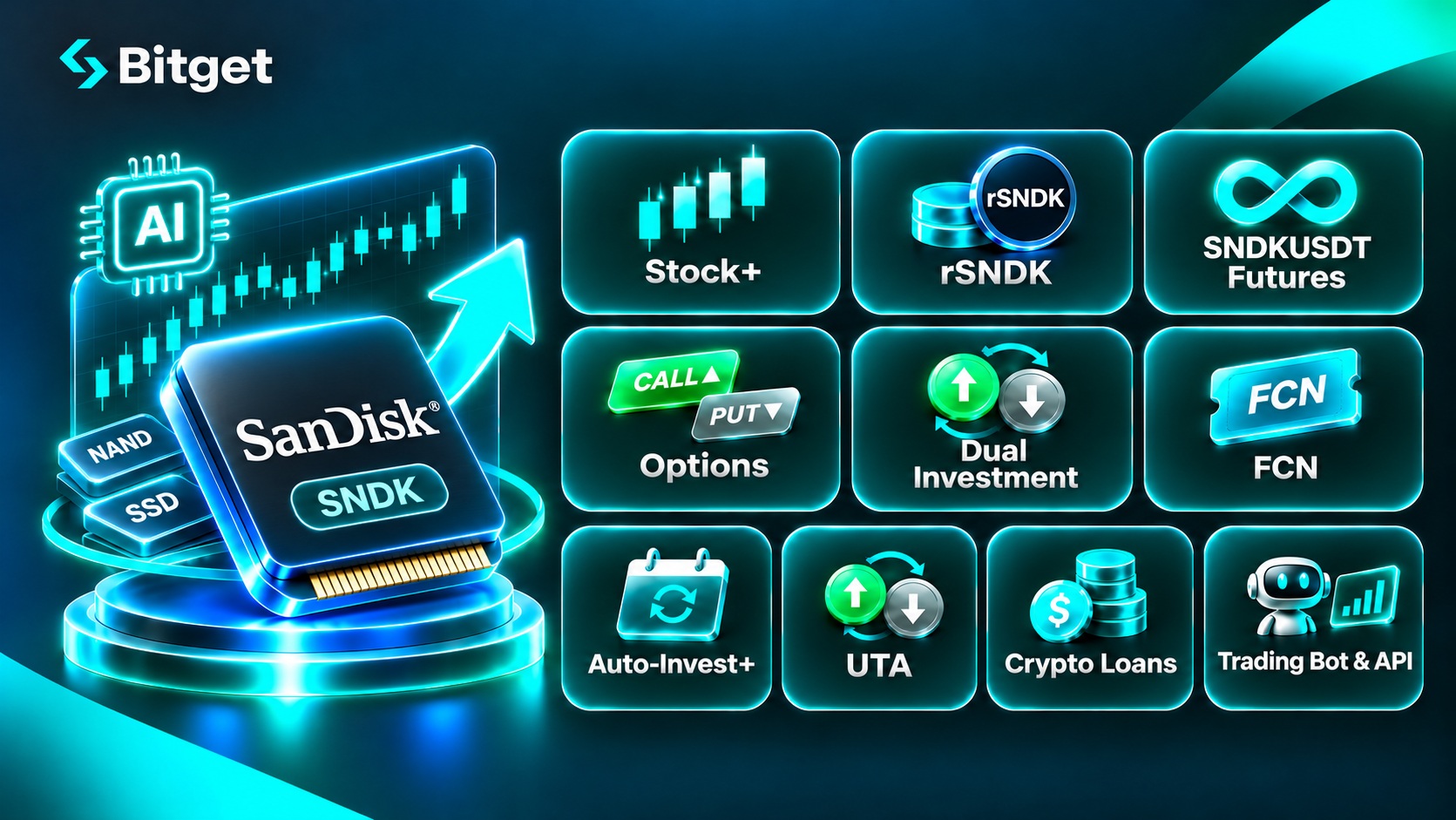
Sandisk's strong earnings growth, AI storage opportunities, and substantial share-price volatility make it an interesting asset for investors with different strategies.
Bitget offers several ways to access Sandisk-related markets, including real U.S. shares, tokenized stocks, perpetual futures, stock options, and structured investment products.
Its broader ecosystem also supports selected collateral, automation, and capital-management features for rSNDK holders.
1. Buy Real Sandisk (SNDK) Shares With Bitget Stock+
Bitget Stock+ provides eligible users with access to real U.S. stocks and ETFs through licensed brokerage partners.
Unlike tokenized assets or perpetual futures, Stock+ is designed for direct share ownership.
Its features include:
-
Access to more than 10,000 U.S. stocks and ETFs.
-
Fractional share trading starting from 0.0001 shares for eligible securities.
-
Funding through USDC, with stock transactions settled in USD.
-
24/5 trading access across supported U.S. equity sessions.
-
Real share ownership through brokerage custody arrangements.
-
Applicable shareholder rights, including corporate actions and voting rights.
-
No management fees, with transaction fees applying.
For investors who believe Sandisk's AI storage demand and technology development will support long-term growth, Stock+ provides a way to build and hold a position in U.S. equities.
Fractional share trading is particularly relevant to Sandisk because its pre-split share price remains relatively high.
After the split, Stock+ shareholders will be entitled to the applicable corporate-action treatment through their broker.
Users should confirm SNDK availability and account eligibility in the Stock+ interface before trading.
2. Trade Sandisk Tokenized Stock (rSNDK) on Bitget
For crypto-native investors, Bitget rSNDK/USDT Spot Trading offers another way to access Sandisk-related price movements.
rSNDK is a tokenized stock issued by Reality and backed 1:1 by underlying Sandisk shares held through brokerage and custody arrangements.
Instead of purchasing shares through a traditional securities account, users can trade rSNDK using USDT within Bitget's spot trading ecosystem.
Key features include:
-
1:1 backing by underlying Sandisk shares.
-
Fractional tokenized-stock exposure.
-
USDT trading and settlement.
-
24/7 trading availability, subject to market conditions.
-
Economic treatment of eligible corporate actions.
-
Daily Proof of Reserves reporting through The Network Firm.
-
Integration with selected Bitget collateral and investment products.
For example, an investor holding USDT who expects Sandisk to recover could purchase rSNDK directly on Bitget's spot market.
The position can be managed alongside other supported cryptocurrencies and tokenized assets.
Bitget's tokenized-stock framework also provides access to underlying stock-market liquidity through its Reality issuance and brokerage arrangements during eligible trading sessions.
However, rSNDK does not represent direct registered share ownership, and holders do not receive shareholder voting rights.
Token prices may also differ from underlying stock prices, particularly outside regular U.S. market hours.
3. Trade Sandisk Perpetual Futures (SNDKUSDT)
For active traders, Bitget SNDKUSDT Perpetual Futures provide exposure to Sandisk-related price movements without directly owning the underlying shares.
Bitget introduced SNDKUSDT stock perpetual futures on April 15, 2026, expanding its range of semiconductor and technology-related contracts.
The contract allows traders to take long or short positions depending on their market outlook.
Key features include:
-
USDT-margined perpetual futures.
-
Long and short trading.
-
24/7 trading access, subject to platform rules.
-
Tier-dependent leverage.
-
Advanced order types and risk-management tools.
-
Funding payments between long and short positions.
SNDKUSDT launched with leverage of up to 50x. Current contract limits are determined by the live risk-tier schedule and may differ from the original specifications.
Consider a simplified example.
A trader opens a $2,000 SNDKUSDT long position using $400 in margin, representing 5x leverage.
If the contract price rises 5%, the position would generate approximately $100 in profit before trading fees and funding costs.
However, a 5% decline would create an approximately $100 loss under the same assumptions.
The ability to trade both directions makes perpetual futures useful for traders responding to Sandisk's volatile market movements.
SNDK stock split adjustment: Bitget has announced that it will automatically adjust SNDKUSDT positions for the November 20 stock split. Contract quantities will increase eightfold, while average entry prices will be divided by eight, preserving the position's economic value under normal processing conditions. The notice also sets out a temporary trading suspension and order-handling arrangements on November 20.
Leverage amplifies both profits and losses and can lead to liquidation.
Trade SNDKUSDT Perpetual Futures on Bitget
4. Trade Sandisk Stock Options on Bitget
Investors who want to trade price movements using options can explore Bitget U.S. Stock Options.
Sandisk is among the underlying stocks supported by Bitget's options service, including eligible pre-market trading.
Options allow traders to express bullish or bearish views using contracts with specified strike prices and expiration dates.
For example:
-
Call options may appeal to traders expecting SNDK to rise.
-
Put options may appeal to traders expecting a decline.
-
Hedging strategies may help eligible investors manage existing stock exposure.
Bitget introduced pre-market options trading on July 31, 2026, expanding access to supported contracts from 4:00 AM to 9:30 AM Eastern Time.
For a volatile stock like Sandisk, this feature can provide additional flexibility around earnings announcements, analyst revisions, and major industry developments.
However, options pricing depends on several factors, including implied volatility, expiration, and time decay.
Options buyers can lose their entire premium, while certain selling strategies carry substantially greater risk.
Learn More About Bitget Stock Options
5. Use rSNDK With Bitget Stock Dual Investment
Investors who have a target entry or exit price for Sandisk can explore Bitget Stock Dual Investment.
Bitget includes rSNDK among the supported assets for its stock-linked Dual Investment products.
The product offers two main strategies.
-
Buy Low: Subscribe using USDT and select a target purchase price below the current market level.
-
Sell High: Use eligible rSNDK holdings in a strategy targeting a higher selling price.
For example, an investor who believes Sandisk has strong long-term potential but wants a lower entry price could consider an available Buy Low product rather than purchasing rSNDK immediately.
If the product's settlement conditions are met, the investment may convert into rSNDK at the agreed price.
Otherwise, the investor receives USDT and the applicable yield under the product terms.
Similarly, an existing rSNDK holder could use a Sell High strategy to target a preferred selling price.
Bitget's October 2026 upgrade expanded Stock Dual Investment options and introduced additional liquidity support through VETA Finance.
However, Dual Investment is not principal-protected. Settlement may occur when market prices are unfavorable, and the value of assets received can decline.
Explore Bitget Stock Dual Investment
6. Explore Sandisk Fixed Coupon Notes (FCN) on Bitget
For investors considering a target-price accumulation strategy, Bitget Fixed Coupon Notes (FCN) offer another structured investment approach.
Bitget introduced FCNs for selected U.S. stock rTokens in August 2026, with Sandisk among the assets featured in the initial product lineup.
An FCN allows an eligible investor to subscribe using USDT, select a target strike price, and receive a predetermined coupon according to the product terms.
At maturity, one of two outcomes applies:
-
If the observation price is at or above the strike price, the investor receives USDT principal and the agreed coupon.
-
If the observation price is below the strike price, the principal converts into the relevant rToken at the agreed strike price, and the investor receives the coupon.
For example, an investor interested in Sandisk could consider an available rSNDK-linked FCN with a target price below the current market.
This provides an alternative to buying rSNDK immediately.
However, FCNs are not principal-protected. If SNDK falls substantially below the strike price, the received rSNDK tokens could be worth less than the original investment.
Subscriptions, available assets, coupons, and terms depend on current offerings, so users should confirm whether an rSNDK-linked FCN is available before participating.
7. Build Sandisk Exposure With Bitget Auto-Invest+
Investors who prefer a systematic accumulation strategy can explore Bitget rToken Auto-Invest.
On October 27, 2026, Bitget expanded Spot Auto-Invest to more than 3,000 U.S. stock and ETF rTokens, covering eligible rTokens available for spot trading, including rSNDK.
Users can configure recurring investments based on their preferred amount and schedule.
Supported frequencies include:
-
Hourly.
-
Daily.
-
Weekly.
-
Monthly.
For example, an investor following Sandisk's long-term AI storage opportunities could configure a recurring rSNDK purchase of 50 USDT every week.
Rather than trying to identify the perfect entry point, the investor accumulates exposure across different market prices.
This dollar-cost averaging approach can help reduce dependence on a single purchase price.
Auto-Invest is particularly relevant to volatile stocks such as Sandisk, where large short-term movements can make market timing difficult.
However, recurring purchases do not protect against losses or guarantee an attractive average entry price.
Explore Bitget rToken Auto-Invest
8. Use rSNDK as Collateral With Bitget Unified Trading Account
Bitget's Unified Trading Account (UTA) provides eligible users with additional flexibility for managing capital across supported assets.
Bitget specifically includes rSNDK among the stock tokens recognized as collateral in selected UTA margin arrangements.
This allows qualified traders to incorporate eligible tokenized-stock holdings into broader multi-asset strategies.
For example, a trader holding rSNDK may be able to use its collateral-adjusted value to support other permitted positions without immediately selling the stock-linked tokens.
The amount of usable collateral depends on the asset's applicable collateral ratio and account-level requirements.
Bitget's UTA framework also supports cross-margin functionality across eligible assets, helping advanced traders manage capital more efficiently.
However, using rSNDK as collateral introduces additional risks.
If Sandisk's price declines sharply, the value of the collateral may fall, potentially triggering margin requirements or liquidation.
Product eligibility and collateral ratios should always be checked before opening leveraged positions.
Learn More About Bitget UTA and rToken Collateral
9. Borrow Against Sandisk rTokens With Bitget Crypto Loans
Eligible users holding rSNDK can also explore Bitget Crypto Loans.
On July 8, 2026, Bitget expanded Crypto Loans to accept 26 popular stock tokens as collateral, including rSNDK.
This allows qualified users to borrow supported assets such as USDT or USDC without immediately selling their tokenized-stock holdings.
The initial published parameters for rSNDK included:
| Parameter |
Initial value |
| Individual collateral limit |
800,000 USDT |
| Initial LTV |
78% |
| Margin-call LTV |
85% |
| Liquidation LTV |
91% |
These are launch parameters and may change.
For example, an investor who wants to maintain exposure to Sandisk while accessing temporary liquidity could consider using eligible rSNDK holdings as collateral.
However, borrowing involves interest costs, and falling collateral values can quickly increase liquidation risk.
This is especially important for SNDK given its substantial share-price volatility.
10. Automate Sandisk Trading With Bitget Trading Bots and API
For active and systematic traders, Bitget provides additional automation tools for supported stock-token markets.
The platform has a dedicated rSNDK/USDT Spot Trend-Following Bot page, where eligible users can review supported strategy settings and current trading availability.
Trend-following strategies can use indicators such as moving averages, MACD, and other market signals to execute orders according to predefined conditions.
Bitget also supports API access for Reality stock trading.
On August 11, 2026, the exchange opened its Reality Stock Spot API, enabling eligible users to place and cancel orders programmatically.
This can be useful for traders managing multiple stock tokens, systematic execution strategies, and larger portfolios.
Advanced users can also explore Bitget's GetAgent tools for market research and strategy analysis, although exact automation capabilities and rSNDK compatibility depend on the relevant service.
Automation does not guarantee profitable trades, and market volatility, technical failures, and execution delays remain important risks.
Explore Bitget rSNDK Trading Bot
Which Sandisk Trading Product Should You Choose on Bitget?
Bitget offers different ways to approach Sandisk depending on investment goals, risk tolerance, and trading experience.
| Bitget product |
Main feature |
Potential use case |
| Stock+ |
Direct U.S. share ownership |
Long-term stock investing |
| rSNDK Spot |
Tokenized exposure using USDT |
Crypto-native stock trading |
| SNDKUSDT Futures |
Long/short leveraged trading |
Active directional strategies |
| Stock Options |
Calls, puts, and hedging |
Event-driven trading |
| Stock Dual Investment |
Buy Low and Sell High strategies |
Target-price investing |
| Fixed Coupon Notes |
Structured entry with a fixed coupon |
Target-price accumulation |
| Auto-Invest+ |
Recurring rSNDK purchases |
Dollar-cost averaging |
| UTA |
Eligible rSNDK collateral |
Multi-asset capital management |
| Crypto Loans |
Borrowing against rSNDK |
Liquidity management |
| Trading Bots and API |
Automated eligible order execution |
Systematic trading |
Product availability, trading permissions, and subscriptions depend on the account, region, and current platform rules.
For investors who prefer direct share ownership, Stock+ provides access to the traditional equity market.
For those already using cryptocurrency, rSNDK offers USDT-based exposure to Sandisk through Bitget's tokenized-stock ecosystem.
More active traders can explore SNDKUSDT perpetual futures or stock options, while investors with longer-term strategies may consider recurring purchases and selected structured products.
The advantage of Bitget's broader stock trading ecosystem is that users can explore these different approaches alongside their existing digital-asset portfolios without managing every asset through an entirely separate platform.
What Should Sandisk Investors Watch in 2027?
Sandisk's performance in 2027 will depend on whether its extraordinary earnings growth can translate into sustainable profitability.
Several developments deserve close attention.
1. NAND Flash Pricing and Supply Conditions
NAND prices will remain one of the most important drivers of Sandisk's financial performance.
Investors should monitor industry supply expansion, customer inventories, and changes in enterprise SSD pricing.
Strong demand combined with disciplined supply could support margins, while oversupply may pressure profitability.
2. Fiscal Q2 2027 Earnings and Future Guidance
Sandisk's next earnings release will provide another test of its growth outlook.
The company currently expects fiscal Q2 revenue of $12.2 billion to $12.6 billion.
Investors should focus on whether Sandisk achieves this guidance and whether management maintains its expectations for margins and customer demand.
3. High Bandwidth Flash and BiCS10 Commercialization
Sandisk's HBF technology and BiCS10 NAND roadmap could create longer-term growth opportunities.
Investors should follow product sampling, customer adoption, manufacturing progress, and potential commercial deployments.
These developments may help determine whether Sandisk can expand beyond traditional memory-market opportunities.
4. Long-Term Customer Agreements and Free Cash Flow
The company's new customer agreements could improve revenue visibility during future NAND cycles.
Investors should monitor how these agreements translate into shipments, pricing stability, and cash generation.
Sandisk has also outlined a longer-term financial framework for fiscal 2028 through fiscal 2030.
Progress toward sustainable cash flow will be important for supporting investment, buybacks, and future shareholder returns.
Final Thoughts
Sandisk enters 2027 with exceptional financial momentum, a growing presence in AI data center storage, and a technology roadmap that could strengthen its position in advanced flash memory. Its latest earnings demonstrate the scale of current demand, but the stock's sharp correction also shows that investors remain concerned about NAND pricing and the sustainability of unusually high margins. The next several quarters will be important in determining whether Sandisk can turn today's favorable market conditions into lasting growth.
For investors looking to participate in Sandisk's future market movements, Bitget offers several ways to access the opportunity. Eligible users can explore direct shares through Stock+, trade rSNDK tokenized stocks using USDT, take long or short positions through SNDKUSDT perpetual futures, or use supported options and investment products to implement more specialized strategies. With tokenized stocks, derivatives, structured products, and capital-management tools available within its broader trading ecosystem, Bitget provides a flexible way to manage Sandisk exposure alongside other U.S. stocks and cryptocurrencies.
Frequently Asked Questions
1. What is Sandisk's stock price in November 2026?
Sandisk stock closed at $835.06 on November 6, 2026, gaining 3.55% during the session. The stock remained approximately 64.5% below its June high of $2,354.39. These are pre-split prices and may change during subsequent trading sessions.
2. Is Sandisk stock a good investment for 2027?
Sandisk offers exposure to NAND flash memory, enterprise SSDs, and AI data center storage. However, its earnings remain sensitive to memory pricing, industry supply, and customer demand. Investors should consider these risks alongside the company's growth opportunities.
3. What is the Sandisk (SNDK) stock price prediction for 2027?
Based on SP Global analyst data reported by Stock Analysis, Sandisk has an average 12-month price target of approximately $2,047, with estimates ranging from $870 to $3,000 before the stock split. These are analyst forecasts rather than guaranteed year-end 2027 prices.
4. Is Sandisk planning a stock split in 2026?
Yes. Sandisk announced an 8-for-1 stock split, with additional shares scheduled for distribution on November 19, 2026, and split-adjusted trading expected to begin November 20. The split changes the share count and nominal price but does not directly change the total investment value.
5. Why is Sandisk important to the AI industry?
Sandisk provides NAND flash memory and enterprise SSDs used to store and retrieve large amounts of data. As AI infrastructure expands, data centers require more storage capacity, faster access, and improved energy efficiency. Sandisk is also developing HBF technology for future AI inference applications.
6. Can I buy Sandisk stock on Bitget?
Eligible users can explore U.S. stock trading through Bitget Stock+, subject to SNDK availability in their account. Bitget also supports rSNDK tokenized stock trading through its rSNDK/USDT spot market.
7. Can I trade Sandisk perpetual futures on Bitget?
Yes. Bitget supports SNDKUSDT perpetual futures, allowing eligible traders to take long or short positions using USDT margin. The contract offers tier-dependent leverage and 24/7 trading, subject to platform rules.
8. Does Bitget support Sandisk stock options?
Yes. Sandisk is included among the underlyings supported by Bitget's U.S. stock options service, including eligible pre-market options trading. Contract availability depends on the trading interface.
9. Can I use rSNDK to earn yield or access loans on Bitget?
Eligible users can explore rSNDK Stock Dual Investment, available FCN offerings, and supported collateral products. Bitget also accepts rSNDK as collateral for selected Crypto Loans and UTA arrangements. These products have different settlement, borrowing, and liquidation risks.
10. What is the difference between SNDK and rSNDK on Bitget?
SNDK represents Sandisk's Nasdaq-listed common shares. rSNDK is a tokenized asset issued by Reality and backed by underlying Sandisk shares. It provides stock-linked economic exposure but does not confer direct shareholder voting rights.
Ready to explore Sandisk trading opportunities? Get started on Bitget and choose the product that fits your strategy.
Disclaimer: This article is for educational and informational purposes only and does not constitute financial or investment advice. Stock prices, analyst forecasts, and trading conditions may change. Tokenized stocks, options, perpetual futures, structured investment products, and collateralized borrowing involve different risks, including potential loss of capital. Product availability varies by jurisdiction and account eligibility. Users should conduct their own research and review applicable terms and conditions before trading.


- Key Takeaways
- Sandisk (SNDK) Stock Performance in 2026
- Sandisk Announces an 8-for-1 Stock Split in November 2026
- Sandisk Stock Outlook 2026–2027: Key Growth Drivers
- What Are the Biggest Risks for Sandisk Stock in 2027?
- Sandisk (SNDK) Stock Price Prediction for 2026–2027
- How to Trade Sandisk (SNDK) on Bitget
- What Should Sandisk Investors Watch in 2027?
- Final Thoughts
- Frequently Asked Questions

 Intel Stock Outlook 2026–2027: How to Trade INTC on Bitget2026-11-09 | 5m
 Oracle Stock Outlook 2026–2027: How to Trade ORCL on Bitget2026-11-09 | 5m