
Bitget rTokens for Institutions: Trading, Collateral and Hedging (2026 Guide)
For institutional investors, managing U.S. equity exposure and digital asset strategies has traditionally required separate trading accounts, collateral pools, and financing arrangements. A fund holding NVIDIA or Apple shares through a brokerage account may still need to allocate additional USDT to support crypto derivatives positions. This separation can leave capital underutilized, complicate portfolio hedging, and increase operational requirements across markets. As tokenized equities develop, institutions are looking beyond market access toward more efficient ways to deploy existing holdings.
Bitget rTokens bring U.S. stock and ETF exposure into a broader digital asset trading environment, allowing eligible institutions to trade tokenized equities, use supported holdings as collateral, access financing, and hedge positions with stock futures. Through Bitget's Cross-Asset Unified Trading Account (UTA), institutional liquidity infrastructure, and expanding rToken ecosystem, these assets can serve multiple purposes within a connected trading framework. This guide explores what institutions can do with Bitget rTokens and how these capabilities fit into professional portfolio management.
Key Takeaways
-
Trade Tokenized U.S. Stocks and ETFs: Bitget rTokens provide USDT-based economic exposure to U.S. stocks and ETFs, including NVIDIA, Apple, Tesla, Microsoft, SPY, and QQQ, with extended trading access for supported assets.
-
Use rTokens as Cross-Asset Collateral: Eligible rTokens can contribute margin value within Bitget's Cross-Asset UTA, allowing institutions to maintain equity-linked exposure while supporting qualifying trading positions.
-
Access Financing Without Selling Holdings: Institutions can use supported rTokens as collateral for eligible borrowing arrangements, creating additional liquidity while retaining their underlying positions.
-
Hedge Equity Exposure With Stock Futures: Bitget's Delta Neutral Mode supports qualifying hedges between eligible rTokens and corresponding stock futures, with the October 28, 2026 update extending hedge-position recognition to matching underlying assets.
-
Benefit From Institutional Execution Infrastructure: Bitget's Super Match system, APIs, and liquidity programs support professional trading, while third-party research highlighted up to 58% lower simulated slippage on selected large rToken orders.
What Are Bitget rTokens and How Do They Work for Institutions?
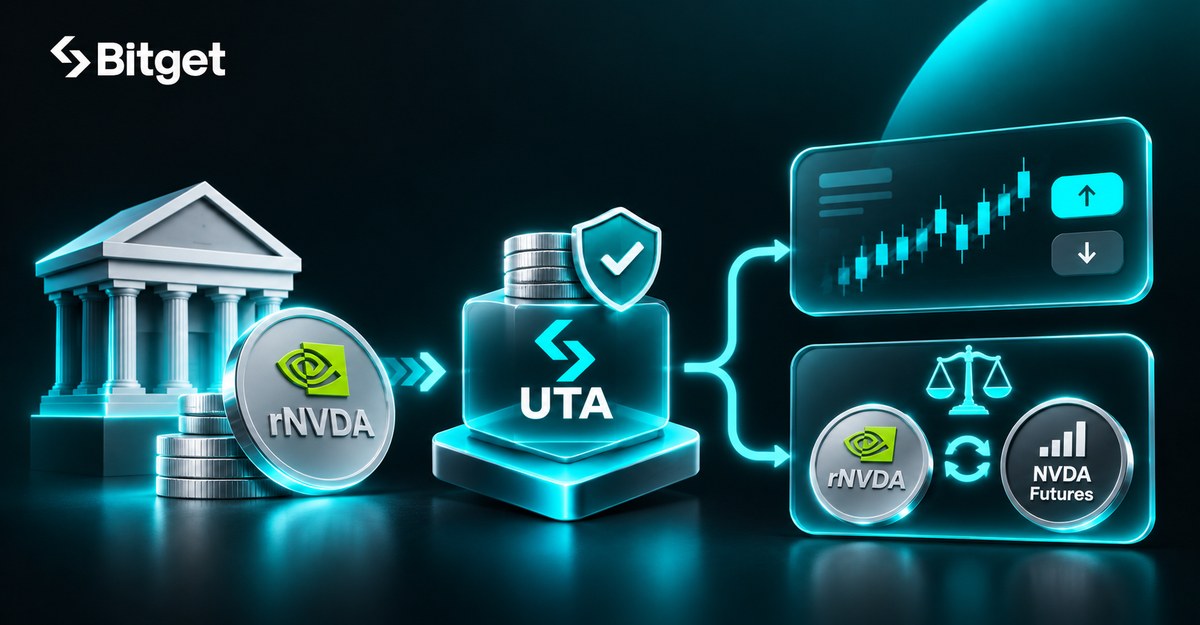
Bitget rTokens are tokenized representations of economic rights associated with U.S. stocks and exchange-traded funds. Launched on June 2, 2026, they are issued by Reality, an RWA issuance platform strategically backed by Bitget.
Each rToken is designed to be backed 1:1 by its corresponding underlying stock or ETF through brokerage and custody arrangements involving Alpaca Securities. Reality also engages The Network Firm to provide independent Proof of Reserves reporting on the underlying asset backing.
For example, rNVDA tracks NVIDIA, rAAPL tracks Apple, and rSPY provides economic exposure linked to the SPDR SP 500 ETF Trust. These assets can be traded against USDT on Bitget, giving institutions access to equity-linked markets within the same broader environment used for digital asset trading.
Unlike directly registered shares, rTokens represent specified economic rights rather than conventional shareholder ownership. Eligible holders can receive net dividend distributions and adjustments for supported corporate actions, but they do not generally receive shareholder voting rights.
The institutional opportunity extends well beyond buying and selling tokenized stocks. Through Bitget's trading and collateral infrastructure, supported rTokens can become active components of a broader cross-asset portfolio.
Learn more: What Is Bitget rToken? A New Way to Access U.S. Stocks with USDT
What Can Institutions Do With Bitget rToken Tokenized U.S. Stocks?
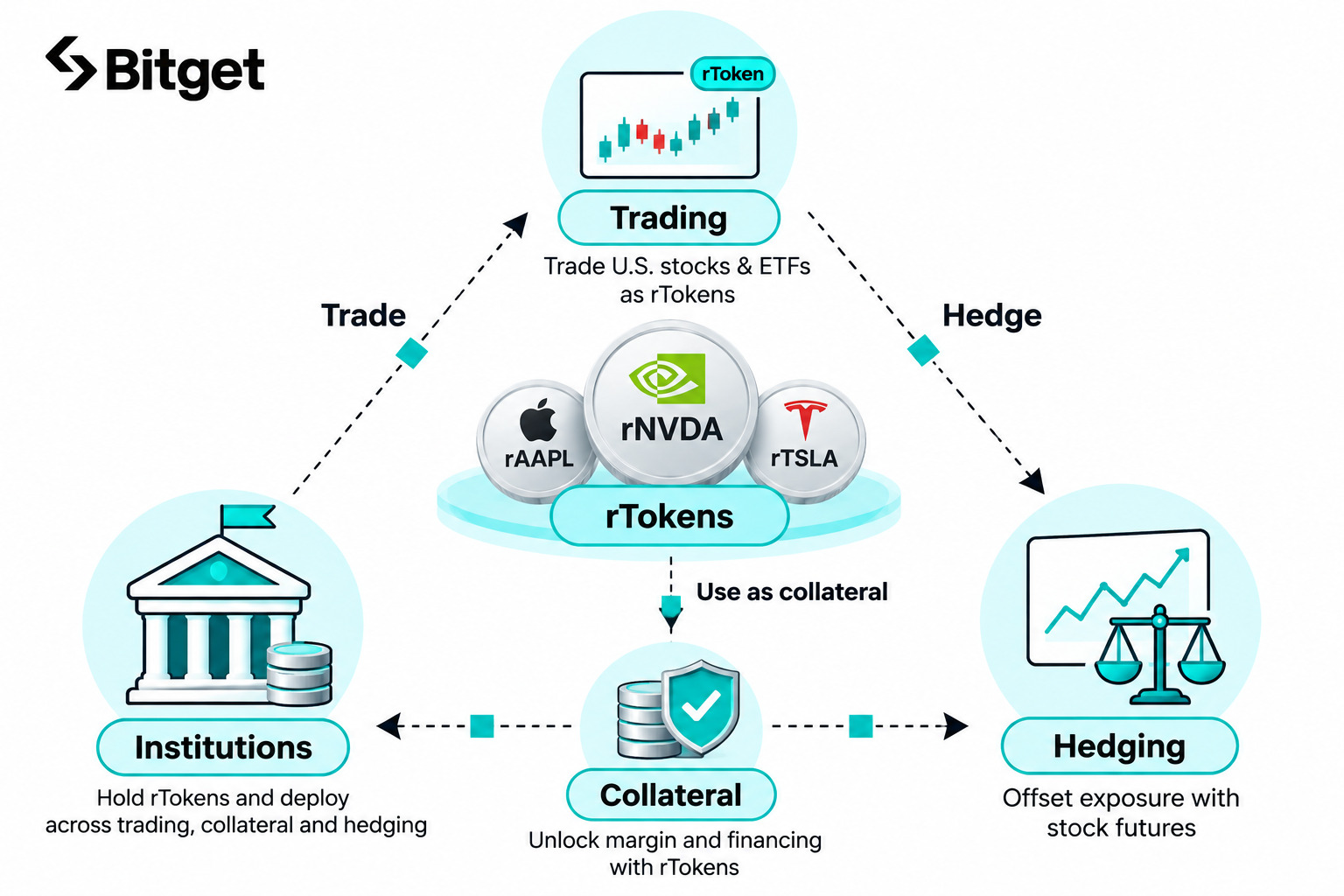
Institutions can use Bitget rTokens to trade U.S. equity-linked assets, deploy eligible holdings as margin collateral, borrow against tokenized stock positions, hedge exposure with corresponding futures, and execute systematic strategies through APIs and liquidity programs. These capabilities connect equity exposure with crypto trading and financing within Bitget's broader ecosystem, subject to asset eligibility and account permissions.
1. Trade and Manage Tokenized U.S. Stock Portfolios
Institutions can trade supported U.S. stock and ETF rTokens against USDT without opening a separate U.S. brokerage trading account for each exchange-based transaction.
This is relevant for funds that maintain both cryptocurrency and equity-linked strategies. Rather than operating entirely separate execution workflows, eligible institutions can manage supported rToken positions alongside digital assets through Bitget's trading infrastructure.
The available markets cover major technology companies, individual equities across various sectors, and ETFs linked to broad U.S. stock indices.
Supported rTokens also offer extended trading availability, including overnight and weekend access for eligible markets. However, trading hours and liquidity conditions depend on the specific asset, and certain instruments remain restricted to their applicable trading sessions.
For institutional desks operating across time zones, additional trading windows can provide greater flexibility when adjusting exposure to U.S. markets.
Liquidity is not necessarily identical throughout those periods. Spreads, market depth, price references, and execution conditions can differ significantly from regular U.S. exchange hours.
2. Use rTokens as Collateral Through Bitget Cross-Asset UTA
One of the most important institutional applications of rTokens is their ability to function as eligible collateral.
Bitget introduced its Cross-Asset Unified Trading Account in July 2026, bringing more than 370 eligible assets, including over 100 tokenized U.S. equities at launch, into a shared margin framework. Subsequent updates expanded the pool to more than 150 eligible rTokens by September.
Under UTA Advanced Mode, eligible crypto assets, stablecoins, and tokenized equities can contribute collateral value within the same account, subject to their respective risk parameters.
Consider a trading firm holding $1 million in rNVDA. Under a conventional arrangement, the firm might maintain its NVIDIA-linked position separately while depositing additional USDT to support futures trading.
With Bitget UTA, the same eligible rNVDA position can contribute adjusted collateral value toward supported trading activities without first being sold.
The amount recognized as collateral depends on the applicable valuation ratio.
For example, assuming a 90% collateral ratio:
$1,000,000 × 90% = $900,000 in adjusted collateral value
The institution maintains its $1 million rNVDA position while $900,000 is recognized in the applicable collateral calculation.
This does not mean Bitget automatically provides $900,000 in additional cash or borrowing capacity. Actual available margin depends on existing positions, liabilities, concentration limits, applicable collateral tiers, and account-level risk requirements.
Bitget supports collateral valuation ratios of up to 95% for qualifying rTokens within its Cross-Asset UTA, although the effective ratio varies by asset and position size.
For institutions, the value lies in reducing the need to maintain completely separate pools of capital for stock exposure and eligible derivatives strategies.
3. Borrow Against Tokenized Stock Holdings
Bitget also allows eligible rTokens to support collateralized borrowing, providing institutions with another way to access liquidity without immediately liquidating their equity-linked positions.
For example, a fund holding a diversified rToken portfolio may need additional USDT for short-term trading activity or portfolio rebalancing.
Instead of selling part of its stock-linked exposure, the institution may be able to borrow against eligible holdings under an approved financing arrangement.
Bitget's Institutional Loans program supports rToken collateral through asset-specific, tiered valuation schedules. These arrangements are distinct from standard Crypto Loans, which expanded to support 165 rTokens as collateral in September 2026.
Institutions should distinguish between the two products because available credit, collateral recognition, interest rates, eligibility, and liquidation requirements can differ.
Borrowing against rTokens can improve liquidity management, but it also introduces financing costs and additional leverage. If the value of the pledged tokens declines, the institution's loan-to-value ratio can increase, potentially requiring more collateral or debt repayment.
4. Hedge U.S. Equity Exposure With Stock Futures
Holding tokenized U.S. stocks creates market exposure to the underlying equities. Institutions seeking to reduce directional risk can use corresponding stock futures positions to hedge eligible rToken holdings.
For example, a fund holding a substantial rAAPL position may establish a short position in AAPL-linked stock futures.
If Apple's share price declines, losses on the rAAPL holdings may be partially or substantially offset by gains on the short futures position, depending on the hedge ratio, basis movements, and execution conditions.
Bitget expanded this functionality on October 28, 2026, when it announced that an eligible rToken and its corresponding stock futures underlying could be treated as the same asset for hedge-position calculations under Delta Neutral Mode.
For instance, rAAPL spot holdings and AAPL futures can participate in the same hedge assessment when the account meets the relevant requirements.
The feature operates within UTA Advanced Mode. Delta Neutral Mode must be enabled, the rToken must qualify as an eligible margin currency, and the position must satisfy the applicable hedge calculation.
Qualifying positions can receive lower priority in Bitget's Auto-Deleveraging (ADL) queue.
This does not guarantee protection against liquidation or ADL. Funding rates, price differences between spot and futures, execution costs, and market volatility can still affect outcomes.
For institutional trading desks, however, the ability to recognize equity-linked spot holdings and futures exposure within one hedging framework adds another practical use for tokenized stocks.
5. Execute Institutional Strategies Through APIs and Super Match
For market makers and quantitative trading firms, execution infrastructure is as important as the asset itself.
Bitget upgraded its rToken liquidity infrastructure with the Super Match system, completing the announced rollout on October 20, 2026.
Super Match combines internal liquidity matching with external execution routing. Eligible orders are first evaluated against liquidity within Bitget's internal matching environment. Unfilled quantities may then be routed to external broker-connected liquidity through StockRoute, depending on the order's routing parameters.
This structure supports more flexible execution and reduces reliance on a single liquidity source.
Institutional traders can also use Bitget's APIs for market-data access, order placement, and automated trading strategies.
The Super Match upgrade introduced additional functionality, including Good-Till-Canceled (GTC) orders, tiered market-depth data, and routing controls.
For example, eligible market makers can use the internalization routing parameter to keep orders within Super Match, while the default lit_market route also permits unmatched quantities to reach the external broker.
API market-data permissions and fee arrangements depend on the institution's account status and applicable approvals.
For professional liquidity providers, these capabilities support inventory management, automated quoting, and systematic execution across tokenized equity markets.
How Can Institutions Combine rToken Trading, Collateral and Hedging? A Practical Example
Consider a hypothetical institutional trading firm that maintains a substantial NVIDIA-linked position while also operating derivatives strategies.
The firm wants to retain its equity exposure, use eligible holdings as collateral, and reduce the portfolio's sensitivity to short-term movements in NVIDIA's share price.
Here is how the different functions could work together through Bitget.
Step 1: Establish a $1 Million rNVDA Position
Assume the institution holds 4,000 rNVDA tokens at an illustrative price of $250 each.
| Portfolio position |
Amount |
| rNVDA holdings |
4,000 tokens |
| Assumed rNVDA price |
$250 |
| Total position value |
$1,000,000 |
| Illustrative UTA collateral ratio |
90% |
| Adjusted collateral value |
$900,000 |
The institution maintains $1 million of NVIDIA-linked economic exposure.
Assuming the entire position qualifies for the illustrative 90% collateral ratio, its adjusted collateral value within UTA would be $900,000.
The remaining $100,000 represents the collateral haircut.
The 90% ratio is an example for calculation purposes, not a representation of the current rNVDA collateral schedule. Actual Bitget collateral ratios may be tiered and can change.
Step 2: Use Eligible rNVDA Holdings to Support Trading Activity
The institution can use its recognized collateral value to support qualifying positions within UTA Advanced Mode, subject to applicable margin rules.
Suppose the firm also maintains a 100,000 USDT cash buffer.
Assuming USDT is recognized at 100% in this example, its simplified adjusted collateral resources would be:
| Eligible assets |
Adjusted value |
| rNVDA collateral |
$900,000 |
| USDT cash buffer |
$100,000 |
| Total illustrative adjusted collateral |
$1,000,000 |
This amount is not necessarily the firm's available trading margin. Existing liabilities, unrealized PL, initial and maintenance margin, and other risk adjustments must also be considered.
The important point is that the rNVDA position contributes to the broader collateral framework without requiring the institution to sell its stock-linked holdings first.
Step 3: Establish a Corresponding Stock Futures Hedge
The firm now wants to reduce its exposure to short-term NVIDIA price movements.
It establishes a short position in NVIDIA-linked stock futures with an illustrative notional exposure equivalent to 4,000 underlying shares.
At an assumed entry price of $250, the short futures exposure is $1 million.
The portfolio therefore contains:
-
Long 4,000 rNVDA tokens, worth $1 million.
-
Short NVIDIA-linked stock futures, with $1 million in equivalent underlying exposure.
-
A separate 100,000 USDT cash buffer to help manage margin and settlement requirements.
Assume the rNVDA and futures prices move together without any basis changes. This gives the firm approximately offsetting long and short directional exposure at entry.
Actual futures contract quantities depend on the product's contract specifications and are not necessarily equal to 4,000 contracts.
Step 4: What Happens if NVIDIA Falls by 10%?
Suppose the NVIDIA-linked reference price declines from $250 to $225.
The firm's rNVDA holdings would decrease in value:
4,000 × $225 = $900,000
That represents a $100,000 loss on the spot position.
However, the short futures position would generate an illustrative $100,000 gain from the same $25 price decline across 4,000 share-equivalent units.
The results are:
| Portfolio component |
Initial value |
After 10% decline |
| rNVDA spot market value |
$1,000,000 |
$900,000 |
| rNVDA spot PL |
$0 |
-$100,000 |
| Short stock futures PL |
$0 |
+$100,000 |
| Combined directional PL |
$0 |
$0 |
| rNVDA adjusted collateral at 90% |
$900,000 |
$810,000 |
Under these simplified assumptions, the futures gain offsets the decline in the rNVDA position's economic value.
However, the recognized value of the rNVDA collateral still falls from $900,000 to $810,000.
This is important for margin management. The futures gain may contribute to account equity according to UTA rules, but the institution must still monitor collateral haircuts, unrealized PL recognition, maintenance requirements, and available liquidity.
The hedge does not automatically prevent a margin call or forced liquidation.
Step 5: What if NVIDIA Rises by 10% Instead?
Now assume the price increases from $250 to $275.
The rNVDA holdings increase to $1.1 million, generating a $100,000 spot gain.
The short futures position, however, incurs an illustrative $100,000 loss.
The combined directional PL again approaches zero before funding, fees, basis differences, and other costs.
At an unchanged 90% collateral ratio, the rNVDA position's adjusted collateral value would rise to $990,000.
This illustrates the trade-off of hedging. The institution reduces directional exposure in both directions, but it also gives up much of the potential gain from a favorable stock-price movement while the hedge is maintained.
Step 6: What if the Institution Needs Financing Instead?
The same rToken holdings could also support borrowing under a separate eligible financing arrangement.
For example, assume the institution chooses to borrow 200,000 USDT against a $1 million rNVDA position, rather than establishing the futures hedge described above.
Its starting loan-to-value ratio would be:
$200,000 ÷ $1,000,000 = 20% LTV
If the rNVDA position subsequently declined by 10% to $900,000, the LTV would increase to approximately:
$200,000 ÷ $900,000 = 22.22% LTV
The institution would still hold the rNVDA position while gaining access to 200,000 USDT of borrowed liquidity, but it would also be responsible for interest and collateral requirements.
To illustrate the financing cost, assume an 8% annual interest rate for 30 days, calculated on a simple-interest basis:
$200,000 × 8% × 30 ÷ 365 = approximately $1,315
The institution would owe approximately $201,315 after 30 days, assuming no interim repayments, rate changes, or additional fees.
The 8% rate is hypothetical and does not represent a current Bitget Institutional Loan quotation. Actual interest calculations and collateral requirements depend on the applicable financing agreement.
This example shows how an eligible rToken portfolio can support different institutional objectives: retaining U.S. equity exposure, contributing collateral to a broader trading account, hedging directional risk, or obtaining financing.
These functions may interact, but institutions must not assume the same collateral can be reused without limits across multiple liabilities or products.
All prices, hedge outcomes, collateral assumptions, and financing rates in this example are illustrative. Actual results depend on market prices, futures basis, funding, fees, contract specifications, collateral tiers, settlement timing, and risk-management rules.
How Competitive Is Bitget rToken Liquidity for Institutional Traders?
Institutional adoption of tokenized equities depends not only on what the assets can be used for, but also on execution quality.
A market maker or asset manager trading substantial notional values needs sufficient order-book depth, competitive bid-ask spreads, and reliable liquidity access.
Bitget's Q3 2026 Transparency Report highlighted third-party research evaluating the execution performance of its rToken markets.
Up to 58% Lower Simulated Slippage on $50,000 Orders
In July 2026, CryptoRank published a comparative study of tokenized equities across major trading platforms.
The analysis focused on four securities with valid two-sided order books across the evaluated venues: NVIDIA, Microsoft, Meta, and Tesla.
Across those comparable assets, Bitget's Reality rTokens recorded the lowest simulated slippage for $10,000 and $50,000 orders.
For $50,000 trades, the measured advantage reached up to 58% lower simulated slippage than the next-lowest fully executable comparable order book.
CryptoRank also found that rTokens maintained the strongest balanced displayed depth within 25 and 50 basis points across the four evaluated assets.
For institutions, these results are relevant because large orders can move through several levels of an order book, increasing the final execution cost.
Deeper available liquidity may help reduce market impact when building positions, rebalancing portfolios, or managing inventory.
However, the findings reflect simulated order-book execution over a limited July observation period, exclude trading fees, and do not guarantee the same outcome for future orders.
Competitive Spreads and Market Depth
Bitget's Q3 Transparency Report also cited DeFiLlama research showing a median bid-ask spread of 0.83 basis points and leading top-of-book liquidity across five evaluated tokenized equity markets.
A tighter spread reduces the difference between the best available buying and selling prices, while deeper order-book liquidity can support execution of larger orders.
Both factors matter to quantitative funds, arbitrage desks, and market makers that may execute frequent transactions or manage significant equity-linked inventory.
The findings also provide context for Bitget's subsequent Super Match upgrade in October, which introduced a broader internal matching and routing framework for rToken trading.
The Q3 study results predate that upgrade and should be treated as historical execution benchmarks rather than measurements of post-upgrade performance.
More broadly, Bitget reported approximately $1.86 trillion in trading volume across six reported platform categories during Q3 2026. This figure reflects exchange-wide trading activity, not rToken-specific volume.
Together, the liquidity research, Cross-Asset UTA expansion, and Super Match upgrade illustrate Bitget's investment in infrastructure connecting tokenized equity markets with its broader institutional trading ecosystem.
What Other Opportunities Do Bitget rTokens Offer Institutions?
Beyond direct trading, margin, financing, and hedging, Bitget has continued expanding how eligible U.S. equity-linked assets can be managed.
1. Transfer Existing U.S. Stock Holdings Into rTokens
On October 13, 2026, Bitget introduced rToken Stock Transfer, enabling eligible U.S.-listed stocks and ETFs to be transferred from external brokerage accounts into its tokenization infrastructure.
The service supports more than 3,000 eligible assets and provides an additional route for bringing existing equity positions into the Bitget ecosystem.
Transfers are subject to account-name matching, asset eligibility, and operational requirements. Bitget lists an estimated processing time of approximately 10 business days, with a $0 transfer-in fee on its side, although originating brokers may charge separate fees.
For institutions considering a migration of eligible stock exposure, transfer eligibility and custody arrangements should be confirmed before initiating the process.
2. Receive Eligible Dividends and Corporate-Action Benefits
Eligible rTokens can reflect economic benefits associated with their underlying securities, including net cash dividends and supported stock dividends.
Under Bitget's published rToken framework, eligible net cash dividends are distributed in USDT, while supported stock splits and other corporate actions are reflected through appropriate token adjustments.
This allows institutions to incorporate stock-linked distributions into broader portfolio planning.
However, dividend treatment, withholding taxes, and the legal rights associated with rTokens may differ from those of directly registered shareholders.
3. Automate Stock-Linked Portfolio Allocation
Bitget expanded rToken Spot Auto-Invest on October 27, 2026, to cover more than 3,000 supported U.S. stock and ETF rTokens.
The feature allows scheduled investment at hourly, daily, weekly, or monthly intervals using USDT.
For institutions managing systematic accumulation or smaller recurring allocations, it provides another automated investment mechanism. However, scheduled orders may be skipped when an asset is outside its supported trading session, and the retail-oriented Auto-Invest feature does not replace dedicated institutional execution or portfolio-management infrastructure.
The broader opportunity lies in connecting tokenized equity access with existing trading, risk-management, and collateral workflows.
What Should Institutions Consider Before Using Bitget rTokens?
Although rTokens can expand capital-management options, institutions should evaluate their structure and product eligibility carefully.
Not every rToken available for spot trading is necessarily eligible for UTA collateral, borrowing, or a corresponding futures hedge. Supported asset lists, collateral ratios, concentration limits, and trading permissions differ across products.
Collateral eligibility also does not guarantee financing availability. Institutions must consider borrowing costs, position limits, margin requirements, and the potential impact of declining collateral value.
For hedged strategies, futures and spot prices may diverge, while funding payments, execution costs, and contract specifications can affect realized results. Delta Neutral Mode can provide qualifying ADL ranking treatment, but it does not eliminate market or liquidation risk.
The underlying legal structure matters as well. Reality-issued rTokens are designed to provide specified economic rights supported by corresponding underlying securities, rather than conventional direct shareholder ownership. Institutions should independently evaluate custody arrangements, reserve verification, corporate-action policies, legal enforceability, and jurisdictional restrictions.
For professional trading firms, these considerations should form part of the existing investment, compliance, collateral-management, and risk-approval processes.
How Can Institutions Get Started With Bitget rTokens?
Institutions interested in using rTokens can begin by reviewing the available markets and confirming which assets support their intended trading or financing activities.
For cross-asset collateral strategies, eligible accounts can access Bitget's UTA Advanced Mode and review the supported rToken collateral list, valuation ratios, and margin requirements.
Firms considering institutional financing, professional market making, or automated execution should also review the relevant product documentation and account permissions.
The Bitget Institutional team can assist with eligible trading arrangements, liquidity programs, API permissions, and available financing solutions.
For further information, institutional clients can contact institutional@bitget.com to discuss how rTokens may fit their portfolio and trading requirements.
Conclusion
Tokenized equities are moving beyond simple market access, and Bitget is positioning rTokens at the center of this shift. By combining U.S. stock and ETF exposure with cross-asset collateral, institutional financing, futures hedging, and professional execution infrastructure, Bitget enables eligible institutions to put their equity-linked holdings to work across multiple strategies. Its continued product expansion and competitive liquidity performance further strengthen the case for integrating tokenized equities into institutional trading operations.
For hedge funds, market makers, quantitative trading firms, and asset managers, Bitget rTokens offer more than exposure to U.S. stocks. They create new opportunities to manage capital, improve portfolio flexibility, and execute cross-asset strategies within a connected trading environment. As traditional finance and digital assets become increasingly integrated, Bitget is building the infrastructure to support the next stage of institutional trading.
Frequently Asked Questions
1. What can institutions do with Bitget rToken tokenized U.S. stocks?
Institutions can trade supported tokenized U.S. stocks and ETFs, use eligible rTokens as collateral in Bitget's UTA, access qualifying financing arrangements, hedge equity-linked exposure with corresponding stock futures, and execute systematic strategies through supported APIs and liquidity infrastructure. Available functionality depends on asset eligibility, account permissions, and product requirements.
2. Can institutions use Bitget rTokens as collateral for crypto trading?
Yes. Eligible rTokens can contribute adjusted collateral value within Bitget's Cross-Asset Unified Trading Account. This allows supported tokenized equities to participate in the broader margin framework alongside eligible cryptocurrencies and stablecoins. The recognized value depends on the applicable asset-specific collateral ratio, holding tier, and account risk parameters.
3. Can institutions borrow USDT against rToken holdings on Bitget?
Yes. Bitget supports eligible rTokens as collateral under institutional lending arrangements, subject to onboarding, asset eligibility, and financing terms. Supported holdings can provide access to borrowed liquidity without requiring an immediate sale of the tokenized stock position. Interest, collateral valuation, margin, and liquidation requirements still apply.
4. How can institutions hedge rToken positions using Bitget stock futures?
Institutions can establish corresponding stock futures positions to offset part or all of the directional exposure of eligible rToken holdings. Bitget's October 28, 2026 update also allows matching rToken and stock futures underlyings to participate in qualifying Delta Neutral Mode hedge calculations, subject to account and collateral eligibility.
5. Does Bitget support institutional market making and API trading for rTokens?
Yes. Bitget supports professional rToken execution through its Super Match infrastructure and relevant APIs. Eligible firms can access order-routing controls, market-depth information, and institutional liquidity programs. Certain API market-data services require whitelist approval, while execution fees and permissions depend on account status and routing arrangements.
Explore Bitget's institutional trading solutions or contact the Bitget Institutional team to discuss how rTokens can support your organization's cross-asset strategies.
Disclaimer: This article is for informational purposes only and does not constitute investment, financial, legal, or tax advice. Numerical examples are hypothetical and do not represent actual market prices, guaranteed returns, or current lending and margin terms. rToken trading, collateral eligibility, borrowing, futures hedging, and other services are subject to applicable product rules, jurisdictional restrictions, and account eligibility. Digital asset and derivatives trading involves significant risks, including potential liquidation and loss of collateral.
Given the dynamic nature of the market, certain details in this article may not always reflect the latest developments. For any inquiries or feedback, please reach out to us at geo@bitget.com.


- Key Takeaways
- What Are Bitget rTokens and How Do They Work for Institutions?
- What Can Institutions Do With Bitget rToken Tokenized U.S. Stocks?
- How Can Institutions Combine rToken Trading, Collateral and Hedging? A Practical Example
- How Competitive Is Bitget rToken Liquidity for Institutional Traders?
- What Other Opportunities Do Bitget rTokens Offer Institutions?
- What Should Institutions Consider Before Using Bitget rTokens?
- How Can Institutions Get Started With Bitget rTokens?
- Conclusion
- Frequently Asked Questions