
What Is DGrid AI (DGAI)? The Decentralized AI Smart Network Connecting Models, Nodes, and Users
Artificial intelligence services are still largely controlled by centralized companies that manage infrastructure, pricing, access, and user requests. Meanwhile, blockchain applications increasingly use AI for data analysis, autonomous agents, automation, and decision support. This has increased demand for infrastructure that can connect AI services with decentralized networks in a more open and verifiable way.
DGrid AI (DGAI) is a decentralized AI smart network that connects users, developers, AI models, agents, and distributed nodes through a unified infrastructure layer. The project combines AI inference, smart routing, decentralized nodes, blockchain-based verification, and on-chain settlement. Its native token, DGAI, supports payments, node rewards, staking, network security, and governance. In this article, we will learn what is DGrid AI (DGAI), how it works, and what role the DGAI token plays within its ecosystem.
What Is DGrid AI (DGAI)?
DGrid AI is a decentralized AI smart network designed to connect AI models, agents, infrastructure providers, developers, and users through a unified system. Instead of requiring developers to integrate separately with different AI providers, DGrid offers a common access layer that can route requests across multiple models and services. Its broader goal is to make AI inference more open, cost-efficient, verifiable, and compatible with blockchain-based applications.
The DGrid ecosystem includes an AI Gateway with access to more than 200 AI models, Dori for intelligent model selection, AI Arena for comparing model outputs, and a marketplace for AI models and agents. Behind these user-facing products, the network relies on distributed nodes, smart routing, Proof of Quality (PoQ), and blockchain-based settlement. Together, these components are designed to create an open AI infrastructure where users can access AI services while providers and node operators contribute resources to the network.
How DGrid AI (DGAI) Works
DGrid AI works as an infrastructure layer between users who need AI services and the models, agents, and nodes that provide them. Instead of connecting separately to different AI providers, developers can send requests through DGrid’s unified interface. Its smart routing system then selects an appropriate model or service based on factors such as capability, cost, quality, and network conditions. The network also uses distributed nodes, blockchain settlement, and Proof of Quality (PoQ) to help verify AI outputs and reduce reliance on a single centralized provider.
Key components of the DGrid AI network include:
-
AI Gateway: Provides access to more than 200 AI models through one unified interface.
-
Smart Routing: Directs each request to a suitable model based on performance, cost, quality, and task requirements.
-
DGrid Nodes: Distributed network participants that provide infrastructure and process AI inference requests.
-
DGridRPC: A standardized JSON-RPC interface that allows applications to communicate with different AI models through one protocol.
-
Proof of Quality (PoQ): Evaluates AI outputs based on factors such as accuracy, consistency, and format compliance.
-
AI Arena: Lets users compare anonymous AI responses and vote for their preferred outputs, which can provide useful preference data for model evaluation.
-
Dori: An AI assistant that helps users choose a suitable model for a specific task.
-
Model and Agent Marketplace: Allows AI model developers and agent providers to offer their services within the DGrid ecosystem.
-
On-Chain Settlement: Uses blockchain-based infrastructure to record and settle payments between users and network participants.
-
Staking and Slashing: Requires node operators to stake DGAI as collateral, while dishonest or unreliable behavior can result in penalties.
-
Governance: Allows DGAI holders who stake their tokens to participate in decisions related to protocol parameters, fees, supported models, and network upgrades.
Together, these components are designed to create a decentralized AI marketplace where users generate demand, AI models and agents provide services, nodes supply infrastructure, and blockchain technology supports verification and settlement. The model aims to make AI access more transparent and flexible while giving developers a single system for interacting with multiple AI services.
DGrid AI (DGAI) Tokenomics
DGAI is the native utility and governance token of the DGrid AI network. It supports AI inference payments, node incentives, staking, governance, network settlement, and ecosystem rewards. The token has a maximum supply of 1 billion DGAI and is designed to coordinate economic activity between users, AI model providers, agents, and distributed node operators.
Token Details
-
Token Ticker: DGAI
-
Blockchain: BNB Chain
-
Token Standard: BEP-20
-
Maximum Supply: 1,000,000,000 DGAI
-
Supply Model: Fixed maximum supply with no planned inflationary minting after launch
-
Core Role: AI inference payments, node rewards, staking, governance, network security, and ecosystem incentives
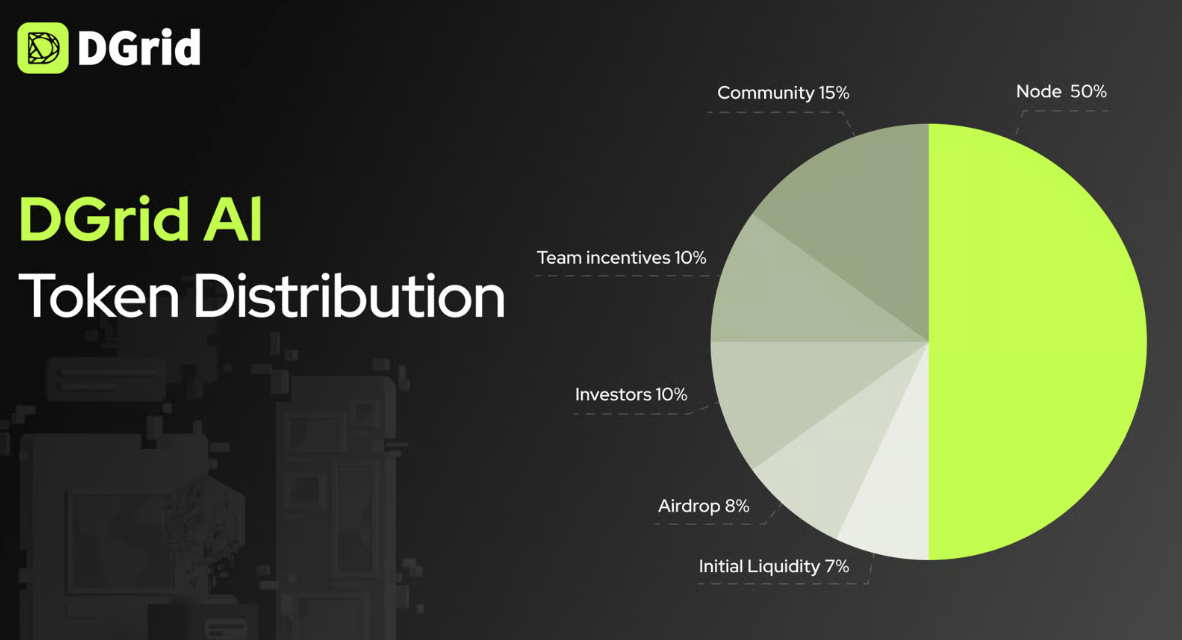
Token Allocation
-
Nodes: 50%
-
Community: 15%
-
Team: 10%
-
Investors: 10%
-
Airdrops: 8%
-
Initial Liquidity: 7%
Token Utilities
-
AI Inference Payments: DGAI is used to pay for AI inference services across the DGrid network. Pricing can depend on factors such as Compute Units, the base price, and request latency.
-
Node Rewards: Node operators can earn DGAI for providing infrastructure and processing AI inference requests on the network.
-
Staking: Node operators stake DGAI as collateral to participate in the network and help support reliable service delivery.
-
Network Security and Slashing: Nodes that violate network rules or provide unreliable services may lose part of their staked DGAI. DGrid's proposed mechanism allows slashed tokens to be burned.
-
Governance: Staked DGAI provides voting power for decisions related to protocol upgrades, fees, supported models, treasury allocation, and other network parameters.
-
Model and Provider Incentives: DGAI can be distributed to model providers and other participants that contribute AI services or infrastructure to the ecosystem.
-
Network Settlement: DGAI serves as a settlement asset between users, nodes, model providers, and other participants within DGrid's decentralized AI marketplace.
DGrid AI (DGAI) Goes Live on Bitget
We are thrilled to announce that DGrid AI (DGAI) will be listed in the DePIN zone. Check out the details below:
-
Deposit: Open
-
Trading: Opens on August 24, 2026, 08:00 (UTC)
-
Withdrawal: Opens on August 25, 2026, 08:00 (UTC)
-
Spot Trading Link: DGAI/USDT
Convert: Opens within 10 minutes after trading begins. You can exchange tokens for BTC, ETH, and other tokens supported by Bitget Convert, with no transaction fees.
Conclusion
DGrid AI brings together decentralized infrastructure, AI models, agents, distributed nodes, and blockchain-based settlement in a single network. Its approach focuses on making AI services easier to access while adding mechanisms for routing, verification, staking, and governance. The DGAI token supports this system by connecting payments, node incentives, network security, and participation in protocol decisions.
The project still faces the usual risks associated with emerging AI and crypto infrastructure, including competition, execution challenges, token unlocks, and the need to prove sustained real-world demand. However, DGrid AI has a clear use case within the growing decentralized AI sector, and its combination of broad model access, distributed infrastructure, and on-chain verification gives it a potentially strong position if adoption continues to expand.
Disclaimer: The opinions expressed in this article are for informational purposes only. This article does not constitute an endorsement of any of the products and services discussed or investment, financial, or trading advice. Qualified professionals should be consulted prior to making financial decisions.


- What Is DGrid AI (DGAI)?
- How DGrid AI (DGAI) Works
- DGrid AI (DGAI) Tokenomics
- DGrid AI (DGAI) Goes Live on Bitget
- Conclusion