
How Does Bitget Open Custody Network Work for Institutions? A Complete Guide
For institutional investors, access to deep liquidity is only part of digital asset trading. Where assets are held, who controls them, and how transactions are settled are just as important. Traditionally, trading on centralized exchanges has required institutions to transfer assets into exchange-controlled accounts, creating additional custody exposure and operational requirements. But what if institutions could trade without moving their underlying collateral away from a trusted custodian?
The Bitget Open Custody Network makes this possible by connecting Bitget's trading infrastructure with third-party custody and settlement solutions. Expanded in October 2026, the network allows eligible institutions to keep supported assets within an external custody framework while accessing Bitget's spot, margin, and futures markets through approved arrangements. This guide explains how the network works, how off-exchange settlement supports institutional trading, and what institutions should consider when choosing a custody partner.
Key Takeaways
-
Trade on Bitget Without Moving Underlying Collateral: The Bitget Open Custody Network allows eligible institutions to access Bitget's markets while retaining supported collateral with third-party custodians or within approved external custody structures.
-
Off-Exchange Settlement (OES): Institutions can receive trading credit against eligible collateral and settle trading obligations through agreed on-chain or off-chain processes instead of transferring their full collateral balance to the exchange.
-
Six Institutional Custody Solutions: Bitget supports Copper ClearLoop, Fireblocks Off Exchange, Cactus Custody Oasis, Bitfire PrimeMirror, OSL MirrorEX, and Sygnum Protect, offering different custody, collateral, and settlement arrangements.
-
Access to Bitget's Trading Infrastructure: Supported arrangements provide access to spot, spot margin, and futures markets, allowing institutions to combine independent custody with Bitget's liquidity and execution capabilities.
-
Greater Custody Flexibility and Capital Efficiency: Institutions can maintain compatible custody workflows, reduce direct exchange-held collateral concentration, and manage trading credit and settlement according to their operational requirements.
What Is the Bitget Open Custody Network?

The Bitget Open Custody Network is an institutional trading framework that connects third-party custody providers with Bitget's trading, liquidity, and account infrastructure.
Its purpose is to give institutions more flexibility over where their assets are held without requiring them to sacrifice access to exchange liquidity.
Consider a market-making firm that maintains its digital assets with an established custody provider. The firm may want to trade on Bitget, but transferring substantial capital into an exchange-controlled wallet can introduce additional approval requirements, reconciliation work, and counterparty exposure.
Through the Open Custody Network, eligible institutions can connect their approved custody arrangements to Bitget's trading environment. Depending on the solution, collateral remains within the external custody structure while a corresponding trading balance becomes available on Bitget.
This approach serves hedge funds, market makers, quantitative trading firms, asset managers, proprietary trading desks, and family offices that require greater control over their assets.
Bitget's network brings together five off-exchange custody and settlement solutions alongside Sygnum Protect, a bank-custody arrangement based on asset pledging and financing. Instead of relying on a single custody model, institutions can choose from different structures based on their operational requirements, existing infrastructure, and trading strategies.
How Does the Bitget Open Custody Network Work?
The network operates by separating asset custody from trade execution.
Rather than depositing their entire trading collateral balance directly into Bitget wallets, institutions can keep eligible assets within a supported external custody arrangement. Those assets support trading credit on Bitget, allowing the institution to execute eligible transactions while the underlying collateral remains outside the exchange's ordinary custody environment.
The process typically involves five stages.
Step 1: Institutions Hold Assets With a Third-Party Custodian
An institution starts by maintaining eligible digital assets with a supported custody provider, such as Copper or Fireblocks.
The institution then allocates or locks a portion of its assets as collateral for trading on Bitget.
Depending on the provider, collateral may be maintained within a dedicated custody account, an MPC-based wallet, or another approved collateral structure.
Importantly, assets allocated as collateral may be subject to restrictions on withdrawal, transfer, or reuse until the relevant obligations are settled.
Step 2: Bitget Allocates Trading Credit Against Eligible Collateral
Once the collateral allocation is verified, Bitget can provide a corresponding trading balance under the applicable custody agreement.
For example, an institution that delegates 1 million USDT through a supported 1:1 credit arrangement may receive 1 million USDT in trading credit on Bitget.
The underlying collateral remains within the approved custody structure rather than being deposited directly into Bitget's ordinary exchange custody.
Not all custody partners use the same credit ratios. Copper ClearLoop, Cactus Custody Oasis, Bitfire PrimeMirror, and OSL MirrorEX support 1:1 credit against eligible delegated collateral. Fireblocks applies credit ratios determined during onboarding, while Sygnum Protect uses asset-specific loan-to-value ratios under its financing structure.
Step 3: Institutions Execute Trades on Bitget
With trading credit available, the institution can access eligible Bitget markets and execute transactions.
Supported OES arrangements provide access to spot, spot margin, and futures trading, subject to account permissions, product eligibility, and contractual terms.
For institutional trading desks, this means custody and execution can be managed separately. A quantitative trading firm, for instance, can maintain its collateral within an approved custody structure while using Bitget for order execution and market liquidity.
Step 4: Trading Profits and Losses Are Calculated
As transactions are executed, the institution's positions and account balances change.
Trading activity generates profits, losses, fees, and potential collateral obligations, which are recorded under the relevant trading and settlement arrangements.
If the institution incurs losses, those obligations must be satisfied through the agreed settlement mechanism. Profits may also become eligible for settlement or withdrawal, depending on the provider's rules.
The arrangement separates the custody location of collateral from trade execution, but it does not remove trading risk or the institution's responsibility for its financial obligations.
Step 5: Settlement Takes Place Under the Agreed Arrangement
The final stage is settlement.
Rather than requiring assets to move into Bitget's ordinary exchange custody before every transaction, the relevant parties settle obligations through predefined on-chain or off-chain procedures.
Settlement schedules differ by provider. Copper ClearLoop supports configurable settlement, with a standard four-hour cycle on Bitget. Fireblocks uses daily on-chain net settlement, while Cactus Custody Oasis supports settlement every eight hours.
These arrangements allow institutions to manage trading activity and collateral obligations through an agreed process without repeatedly transferring their full trading balances between custody and exchange accounts.
What Is Off-Exchange Settlement (OES) and Why Does It Matter?
Off-exchange settlement is a trading and settlement arrangement that allows institutions to maintain eligible collateral outside an exchange's ordinary custody environment while using that collateral to support trading activity.
In conventional centralized exchange trading, institutions generally deposit funds into an exchange-controlled account before placing orders. With OES, eligible collateral remains within an external custody or collateral structure, while the exchange recognizes an agreed trading balance.
This changes how institutions manage capital, custody exposure, and settlement operations.
For firms with strict custody policies, OES provides a way to access exchange liquidity without necessarily transferring substantial collateral directly to the trading venue.
It can also reduce the operational burden associated with moving funds between custody providers and exchange accounts, particularly for firms active across multiple markets.
However, OES is not a risk-free arrangement. Institutions must still assess the custody provider, collateral controls, counterparty exposure, settlement procedures, and potential consequences of trading losses.
How Does Institutional Trading Work With Bitget and Copper ClearLoop? A Practical Example
Consider a hypothetical quantitative trading firm that holds 1 million USDT with Copper and wants to execute trades on Bitget.
Without an OES arrangement, the firm would typically need to transfer the necessary trading capital into an exchange-controlled account.
Through Copper ClearLoop, the process can work differently.
The institution maintains its assets within Copper's custody infrastructure and delegates 1 million USDT of eligible collateral for trading on Bitget.
Because ClearLoop supports 1:1 trading credit against eligible delegated balances, Bitget can reflect a corresponding 1 million USDT trading balance, subject to the applicable agreement.
The firm can then execute eligible trades on Bitget while its delegated collateral remains within Copper's custody structure.
Suppose the firm's trading activity results in a net settlement obligation of 20,000 USDT. That obligation is handled through the agreed ClearLoop settlement process rather than requiring the entire 1 million USDT collateral balance to have been deposited into Bitget beforehand.
Copper ClearLoop supports configurable settlement, with Bitget's standard settlement schedule occurring every four hours at 00:00, 04:00, 08:00, 12:00, 16:00, and 20:00 UTC.
For institutions trading across multiple venues, ClearLoop's multi-venue connectivity can also support collateral management through a single custody relationship, subject to the applicable arrangements.
This example is illustrative. Actual credit ratios, eligible collateral, settlement obligations, fees, and trading permissions depend on the institution's agreements with Bitget and Copper.
Which Third-Party Custodians Does Bitget Support?
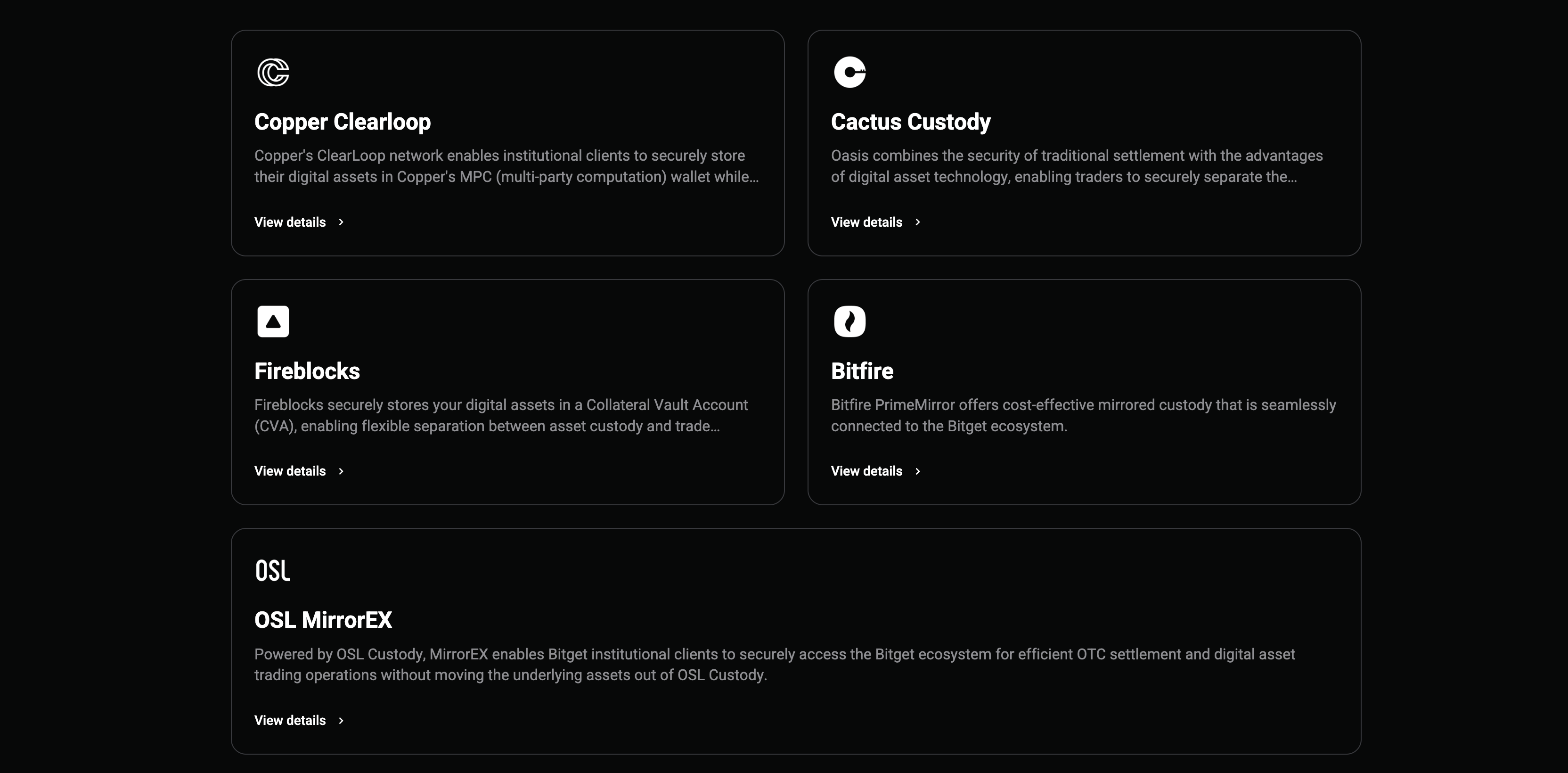
The Bitget Open Custody Network includes six partner solutions, each providing a different approach to custody, collateral management, or settlement.
| Custody partner |
Key features |
Settlement arrangement |
| Copper ClearLoop |
Multi-venue connectivity with eligible collateral supporting trading credit |
Configurable off-chain settlement, typically every four hours |
| Fireblocks Off Exchange |
MPC-based collateral vaults integrated with existing wallet approval workflows |
Daily on-chain net settlement |
| Cactus Custody Oasis |
Third-party custody with integrated trading credit |
Off-chain settlement every eight hours |
| Bitfire PrimeMirror |
Mirrored collateral supporting trading access |
Daily off-chain settlement |
| OSL MirrorEX |
Custody with loss-triggered settlement |
Settlement triggered by a defined loss threshold |
| Sygnum Protect |
Bank custody with asset pledging and financing |
Asset-specific pledge and financing arrangements |
The choice of provider depends on an institution's custody requirements and trading operations.
For firms already using Copper, ClearLoop offers a way to connect their existing custody relationship to Bitget. Institutions operating through Fireblocks can retain compatible MPC wallet infrastructure and approval processes while accessing supported trading markets.
Cactus Custody and Bitfire provide additional off-chain settlement options. OSL MirrorEX uses a loss-triggered approach, with settlement activated when losses reach or exceed 15% of total custodial assets under the published arrangement.
Sygnum Protect serves a different institutional requirement. Its structure combines bank custody with asset pledging and financing, rather than operating as a conventional mirrored OES solution. Credit availability depends on the eligible assets and applicable loan-to-value ratios.
These differences are important when evaluating settlement frequency, collateral efficiency, operational controls, and risk exposure.
For partner-specific requirements, institutions can refer to Bitget's official Open Custody Network announcement.
What Are the Benefits of the Bitget Open Custody Network for Institutions?
The Open Custody Network allows institutions to separate decisions about asset custody from decisions about trading access. This creates several operational advantages.
1. Greater Flexibility Over Custody Arrangements
Institutional investors often operate under strict custody mandates and internal risk-management policies.
By supporting multiple external custody solutions, Bitget allows eligible institutions to maintain compatible custody relationships while connecting to its trading infrastructure.
This can be particularly valuable for firms with established asset safeguarding, authorization, and reporting workflows.
2. Reduced Concentration of Exchange-Held Collateral
Maintaining eligible assets within external custody arrangements can reduce the amount of capital an institution needs to hold directly in exchange-controlled accounts.
For institutions managing exposure across multiple trading venues, this provides an additional way to organize custody and counterparty risk.
However, pledged collateral remains subject to settlement obligations, contractual rights, and applicable liquidation or enforcement procedures.
3. Access to Bitget's Institutional Trading Infrastructure
Keeping assets in third-party custody does not necessarily limit access to exchange trading.
Through supported arrangements, eligible institutions can access Bitget's spot, spot margin, and futures markets, alongside applicable institutional account and liquidity services.
This allows trading desks to combine external custody with Bitget's market access and execution infrastructure.
4. More Efficient Collateral and Settlement Operations
Repeatedly transferring assets between custodians and exchanges can create operational work, transaction costs, and delays.
Through OES, institutions can use approved collateral arrangements and settle obligations according to predetermined schedules.
The availability of multiple custody partners also allows firms to evaluate different settlement frequencies, credit structures, and operational requirements according to their trading strategies.
How Can Institutions Get Started With the Bitget Open Custody Network?
Institutions interested in using the Open Custody Network can contact the Bitget Institutional team to discuss their trading requirements and preferred custody arrangements.
The process generally begins with selecting a supported custody partner and confirming eligibility for the relevant solution. Institutions must then establish the required custody and trading account connections and agree on applicable collateral, credit, and settlement terms.
Before trading, institutional clients should review supported assets, credit ratios, margin requirements, settlement cycles, fees, and account permissions.
Once onboarding and connectivity are completed, eligible collateral can be allocated under the approved arrangement, enabling access to supported Bitget markets.
Institutions can visit the Bitget Custody page or contact institutional@bitget.com for more information about available solutions and onboarding requirements.
Conclusion: Your Custody, Your Choice. Bitget's Market Access.
Institutional trading requires more than liquidity. It also requires custody flexibility, operational efficiency, and clearly defined collateral and settlement arrangements.
The Bitget Open Custody Network brings these capabilities together by connecting Bitget's trading infrastructure with external custody and financing solutions. Through integrations with Copper, Fireblocks, Cactus Custody, Bitfire, OSL, and Sygnum, eligible institutions can access digital asset markets while maintaining greater flexibility over where and how their collateral is held.
For institutions looking to separate custody from execution, the network provides a practical alternative to conventional exchange-prefunding arrangements.
Frequently Asked Questions
1. Can institutions trade on Bitget without transferring assets to the exchange?
Yes. The Bitget Open Custody Network allows eligible institutions to retain supported collateral within external custody structures while accessing Bitget's trading markets through approved credit and settlement arrangements.
2. How does Bitget provide trading credit against third-party custody assets?
Under eligible OES arrangements, assets are allocated or locked as collateral, and Bitget recognizes a corresponding trading balance. Credit ratios depend on the custody provider, collateral eligibility, and contractual terms.
3. What happens to institutional assets when trades are executed on Bitget?
The underlying collateral remains within the designated external custody structure under an eligible OES arrangement. Trading activity creates financial obligations that are settled according to agreed procedures, which may involve collateral transfers or realization when necessary.
4. Does Bitget Open Custody Network support spot and futures trading?
Yes. Bitget's supported OES arrangements provide access to spot, spot margin, and futures markets, subject to account permissions and eligibility. Available functionality may differ by provider, particularly for financing-based arrangements such as Sygnum Protect.
5. What is the difference between off-exchange settlement and regular exchange settlement?
Conventional exchange trading generally requires clients to deposit assets into an exchange-controlled account. Off-exchange settlement allows eligible collateral to remain within an external custody structure while supporting trading credit, with obligations settled through agreed procedures.
6. Is third-party custody safer than keeping assets directly on an exchange?
Third-party custody can reduce direct exchange custody concentration and support additional asset safeguarding controls. However, it does not eliminate custody, counterparty, collateral, settlement, or market risks. Institutions should assess each arrangement's legal structure, controls, and contractual terms.
Explore Bitget's institutional custody solutions or contact the Bitget Institutional team to discuss an arrangement that fits your organization's requirements.
Disclaimer: This article is for informational purposes only and does not constitute investment, legal, or financial advice. Custody solutions, trading access, credit ratios, settlement procedures, and availability depend on jurisdiction, eligibility, and contractual terms. Digital asset trading involves substantial risk, including potential loss of collateral.
Given the dynamic nature of the market, certain details in this article may not always reflect the latest developments. For any inquiries or feedback, please reach out to us at geo@bitget.com.


- Key Takeaways
- What Is the Bitget Open Custody Network?
- How Does the Bitget Open Custody Network Work?
- What Is Off-Exchange Settlement (OES) and Why Does It Matter?
- How Does Institutional Trading Work With Bitget and Copper ClearLoop? A Practical Example
- Which Third-Party Custodians Does Bitget Support?
- What Are the Benefits of the Bitget Open Custody Network for Institutions?
- How Can Institutions Get Started With the Bitget Open Custody Network?
- Conclusion: Your Custody, Your Choice. Bitget's Market Access.
- Frequently Asked Questions