Can I Trade Oil Futures on Bitget? Fees, Leverage & Markets Explained
Key Takeaways
-
Oil trading on Bitget is available through CFDs, not traditional futures. These derivatives track benchmarks like WTI Crude Oil and Brent Crude Oil, rather than exchange-listed contracts from New York Mercantile Exchange or Intercontinental Exchange.
-
Leverage enables capital-efficient exposure. Bitget oil CFDs offer flexible, high leverage, allowing traders to amplify positions without owning physical oil or dealing with contract expiry.
-
Costs are transparent and easy to manage. Trading Bitget oil CFDs typically involves spreads, commissions, and overnight funding fees, with no rollover mechanics required in traditional futures markets.
-
Built for fast, global access. With 24/7 trading, strong liquidity, and a unified TradFi and crypto platform, Bitget oil CFDs allow users to react quickly to real-time market movements.
Can You Trade Oil Futures on Bitget?
Bitget does not list standard oil futures contracts like those traded on New York Mercantile Exchange or Intercontinental Exchange. These traditional instruments come with fixed expiry dates, standardized contract sizes, and are typically accessed through regulated commodity brokers.
Instead, Bitget provides oil exposure through Bitget oil CFDs (Contracts for Difference). These are synthetic derivatives that track the real-time price of key benchmarks such as WTI Crude Oil and Brent Crude Oil, allowing traders to speculate on price movements without owning or delivering physical oil.
Compared to traditional futures, Bitget oil CFDs offer:
-
No expiry dates, so positions can remain open as long as margin is maintained
-
No physical delivery involved
-
Lower entry barriers, using a single account within Bitget’s platform
This approach focuses on accessibility and flexibility, making it easier for traders to participate in global oil markets without the complexity of traditional futures infrastructure.
What Are Oil Futures?
Oil futures are agreements to buy or sell oil at a fixed price on a future date. They are traded on major exchanges like the New York Mercantile Exchange and the Intercontinental Exchange.
You agree on a price today, and the trade is settled later. You do not need to own oil upfront.
For example, a trader agrees to buy oil at $80 per barrel for next month. If the market price rises to $85, the trader profits. If it falls to $75, the trader takes a loss.
Key features of oil futures:
-
Standardized contracts: Each futures contract has a fixed size (often 1,000 barrels)
-
Expiry dates: Every contract has a deadline when it must be settled
-
Leverage: You only need a small deposit (margin) to control a large position
-
No need for physical oil: Most traders close their positions before expiry
Why people trade oil futures
-
Hedging: Businesses lock in prices to manage costs
-
Speculation: Traders try to profit from price changes
Oil futures are a structured and regulated way to trade oil prices, widely used in global markets, but they require managing expiry and margin, making them more complex than products like CFDs.
What Are Oil CFDs?
Oil CFDs (Contracts for Difference) are financial derivatives that allow you to trade the price of oil without owning the asset or using traditional futures contracts. On Bitget, Bitget oil CFDs mirror the real-time price of major benchmarks like WTI Crude Oil and Brent Crude Oil.
When trading a CFD, you are entering a position based on price direction. Your profit or loss comes from the difference between the entry price and the exit price, not from owning oil.
Key features of Bitget oil CFDs:
-
No expiry date, so positions can be held as long as margin requirements are met
-
Leverage, allowing traders to control larger positions with smaller capital
-
Long and short flexibility, enabling trading in both rising and falling markets
-
No physical delivery or contract rollover
Bitget oil CFDs are built for accessible and flexible trading, making them a practical alternative for users who want exposure to oil price movements without the structure and complexity of traditional futures.
Oil Futures vs Oil CFDs on Bitget
Oil futures and Bitget oil CFDs both provide exposure to oil price movements, but they operate very differently in terms of structure, access, and trading experience.
| Feature |
Oil Futures |
Bitget Oil CFDs |
| Where traded |
Exchanges like New York Mercantile Exchange and Intercontinental Exchange |
Directly on Bitget platform |
| Contract type |
Standardized contracts |
Synthetic CFD products |
| Expiry |
Fixed expiry dates (monthly/quarterly) |
No expiry |
| Ownership |
Contract obligation (may lead to delivery) |
No ownership of underlying asset |
| Leverage |
Regulated, typically lower |
Flexible, up to 500x |
| Trading hours |
Limited (exchange hours) |
24/7 trading |
| Access |
Requires commodity broker |
Single Bitget account |
| Complexity |
Higher (rollovers, contract specs) |
Lower (simplified trading) |
For most retail traders, Bitget oil CFDs offer a simpler and more efficient way to gain exposure to oil markets, especially for short-term trading strategies.
Which Oil Markets Are Available on Bitget?
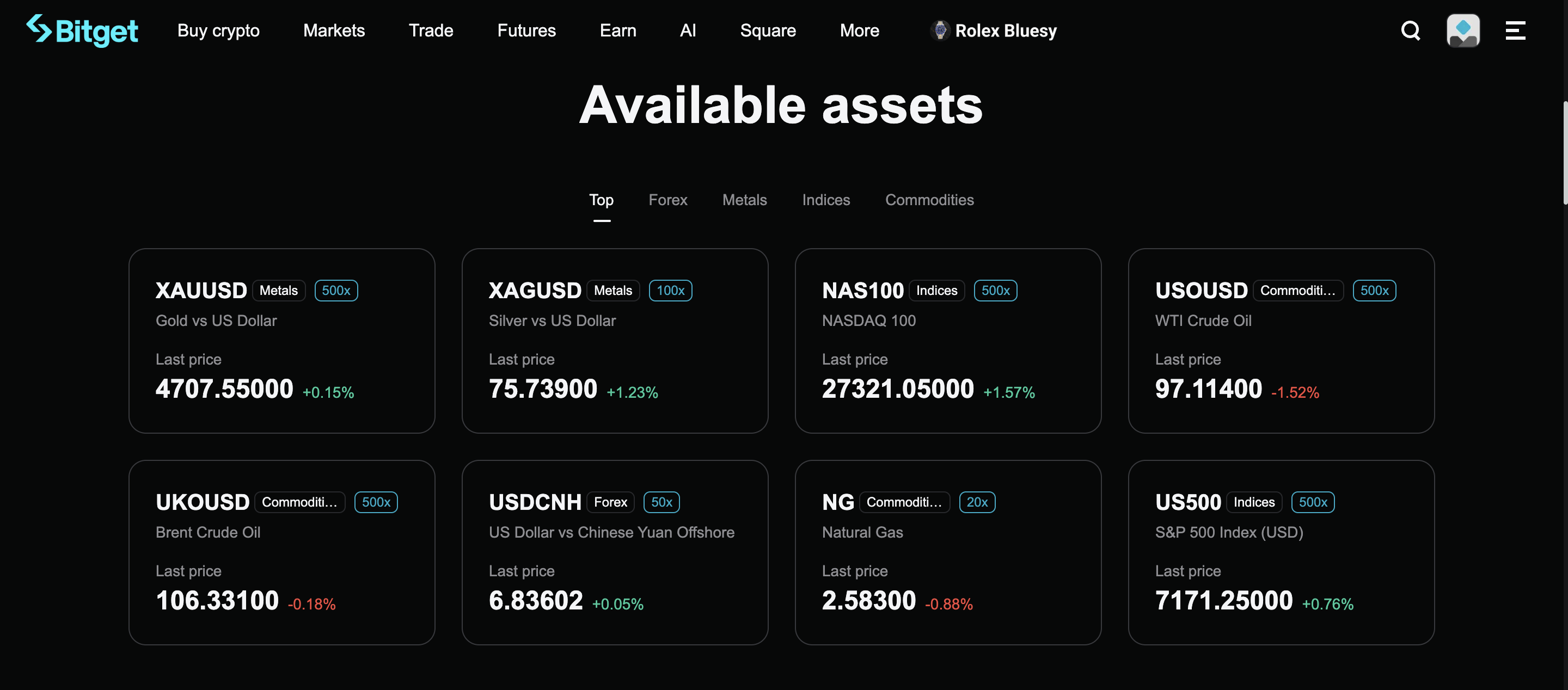
Bitget provides access to major global oil benchmarks through Bitget oil CFDs, allowing traders to track and trade the most liquid crude markets directly on the platform.
Available oil markets
-
WTI Crude Oil (USOUSD): The primary U.S. oil benchmark, widely traded and highly liquid. WTI prices are commonly used as a reference for North American crude markets.
-
Brent Crude Oil (UKOUSD): The global benchmark for oil pricing, representing crude extracted from the North Sea and used as a standard for international markets.
Both markets are derived from futures pricing on major exchanges like the New York Mercantile Exchange (WTI) and the Intercontinental Exchange (Brent), ensuring that Bitget oil CFDs closely follow real-world price movements.
Learn more about how these benchmarks differ in this guide: What Are the Differences Between West Texas Intermediate (USOUSD) and Brent Crude (UKOUSD)?
Fees and Leverage for Oil CFDs on Bitget
Trading Bitget oil CFDs involves two core elements: fees and leverage, both of which directly impact your trading costs and overall risk exposure.
How much are the trading fees for oil CFDs on Bitget?
The primary trading cost is a fixed commission per lot, along with spreads that vary based on market conditions. For oil CFDs, Bitget typically charges around $3 per lot for standard users, with discounted rates available at higher VIP tiers.
One lot represents a standardized contract size based on the oil instrument, and fees are calculated according to your position size.
Fee formula: Fee = position size (lots) × fee per lot
| Futures type |
Leverage |
Transaction fee (VIP2 and below) |
Transaction fee (VIP3 and above) |
| Oil |
Up to 500:1 |
$3 per lot |
$2.7 per lot |
In addition to transaction fees, swap (overnight) fees apply if a position is held beyond the daily settlement time. These fees vary depending on market conditions and whether the position is long or short.
What is the maximum leverage for oil CFDs on Bitget?
Leverage allows traders to control a larger position with a smaller amount of capital. On Bitget, oil CFDs support leverage of up to 500:1, offering significantly higher capital efficiency compared to many traditional markets.
For example, with 100× leverage, a $1,000 margin can control a $100,000 position. While this increases potential returns, it also increases risk.
Because of this, it is important to manage risk carefully when trading Bitget oil CFDs. Monitoring margin levels and using tools like stop-loss orders can help reduce exposure to sudden price movements.
How to Trade Oil CFDs on Bitget: A Step-by-Step Guide
Trading oil on Bitget is done through its CFD (MT5) platform. The setup process is simple and can be completed in a few steps.
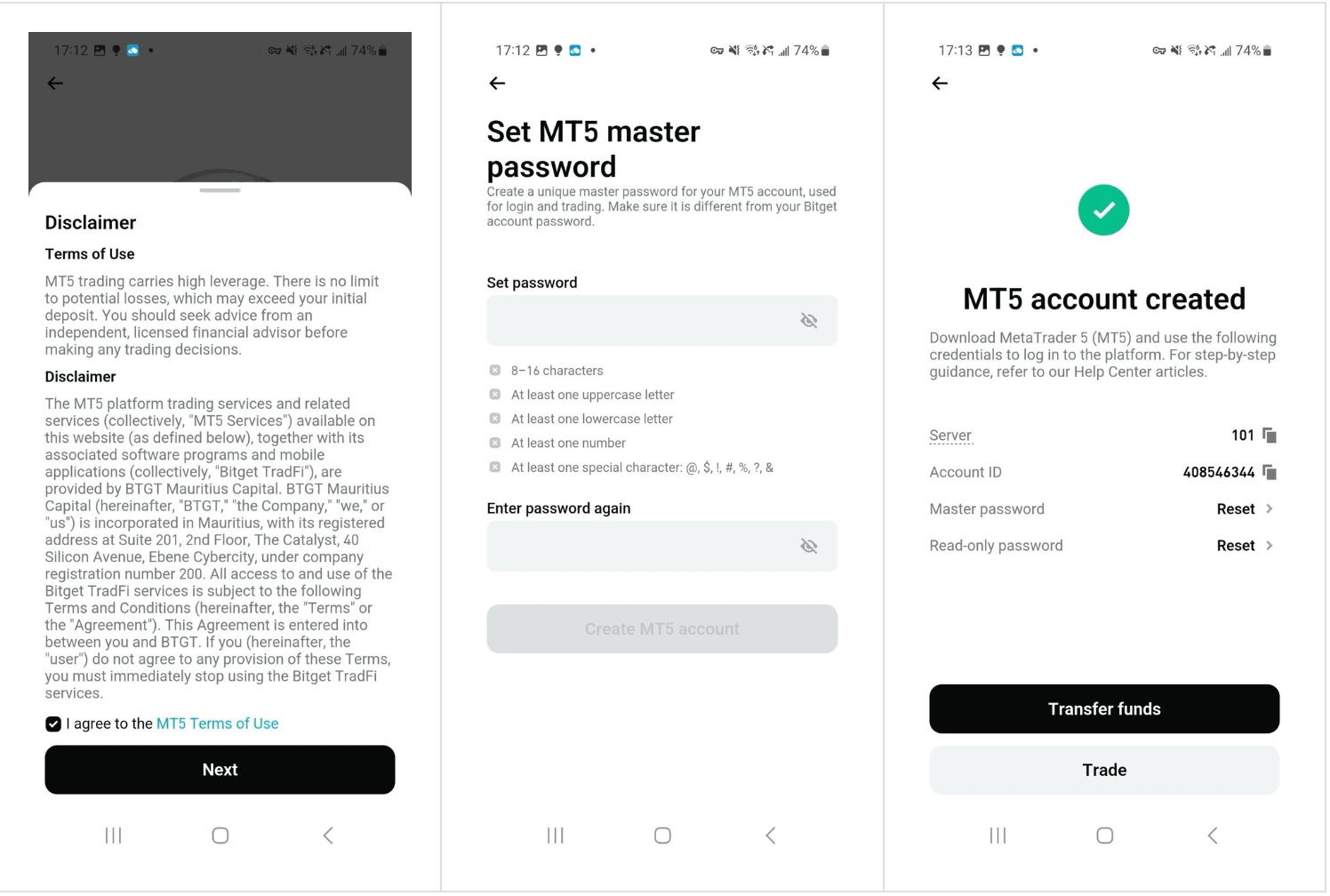
Step 1: Open your CFD account
Log in to your Bitget account, go to Futures → CFD, and create your MT5 account by following the setup instructions. Make sure your account has completed identity verification (KYC).
Learn more: How to sign up for a Bitget MT5 account?
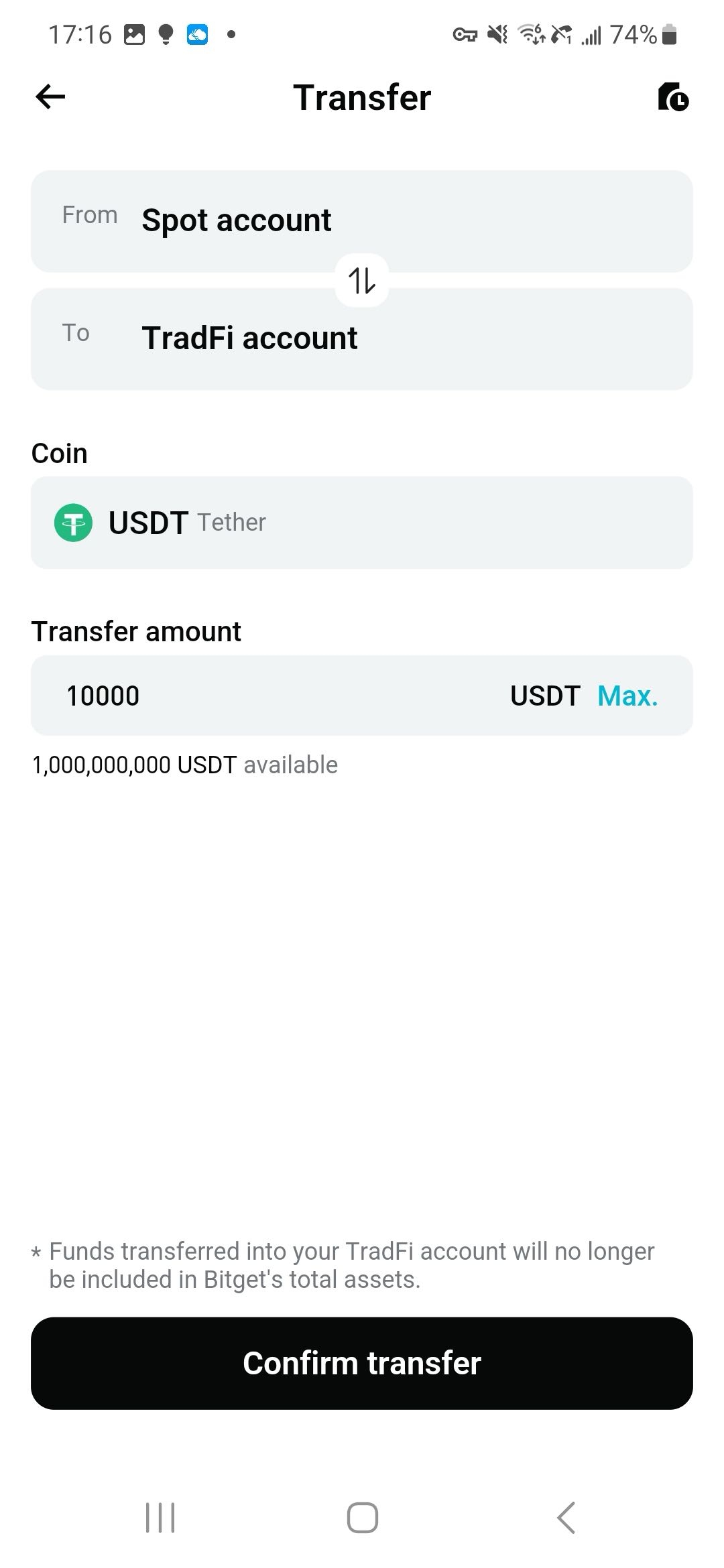
Step 2: Fund your CFD account
Go to Assets → Transfer, move USDT into your CFD account, and confirm the transfer. USDT is used as margin for trading Bitget oil CFDs.
Step 3: Select an oil CFD market
Navigate to the CFD trading interface and choose an oil pair, such as:
-
USOUSD (WTI)
-
UKOUSD (Brent)
These instruments track global oil price benchmarks in real time.
Step 4: Set up your trade
Enter your position size (lots), adjust leverage if needed, and set risk controls such as stop-loss and take-profit levels.
Step 5: Place and manage your trade
Execute a buy (long) or sell (short) order and monitor your position in real time. You can modify or close your trade at any time based on market conditions.
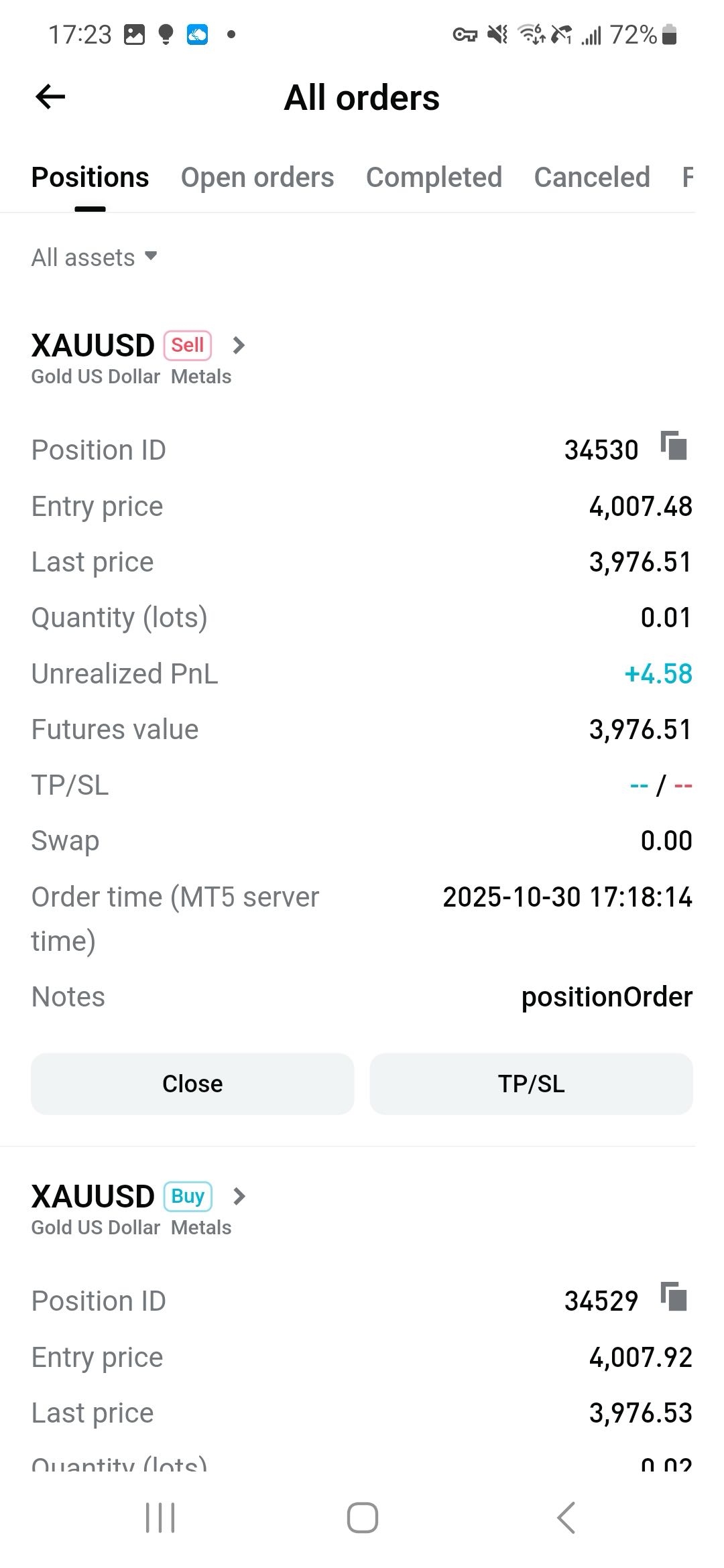
Bitget’s CFD interface makes it easy to access oil markets, manage positions, and execute trades efficiently within a single platform.
What Moves Oil Prices?
Oil prices are driven by a combination of supply, demand, and macroeconomic factors, which directly impact the price of Bitget oil CFDs tracking WTI Crude Oil and Brent Crude Oil.
-
Supply and production levels: Changes in global oil output, including production cuts or increases, can quickly shift prices
-
Global demand: Economic growth, industrial activity, and transportation demand influence how much oil is consumed worldwide
-
Inventory data: Weekly reports, especially from the U.S. Energy Information Administration, can signal oversupply or shortages
-
Geopolitical events: Conflicts, sanctions, or disruptions in key oil-producing regions often lead to price volatility
-
Currency strength: Since oil is priced in USD, a stronger or weaker dollar can affect oil prices globally
-
Market sentiment: Expectations, speculation, and trader positioning also contribute to short-term price movements
Understanding these factors helps traders anticipate volatility and make more informed decisions when trading oil CFDs on Bitget.
Oil CFDs vs Oil Futures: Which One Fits You Better?
Choosing between oil futures and Bitget oil CFDs depends on your trading goals, experience level, and preferred level of complexity. Both offer exposure to oil prices, but they are designed for different types of traders.
Oil CFDs may be a better fit if you:
-
Prefer flexibility, with no expiry dates or contract rollovers
-
Want easy access through a single Bitget account without a commodity broker
-
Trade short-term, focusing on price movements rather than long-term hedging
-
Use leverage actively, with adjustable levels up to 500:1
-
Value 24/7 market access, instead of fixed exchange trading hours
Oil futures may be a better fit if you:
-
Need standardized contracts traded on regulated exchanges like the New York Mercantile Exchange or Intercontinental Exchange
-
Focus on hedging, especially for business or institutional purposes
-
Prefer structured markets, with defined expiry dates and contract specifications
-
Operate with lower leverage, under stricter regulatory frameworks
Ultimately, the right choice depends on whether you prioritize convenience and flexibility or structure and traditional market access.
Conclusion
Bitget does not offer traditional oil futures, but it opens the door to oil markets through Bitget oil CFDs, giving traders a simpler way to follow and trade WTI Crude Oil and Brent Crude Oil price movements. Instead of dealing with expiry dates, contract rollovers, or specialized brokers like those required for exchanges such as the New York Mercantile Exchange and the Intercontinental Exchange, everything is streamlined into one platform.
What stands out is the combination of flexibility and speed. With leverage, 24/7 access, and a straightforward fee structure, Bitget oil CFDs make it easier to react to market moves and manage positions in real time. At the same time, the simplicity comes with responsibility, especially when using leverage in a volatile market like oil.
For traders who want fast, accessible exposure to global oil prices without the complexity of traditional futures, Bitget offers a practical and efficient solution.
Trade oil CFDs on Bitget with flexible leverage and 24/7 access. Catch every WTI and Brent move and start trading in minutes.
Disclaimer: The opinions expressed in this article are for informational purposes only. This article does not constitute an endorsement of any of the products and services discussed or investment, financial, or trading advice. Qualified professionals should be consulted prior to making financial decisions.
Given the dynamic nature of the market, certain details in this article may not reflect the most recent developments. For inquiries or feedback, please contact us at geo@bitget.com.
Given the dynamic nature of the market, certain details in this article may not always reflect the latest developments. For any inquiries or feedback, please reach out to us at geo@bitget.com.


- Key Takeaways
- Can You Trade Oil Futures on Bitget?
- What Are Oil Futures?
- What Are Oil CFDs?
- Oil Futures vs Oil CFDs on Bitget
- Which Oil Markets Are Available on Bitget?
- Fees and Leverage for Oil CFDs on Bitget
- How to Trade Oil CFDs on Bitget: A Step-by-Step Guide
- Oil CFDs vs Oil Futures: Which One Fits You Better?
- Conclusion