What Could $100 in Bitcoin Be Worth by 2030? The Long-Term Bitcoin Thesis
It’s just $100 – dinner money in most cities. But in Bitcoin, it might be something else entirely. Over the past decade, the world’s largest cryptocurrency has repeatedly turned small allocations into outsized returns for early believers. In 2013, $100 in Bitcoin would have bought thousands of coins. Even in later cycles, modest purchases made during market downturns often multiplied dramatically during subsequent bull runs. That history is why many investors view Bitcoin not simply as a trade, but as an asymmetric bet — one where the downside is limited to the initial investment while the potential upside remains open-ended.
Looking ahead to 2030, the question becomes less about short-term volatility and more about structural change. By the end of the decade, Bitcoin will likely have moved through two more halving cycles, including the critical 2028 supply reduction that further tightens issuance. At the same time, institutional adoption, regulatory clarity, and macroeconomic shifts could reshape how the asset fits into the global financial system. In that context, a simple $100 allocation today becomes a thought experiment: what could a small slice of the world’s first digitally scarce asset be worth in a decade?
Why 2030 Matters for Bitcoin
The Halving Effect
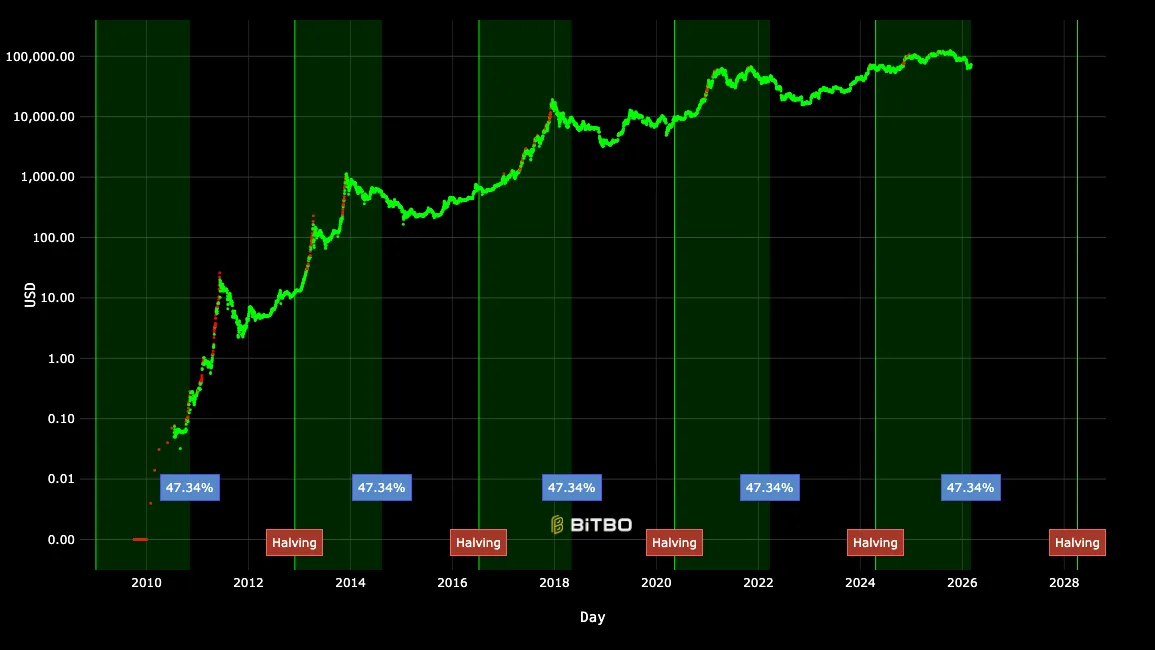
One of Bitcoin’s most powerful mechanics is written directly into its code: scarcity. Roughly every four years, the Bitcoin network undergoes a halving event, cutting the block reward paid to miners in half. This process steadily reduces the rate at which new BTC enters circulation, tightening supply over time.
Historically, these moments have acted as major catalysts for price appreciation. After the 2016 halving, Bitcoin climbed from around $650 to nearly $20,000 during the following cycle. Following the 2020 halving, the asset surged from roughly $11,000 to above $60,000 within the next 18 months. The 2024 halving — which reduced block rewards from 6.25 BTC to 3.125 BTC — marked the most recent supply shock, reinforcing Bitcoin’s long-term scarcity narrative.
Source: Bitbo
Looking ahead to the end of the decade, the next major milestone will be the 2028 halving, when block rewards are expected to fall again to just 1.5625 BTC per block. By the time Bitcoin reaches 2030, the network will be operating with significantly reduced new supply compared with earlier cycles. While past performance never guarantees future results, the halving cycle has historically aligned with Bitcoin’s strongest bull markets — making the years surrounding the 2028 event a key focal point for long-term investors.
Institutional Momentum
The infrastructure surrounding Bitcoin today looks dramatically different than it did just a few years ago. The launch of spot Bitcoin exchange-traded funds in the United States opened the door for traditional capital to flow directly into the asset. Within their first year, these ETFs collectively accumulated more than 1.2 million BTC — roughly 6% of the total supply — signaling substantial demand from institutional investors.
Corporate adoption has also accelerated. Companies such as MicroStrategy and Tesla have added Bitcoin to their balance sheets, treating it as a strategic treasury reserve rather than a speculative asset. Meanwhile, asset managers, hedge funds and pension funds are increasingly exploring exposure through ETFs, custody platforms and structured products. As these channels mature, Bitcoin’s accessibility expands globally, potentially unlocking billions in additional capital inflows by the end of the decade.
Macro Tailwinds
Beyond crypto-native adoption, broader macroeconomic conditions may also strengthen Bitcoin’s long-term case. Over the past decade, sovereign debt levels have expanded dramatically across major economies, while inflationary pressures have periodically eroded purchasing power. In this environment, scarce assets — historically gold — often gain renewed attention from investors seeking long-term stores of value.
Bitcoin is increasingly entering that conversation as a digital alternative. With its fixed supply cap of 21 million coins and transparent monetary policy, the asset offers a level of scarcity rarely seen in traditional financial systems. At the same time, regulatory frameworks around digital assets continue to evolve, gradually legitimizing Bitcoin within global markets.
If these trends continue, the financial infrastructure surrounding Bitcoin in 2030 could look nothing like it did in 2020 — potentially transforming the asset from a niche experiment into a widely recognized macro asset class.
Running the Numbers: Three 2030 Scenarios
Forecasting Bitcoin’s future price is notoriously difficult. Yet several widely followed valuation frameworks — from scarcity-based models to network growth metrics — offer ways to estimate where the asset could land by the end of the decade. Analysts often combine approaches such as the stock-to-flow model, which evaluates Bitcoin’s scarcity relative to supply issuance, and Metcalfe’s Law, which values networks based on the growth of users and connections. When layered with institutional demand forecasts, these models create a range of potential outcomes rather than a single price target.
Large investment firms have already begun publishing long-term projections. Analysts at ARK Invest, for example, have suggested Bitcoin could reach roughly $300,000 in a conservative case, $710,000 in a base case, and as high as $1.5 million in a bullish scenario by 2030, depending largely on how deeply the asset penetrates global store-of-value markets. These estimates assume continued adoption from institutions, increasing use of Bitcoin as “digital gold,” and expanding infrastructure across global financial markets.
To understand what that could mean for a small allocation, consider the following thought experiment. At a hypothetical Bitcoin price of around $70,000, a $100 investment would purchase roughly 0.0014 BTC. If Bitcoin reaches the projected ranges above by 2030, that small slice of the network could grow significantly.
| Scenario |
BTC Price (2030) |
$100 Turns Into |
| Conservative |
$300,000 |
~$420 |
| Base Case |
$710,000 |
~$990 |
| Bull Case |
$1,500,000 |
~$2,100 |
In the conservative case, Bitcoin adoption grows steadily but faces regulatory friction or slower institutional inflows. The base case assumes Bitcoin continues maturing into a legitimate store-of-value asset, capturing a meaningful portion of gold’s role in global portfolios. The bullish scenario imagines a world where Bitcoin captures a much larger share of global wealth storage — potentially including sovereign reserves, corporate treasuries, and widespread institutional allocation.
For long-term investors, the appeal lies in the asymmetry. Even if Bitcoin grows modestly relative to its past performance, a small allocation could still produce meaningful returns over time. And if the more aggressive adoption scenarios play out, the upside potential expands dramatically.
The Bigger Thesis: Bitcoin as Digital Scarcity
Behind every long-term price forecast lies a deeper investment thesis: Bitcoin is designed to be the scarcest monetary asset ever created. Unlike fiat currencies, which can be expanded through central bank policy, Bitcoin’s supply is permanently capped at 21 million coins. That fixed issuance schedule is enforced by thousands of independent nodes across the network, making it nearly impossible to alter without global consensus. As a result, Bitcoin’s monetary policy is not only predictable — it is immutable.
This is why many investors refer to Bitcoin as “digital gold.” Gold has historically served as a store of value because it is difficult to mine and its supply grows slowly over time. Bitcoin takes that concept further. Its issuance declines every four years through the halving mechanism, pushing the asset’s inflation rate lower with each cycle. By the end of the decade, Bitcoin’s annual supply growth will be close to zero, making it one of the hardest monetary assets in existence.
The store-of-value narrative is also strengthened by network effects. Over the past decade, Bitcoin has built the deepest liquidity, strongest brand recognition and most secure infrastructure in the digital asset industry. Exchanges, custodians, payment rails and institutional-grade trading platforms have all emerged around the network, creating a financial ecosystem that continues to expand each year.
At the same time, generational shifts are beginning to reshape investment preferences. Younger investors who grew up in the digital economy often view decentralized assets as a natural extension of the internet rather than a speculative novelty. As adoption spreads globally and financial infrastructure matures, Bitcoin increasingly resembles a long-term macro asset — one that some investors hold not to trade, but to hedge against monetary instability and participate in a new form of digital scarcity.
What Could Go Wrong?
Despite Bitcoin’s compelling long-term thesis, the path to 2030 is far from guaranteed. The asset remains volatile, politically sensitive and deeply tied to broader financial conditions. Even the most optimistic projections assume that adoption continues expanding — something that could easily be disrupted.
One of the most frequently cited risks is regulatory hostility. While many jurisdictions have gradually moved toward clearer crypto frameworks, policy shifts can happen quickly. Strict regulations on exchanges, custody, or institutional participation could slow capital inflows and dampen market momentum. Governments may also view decentralized assets as competing with national monetary systems, potentially creating friction as adoption grows.
Liquidity conditions represent another major variable. Bitcoin has historically performed best during periods of abundant global liquidity and low interest rates. If the global economy enters a prolonged credit contraction or financial crisis, risk assets — including Bitcoin — could face significant selling pressure. A liquidity crunch could temporarily suppress prices even if the long-term fundamentals remain intact.
There is also the possibility that competing investment narratives overshadow Bitcoin. Capital flows constantly rotate between sectors, and emerging technologies such as artificial intelligence, robotics or biotech could capture investor attention and funding. If equities or other asset classes deliver stronger returns over the decade, Bitcoin’s store-of-value narrative may struggle to maintain momentum with retail investors.
Finally, volatility fatigue remains a real challenge. Bitcoin’s dramatic boom-and-bust cycles have created enormous gains for some investors, but they have also shaken out many others. If prolonged periods of sideways price action discourage retail participation, market enthusiasm could cool, slowing the pace of adoption.
None of these risks invalidate Bitcoin’s long-term thesis. But they highlight an important reality: the road to 2030 will likely include significant uncertainty, and Bitcoin’s trajectory will depend not only on its technology but also on the broader evolution of global finance.
So… Is $100 Worth the Bet?
In the grand scheme of global finance, $100 is a tiny allocation. It won’t change a portfolio overnight, and it certainly isn’t a guaranteed path to wealth. But that’s not really the point. For many investors, buying a small amount of Bitcoin is less about chasing quick profits and more about gaining exposure to a new monetary network that is still in the early stages of adoption.
Viewed through that lens, Bitcoin becomes an exercise in asymmetric risk. The downside is clearly defined — at worst, the $100 goes to zero. The upside, however, is tied to the possibility that Bitcoin continues evolving into a widely recognized store-of-value asset, potentially competing with gold or even becoming part of sovereign and institutional reserves over time. If that thesis plays out, even a modest allocation could grow far beyond its starting point.
By 2030, $100 in Bitcoin may still be just $100.
Or it could represent one of the simplest asymmetric bets of the decade.
Where to Buy Bitcoin in 2026: Why Bitget Is Becoming a Top Choice for Traders
For investors considering a small Bitcoin allocation, choosing the right platform can be just as important as deciding when to buy. One exchange gaining traction among global traders is Bitget, a cryptocurrency platform that has rapidly expanded across spot markets, derivatives trading and social trading services. Founded in 2018, Bitget now serves users in more than 100 countries and offers access to hundreds of digital assets, including Bitcoin, with competitive trading fees and multiple fiat on-ramps that allow users to purchase BTC using bank cards, peer-to-peer markets and regional payment providers.
More recently, Bitget has moved to bridge crypto markets with traditional finance through the launch of Bitget TradFi, a trading suite that introduces traditional financial instruments into the platform’s ecosystem. The feature allows users to trade assets such as forex pairs, global indices, commodities and precious metals like gold using stablecoins from the same account used for crypto trading. By bringing these markets together, the exchange aims to create a more unified trading environment where users can access both digital assets and macro markets without switching platforms.
Alongside its cross-market trading capabilities, Bitget is also known for its copy trading ecosystem, which enables users to automatically replicate strategies from experienced traders. Combined with security measures such as a sizable protection fund and proof-of-reserves transparency, these features have helped position Bitget as a platform attracting both new retail participants and more experienced traders. As Bitcoin adoption continues expanding globally, exchanges that combine accessibility, liquidity and broader market exposure are increasingly becoming key entry points into the digital asset economy.
Ready to explore Bitcoin and global markets in one place? Create your account on Bitget and start trading today.
Disclaimer: The opinions expressed in this article are for informational purposes only. This article does not constitute an endorsement of any of the products and services discussed or investment, financial, or trading advice. Qualified professionals should be consulted prior to making financial decisions.


- Why 2030 Matters for Bitcoin
- Running the Numbers: Three 2030 Scenarios
- The Bigger Thesis: Bitcoin as Digital Scarcity
- What Could Go Wrong?
- So… Is $100 Worth the Bet?
- Where to Buy Bitcoin in 2026: Why Bitget Is Becoming a Top Choice for Traders