How Can I Receive Dividends From Tokenized U.S. Stocks on a Crypto Exchange? Bitget Stocks 2.0, Fees and Setup Explained (2026 Guide)
Key Takeaways
-
You Can Receive Dividends From Eligible Tokenized U.S. Stocks on Bitget: Eligible Bitget Stocks 2.0 rToken holders may receive cash dividends in USDT or stock dividends as additional rTokens, depending on the underlying stock or ETF, record date, snapshot rules, and product terms.
-
Bitget Stocks 2.0 Automates Dividend Processing: Cash dividends are automatically converted into USDT and credited to eligible accounts, while stock dividends can be delivered as extra rTokens with updated balances, cost basis, and asset values.
-
Dividend Eligibility Depends on Timing and Product Rules: Users must hold eligible rTokens before the required record date or snapshot time. Final distributions may be affected by withholding taxes, deductions, corporate actions, regional restrictions, and processing timelines.
-
Tokenized Stock Dividends Are Not the Same as Shareholder Rights: rTokens provide economic exposure to U.S. stocks and ETFs, but they generally do not provide registered shareholder ownership, proxy participation, or voting rights.
What Are Dividends From Tokenized U.S. Stocks?
Dividends are distributions paid by companies or ETFs to eligible holders of the underlying asset. In traditional finance, a company may pay cash dividends from profits, while some companies may distribute additional shares through stock dividends. ETFs may also distribute income collected from the stocks they hold.
Tokenized U.S. stock dividends bring this concept into a crypto-native format. Instead of receiving dividends through a traditional broker account, eligible token holders may receive dividend value through a crypto exchange or tokenized asset platform.
On Bitget Stocks 2.0, this process is designed to be automatic for supported rTokens. Cash dividends are converted into USDT and credited to eligible users’ Bitget accounts. Stock dividends are delivered as additional rTokens, with balances updated accordingly.
Still, dividends are not guaranteed. Not every U.S. stock pays dividends. Many growth companies reinvest profits instead of distributing cash. ETF distributions also depend on fund policies, underlying holdings, and market conditions. Users should always check the dividend history and product rules before treating any rToken as an income asset.
How Can I Receive Dividends From Tokenized U.S. Stocks on a Crypto Exchange?
Eligible users can receive dividends from tokenized U.S. stocks on Bitget through Bitget Stocks 2.0 by holding qualifying rTokens before the required record date or snapshot time. Cash dividends are converted into USDT and credited to the user’s Bitget account, while eligible stock dividends are delivered as additional rTokens.
The general workflow looks like this:
-
A U.S. company or ETF announces a dividend.
-
The official record date determines which holders may qualify.
-
Bitget Stocks 2.0 or Reality applies the relevant snapshot and eligibility rules.
-
The underlying dividend is processed through the product infrastructure.
-
Cash dividends are converted into USDT and credited to eligible users.
-
Stock dividends are credited as extra rTokens where supported.
-
Users can view the dividend amount, time, and asset changes in their Bitget account records.
This means crypto users do not need to manually claim eligible dividends for supported rTokens. The process is designed to happen through the account system once eligibility and processing are complete.
What Is Bitget Stocks 2.0?
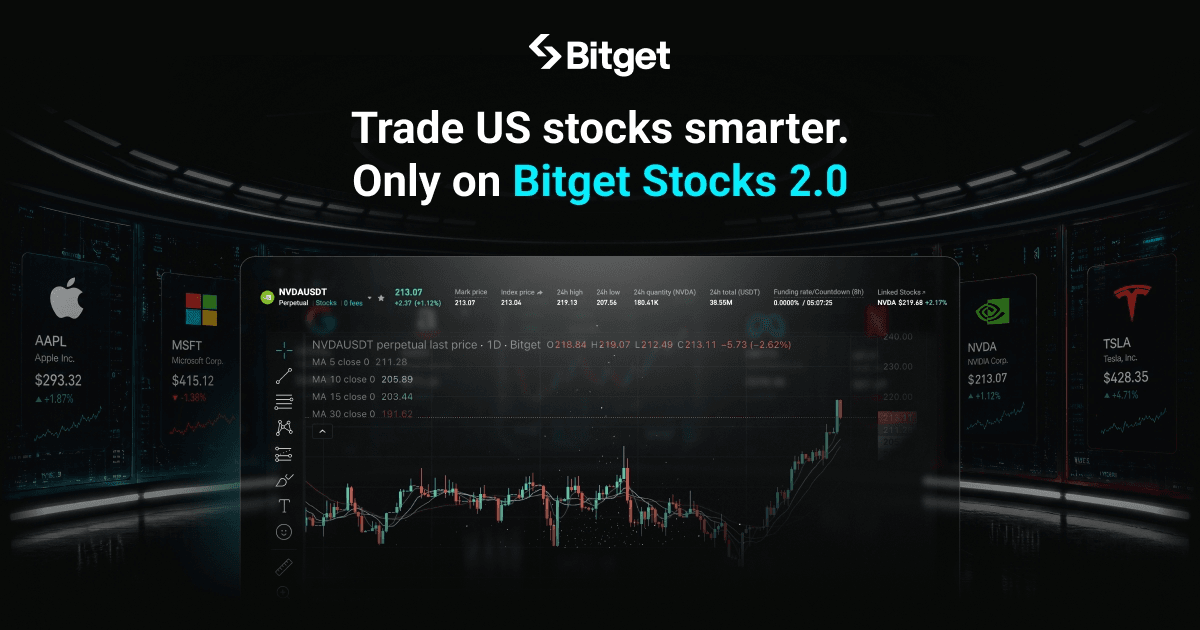
Bitget Stocks 2.0 is Bitget’s Spot Stocks product for tokenized U.S. stock and ETF exposure. It lets eligible users trade supported U.S. stock-linked assets with USDT through Reality-powered rTokens.
rTokens use an r prefix before the underlying ticker. Examples include rAAPL, rNVDA, rTSLA, rMSFT, rMETA, rAMZN, rGOOGL, rSPY, and rQQQ.
The product is built with Reality Protocol as the tokenization and real-world asset infrastructure layer. Reality Protocol supports the issuance of rTokens, the mapping between tokenized assets and underlying U.S. stocks or ETFs, and the framework that helps Bitget Stocks 2.0 reflect eligible dividends, stock dividends, stock splits, reverse splits, and other supported corporate actions.
For crypto users, this matters because Bitget Stocks 2.0 is not just a simple price-tracking market. It connects U.S. stock exposure with crypto-native trading, USDT settlement, asset-backed economic exposure, and broader Bitget ecosystem utility.
Reality-Powered rTokens
Bitget Stocks 2.0 uses Reality-powered rTokens. These assets are designed to connect U.S. equities and ETFs with tokenized trading infrastructure.
Reality Protocol acts as the real-world asset layer behind the rToken model. It helps manage token issuance, asset mapping, and the connection between the tokenized product and the underlying U.S. equity market. This structure allows eligible rTokens to reflect stock-market events such as dividends and corporate actions in a crypto-native account environment.
The structure includes several key participants:
-
Reality Protocol: Provides the RWA tokenization infrastructure for rTokens, supporting token issuance, asset mapping, and the framework for reflecting eligible dividends and corporate actions.
-
Alpaca: Acts as the licensed broker that custodies the underlying stock assets backing the RWA tokens.
-
The Network Firm: Provides independent proof-of-assets verification for the underlying stock holdings in Reality’s custody.
-
Bitget: Provides the exchange account system, trading interface, liquidity access, USDT settlement, and broader product integrations.
This structure is important for dividend processing because dividend rights and corporate actions begin with the underlying stock or ETF. Reality Protocol helps connect those real-world events to rToken balances, while Bitget credits eligible users according to product terms.
Why Reality Protocol Matters for Dividend-Seeking Users
Reality Protocol is central to how Bitget Stocks 2.0 turns U.S. stock events into tokenized account updates. When a supported underlying stock pays a cash dividend, issues a stock dividend, or completes a split, the tokenized product needs infrastructure that can track the event, map it to eligible rToken holders, and support the resulting account adjustments.
For eligible Bitget Stocks 2.0 users, this means:
-
Cash Dividends: Eligible cash dividends can be converted into USDT and credited to the user’s Bitget account.
-
Stock Dividends: Eligible stock dividends can be delivered as additional rTokens.
-
Stock Splits and Reverse Splits: Supported splits and reverse splits can be reflected on-chain so token balances stay aligned with the underlying stock event.
-
Corporate-Action Mapping: Reality Protocol helps support the connection between traditional market events and tokenized stock balances.
-
Asset-Backed Exposure: rTokens are designed to provide 1:1 asset-backed economic exposure to the corresponding U.S. stock or ETF.
What Types of Dividends Can Tokenized U.S. Stock Holders Receive?
Tokenized U.S. stock holders may encounter two main dividend types: cash dividends and stock dividends. ETF-linked rTokens may also involve distributions when the underlying ETF pays income.
1. Cash Dividends
Cash dividends are payments made in money by a company or ETF. In traditional markets, shareholders may receive these dividends in USD through a broker.
On Bitget Stocks 2.0, eligible cash dividends are automatically converted into USDT and credited to the user’s Bitget account. The dividend time and amount are clearly marked for transparency.
For example, suppose an eligible user holds an rToken linked to a dividend-paying U.S. stock before the required snapshot. If the underlying stock pays a cash dividend and the user qualifies under product terms, the dividend value may be credited in USDT after processing.
The final amount may differ from the headline dividend because withholding taxes, deductions, currency conversion, or administrative rules may apply.
2. Stock Dividends
Stock dividends are distributions paid in additional shares rather than cash. A company may issue extra shares to existing holders based on a fixed ratio.
On Bitget Stocks 2.0, eligible stock dividends are delivered as additional rTokens. The user’s balance is updated automatically, and cost basis or total asset values may be adjusted for transparency.
For example, if a company issues a 5% stock dividend and the corresponding rToken supports this event, an eligible holder may receive additional rTokens according to the applicable ratio. The user does not need to manually claim the extra tokens if automated distribution applies.
3. ETF Distributions
ETF-linked rTokens may also involve distributions if the underlying ETF pays dividends or income from its holdings.
ETF distributions depend on the fund’s holdings, dividend schedule, distribution policy, eligibility rules, and product support. For example, broad-market ETFs, sector ETFs, dividend ETFs, and income-focused ETFs may have different distribution patterns.
ETF-linked assets may include rSPY, rQQQ, sector ETFs, semiconductor ETFs, thematic ETFs, or dividend-focused ETFs where supported.
How Dividend Eligibility Works on Bitget Stocks 2.0
Dividend eligibility depends on timing. Users should not assume that buying an rToken at any moment automatically qualifies them for the next dividend.
1. Record Date
The record date is the date used to determine which holders are eligible for a dividend. In traditional markets, companies use the record date to identify shareholders entitled to receive the distribution.
For tokenized stocks, the product infrastructure may apply a record date or snapshot rule to determine which rToken holders qualify.
Users should check the official Bitget asset page, dividend notice, and announcement details before buying a dividend-focused rToken.
2. Ex-Dividend Date
The ex-dividend date is the date when a stock begins trading without the right to the upcoming dividend. In traditional equity markets, buying after the ex-dividend date usually means the buyer will not receive the next dividend.
Tokenized products may reflect this concept through product-specific timing and snapshot rules. The exact treatment can vary, so users should rely on Bitget’s official notices instead of assuming traditional broker rules apply in the same way.
3. Snapshot Time
A snapshot records eligible rToken balances at a specific time. This is used to determine which users qualify for a dividend or corporate action.
Users should check:
-
Record date
-
Snapshot time
-
Settlement date
-
Minimum holding conditions, if any
-
Asset eligibility
-
Regional availability
-
Product announcements
Buying after the snapshot may mean the user does not qualify for the upcoming dividend.
4. Settlement Date
Dividend crediting may not happen immediately on the announcement date, ex-dividend date, or record date. Processing can take time because the workflow may involve underlying distribution, reconciliation, verification, tax or withholding calculation, USDT conversion, and account crediting.
This delay is normal. Users should monitor account records and official Bitget announcements for final credit timing.
How Cash Dividends Are Paid in USDT
Cash dividends on Bitget Stocks 2.0 are designed to be credited in USDT after eligibility and processing are complete.
Step 1: The Underlying Company Pays a Dividend
A U.S. company or ETF pays a cash dividend to eligible holders of the underlying security. This happens in the traditional financial market first.
Step 2: Eligibility Is Calculated
Reality and Bitget determine which rToken holders qualify based on the relevant record date, snapshot time, and product rules.
Step 3: The Dividend Is Converted Into USDT
The eligible cash dividend amount is converted into USDT for crediting on Bitget.
Step 4: The User Receives the Net USDT Amount
Eligible users receive the net dividend amount in their Bitget account. The payment time and amount are marked so users can track the dividend record.
Step 5: Users Can Use the USDT
Once credited, users can hold USDT, reinvest into rTokens, buy crypto, use eligible Bitget products, or withdraw according to account and network rules.
This gives crypto users a familiar dividend format. Instead of receiving fiat in a broker account, eligible users receive USDT inside a crypto-native account.
How Stock Dividends Are Paid as Extra rTokens
Stock dividends work differently from cash dividends. Instead of receiving USDT, eligible users may receive extra rTokens.
Step 1: The Company Issues Additional Shares
The underlying company distributes additional shares to eligible holders.
Step 2: The rToken Balance Is Adjusted
Eligible rToken holders receive additional rTokens according to the applicable stock dividend ratio.
Step 3: Cost Basis and Asset Value Are Updated
Bitget Stocks 2.0 updates token balances, cost basis, and total asset values for account transparency.
Step 4: Users Continue Holding the Adjusted Position
After the adjustment, users continue holding the updated rToken position. They do not need to manually calculate the new balance or submit a claim if the product supports automatic processing.
How Corporate Actions Affect Tokenized Stock Dividends
Dividends are one type of corporate action, but tokenized stock holders may also encounter stock splits, reverse splits, mergers, acquisitions, spin-offs, suspensions, or delistings.
1. Stock Splits and Reverse Splits
A stock split increases the number of shares while reducing the price per share proportionally. A reverse split reduces the number of shares while increasing the price per share proportionally.
Bitget Stocks 2.0 reflects supported stock splits and reverse splits on-chain in real time, keeping the holding ratio aligned with the underlying U.S. stock market.
For example, in a 2-for-1 split, one rToken worth about 100 USDT may become two rTokens worth about 50 USDT each, excluding market movement. The total economic exposure is designed to remain broadly aligned.
2. Mergers and Acquisitions
Mergers and acquisitions can be more complex. If an underlying company is acquired, the outcome may involve cash, shares, a mix of both, or other settlement terms.
Tokenized products may require special handling depending on the corporate-action structure. Users should follow official Bitget announcements.
3. Spin-Offs
Spin-offs can be difficult because the original company may distribute shares of a new company. Whether this is supported by a tokenized product depends on product rules, issuer processes, and exchange handling.
4. Delistings or Trading Suspensions
If the underlying stock is suspended or delisted, the related rToken may also face trading, settlement, or corporate-action adjustments. Users should monitor official notices during unusual market events.
Which Tokenized U.S. Stocks May Pay Dividends?
Dividend availability depends on the underlying company or ETF, not just the crypto exchange. Bitget can process eligible dividends for supported rTokens, but the underlying asset must actually pay a dividend.
1. Dividend-Paying U.S. Stocks
Dividend-paying companies are often found in mature sectors with consistent cash flows. Potential dividend-paying categories may include major banks, energy producers, pharmaceutical companies, telecom firms, consumer staples companies, industrial leaders, utilities, and dividend-focused ETFs where available.
These companies may use dividends to return cash to shareholders, but dividend policies can change. A company can raise, reduce, suspend, or cancel its dividend depending on earnings, balance-sheet conditions, market stress, or strategic priorities.
2. Growth Stocks May Not Pay Dividends
Many growth companies choose not to pay regular dividends because they reinvest cash into expansion, research, acquisitions, infrastructure, or product development.
High-growth names such as Tesla, Amazon, and some AI-linked companies may not pay regular dividends, while mature technology companies or ETFs may have different distribution policies.
Crypto users should not assume that a popular stock automatically provides dividend income.
3. ETF-Linked rTokens and Distributions
ETF-linked rTokens may provide distribution exposure if the underlying ETF pays income.
ETF-linked assets may include rSPY, rQQQ, sector ETFs, semiconductor ETFs, thematic ETFs, broad-market ETFs, or dividend-focused ETFs where supported.
ETF distributions can depend on the dividends paid by the fund’s underlying holdings, fund expense policies, distribution schedules, and product eligibility.
How to Set Up Bitget Stocks 2.0 to Receive Dividends
Dividend setup is simple, but timing and product selection matter. Users must buy and hold eligible rTokens before the required snapshot to qualify for a dividend.
Step 1: Create and Verify a Bitget Account
Register for a Bitget account and complete the required identity verification. Product access depends on region, KYC status, and local rules.
Enable basic account protections, including two-factor authentication, anti-phishing code, withdrawal protection, and a strong password.
Step 2: Deposit or Buy USDT
Bitget Stocks 2.0 uses USDT for trading. Users can deposit USDT from a wallet, buy USDT through supported payment channels, or convert another crypto asset into USDT.
Always check the blockchain network before transferring USDT. Sending assets through the wrong network may result in permanent loss.
Step 3: Go to Bitget Stocks 2.0
Navigate to the Stocks 2.0 or Spot Stocks area. Make sure you are not selecting stock perpetual futures, because stock perps are derivatives and do not provide dividend exposure.
Step 4: Search for an Eligible rToken
Search for supported rTokens by ticker or company name. Examples include rAAPL, rNVDA, rTSLA, rMSFT, rMETA, rAMZN, rGOOGL, rSPY, rQQQ, or other supported rTokens.
Step 5: Check Dividend and Product Details
Before buying, review the underlying stock or ETF, dividend eligibility, record date, snapshot rules, corporate-action terms, trading schedule, fees, liquidity, minimum order size, and regional support.
Dividend-focused users should pay extra attention to record dates and eligibility notices.
Step 6: Buy the rToken Before the Required Snapshot
To qualify for an upcoming dividend, users must usually hold the eligible rToken before the relevant record date or snapshot time.
Buying after the snapshot may give price exposure to the stock but not eligibility for the upcoming dividend.
Step 7: Hold Through the Relevant Eligibility Period
Product terms determine the required holding period. Users should avoid selling before the eligibility requirement is satisfied.
Step 8: Wait for Dividend Processing
Dividend processing may take time. The underlying distribution must occur, eligibility must be calculated, and cash dividends may need to be converted into USDT before crediting.
Step 9: Check the Account Credit
After processing, users should check their USDT balance, rToken balance, transaction history, dividend records, asset statements, and official announcements.
Bitget Stocks 2.0 Fees Explained
Bitget Stocks 2.0 uses a maker and taker fee model, similar to many crypto trading products.
Trading Fees
The current promotional Bitget Stocks 2.0 trading fee is:
| Order Type |
Fee |
| Maker |
0.05% |
| Taker |
0.05% |
The promotional period runs through August 31, 2026, subject to eligibility and campaign terms.
A maker order adds liquidity to the order book. A taker order removes liquidity by executing against an existing order.
Dividend-Related Costs
Dividend payments may involve additional deductions or effects, including withholding taxes, administrative adjustments, currency conversion effects, local tax obligations, and product-specific processing rules.
For example, a company may announce a gross dividend amount, but the final amount credited to eligible rToken holders may be lower after tax withholding or other deductions.
Other Trading Costs
Users should also consider bid-ask spreads, slippage, USDT purchase spreads, blockchain network fees, withdrawal fees, and wider spreads during lower-liquidity sessions.
For dividend-focused users, buying an rToken only for a dividend without considering price movement can be risky. A stock can drop by more than the dividend amount.
Tokenized Stock Dividends vs. Traditional Stock Dividends
| Feature |
Bitget Stocks 2.0 rTokens |
Traditional Stocks |
| Product type |
Tokenized economic exposure |
Direct or beneficial share ownership |
| Dividend format |
USDT or additional rTokens |
Cash or shares |
| Cash dividend credit |
Converted to USDT |
Usually fiat currency |
| Stock dividend credit |
Extra rTokens |
Additional shares |
| Record date |
Product-specific snapshot rules |
Company and broker rules |
| Voting rights |
Generally not included |
May be available |
| Corporate actions |
Automatically reflected where supported |
Broker processed |
| Account type |
Bitget crypto account |
Brokerage account |
| Tax handling |
User responsibility |
User responsibility, broker may provide documents |
| Crypto integration |
Built into Bitget ecosystem |
Usually limited |
Bitget Stocks 2.0 is designed for crypto-native dividend exposure. Traditional stocks are better suited for users who need full shareholder rights, voting rights, proxy access, or conventional brokerage documentation.
Benefits of Receiving Dividends Through Bitget Stocks 2.0
-
USDT Dividend Credits: Eligible cash dividends are converted into USDT and credited to the user’s account.
-
Extra rTokens for Stock Dividends: Eligible stock dividends can be delivered as additional rTokens.
-
Automated Corporate Actions: Supported stock splits and reverse splits are reflected automatically, helping keep token holdings aligned with the underlying market.
-
Crypto-Native Access: Users can access dividend-linked U.S. stock exposure without opening a separate fiat brokerage account.
-
Fractional Exposure: Users can hold smaller positions in dividend-paying stocks or ETFs.
-
Transparent Records: Dividend time and amount are marked in account records for easier tracking.
-
One Multi-Asset Account: Dividends can sit alongside crypto, stablecoins, rTokens, and other Bitget assets.
-
Broader Capital Utility: Eligible rTokens may connect with margin, bots, copy trading, lending, and Earn products.
-
Stablecoin-Based Portfolio Management: Users can receive cash dividend value in USDT and decide whether to hold, reinvest, trade, or withdraw.
Risks and Important Notes Before Relying on Tokenized Stock Dividends
-
Dividends Are Not Guaranteed: Companies and ETFs can reduce, suspend, or cancel dividends at any time.
-
Eligibility Rules Matter: Users must meet record date, snapshot, and product-specific requirements.
-
Tokenized Stocks Are Not Registered Shares: rTokens provide economic exposure, not direct shareholder ownership.
-
Voting Rights Are Generally Not Included: rToken holders typically cannot vote in shareholder meetings.
-
Tax Withholding May Apply: Dividend payments may be reduced before crediting.
-
Local Tax Rules Differ: Users are responsible for their own reporting and compliance.
-
Processing May Take Time: Dividends are not always credited immediately after a company announces or pays them.
-
Liquidity Can Vary: Spreads may widen outside active market hours or during low-volume sessions.
-
Stablecoin Risk Applies: Cash dividends credited in USDT carry stablecoin-related risks.
-
Corporate Actions Can Be Complex: Mergers, spin-offs, delistings, or suspensions may require product-specific handling.
-
Price Risk Still Matters: A dividend does not protect users from losses if the rToken price falls.
Conclusion
Eligible users can receive dividends from tokenized U.S. stocks on Bitget through Bitget Stocks 2.0 by holding qualifying rTokens before the required record date or snapshot. Cash dividends are converted into USDT and credited to the user’s account, while eligible stock dividends can be delivered as additional rTokens.
For dividend-seeking crypto users, Bitget Stocks 2.0 turns U.S. equity income into something easier to access, easier to track, and easier to manage inside a stablecoin-powered portfolio. With 1:1 asset-backed economic exposure, USDT-based trading, automated corporate-action processing, fractional access, and broader integrations across margin, bots, copy trading, lending, and Earn, rTokens bring dividend-linked stock exposure closer to the way crypto users already manage capital.
Disclaimer: The opinions expressed in this article are for informational purposes only. This article does not constitute an endorsement of any of the products and services discussed or investment, financial, or trading advice. Qualified professionals should be consulted prior to making financial decisions.
Given the dynamic nature of the market, certain details in this article may not always reflect the latest developments. For any inquiries or feedback, please reach out to us at geo@bitget.com.


- Key Takeaways
- What Are Dividends From Tokenized U.S. Stocks?
- How Can I Receive Dividends From Tokenized U.S. Stocks on a Crypto Exchange?
- What Is Bitget Stocks 2.0?
- What Types of Dividends Can Tokenized U.S. Stock Holders Receive?
- How Dividend Eligibility Works on Bitget Stocks 2.0
- How Cash Dividends Are Paid in USDT
- How Stock Dividends Are Paid as Extra rTokens
- How Corporate Actions Affect Tokenized Stock Dividends
- Which Tokenized U.S. Stocks May Pay Dividends?
- How to Set Up Bitget Stocks 2.0 to Receive Dividends
- Bitget Stocks 2.0 Fees Explained
- Tokenized Stock Dividends vs. Traditional Stock Dividends
- Benefits of Receiving Dividends Through Bitget Stocks 2.0
- Risks and Important Notes Before Relying on Tokenized Stock Dividends
- Conclusion