SpaceX Stock Price Forecast: Is the $112 Sell-Off a Buy Before August Earnings?
SpaceX builds rockets designed to reach orbit, the Moon and eventually Mars. Its stock, however, has recently been moving in the opposite direction.
SpaceX shares closed at $112.55 on July 29, falling 3.32% during the session as nearly 54 million shares changed hands. The stock is now approximately 16.6% below its $135 IPO price and about 50% below its post-IPO high of $225.64. It is also trading only slightly above its current 52-week low of $107.01.
That sharp reversal has created an intriguing question for investors. Has Wall Street pushed SpaceX too far, creating a rare opportunity to buy one of the world’s most closely watched growth companies at a discount? Or is the falling price warning that SpaceX remains too expensive ahead of its first earnings report as a public company?
The answer may become clearer on Tuesday, August 4, when SpaceX reports its second-quarter 2026 financial and operational results after the market closes. The company’s earnings webcast will begin at 4:30 p.m. Eastern Time, giving investors their first detailed look at SpaceX’s performance since its June market debut.
Key Takeaways
-
SpaceX stock closed at $112.55 on July 29, 2026, after declining 3.32% in the session.
-
SPCX is approximately 16.6% below its $135 IPO price and roughly 50% below its $225.64 high.
-
SpaceX will release its Q2 2026 results after the market closes on August 4, followed by a webcast at 4:30 p.m. ET.
-
Investors will focus on Starlink growth, launch revenue, Starship spending, profit margins, cash flow and management’s outlook.
-
The lower stock price may attract long-term buyers, but SpaceX’s enormous valuation, heavy investment requirements and potential share-unlock pressure still create substantial risk.
SpaceX’s technology may be built for the long haul, but the stock now faces a much nearer-term countdown: earnings day.
SpaceX Stock Has Fallen Back to Earth
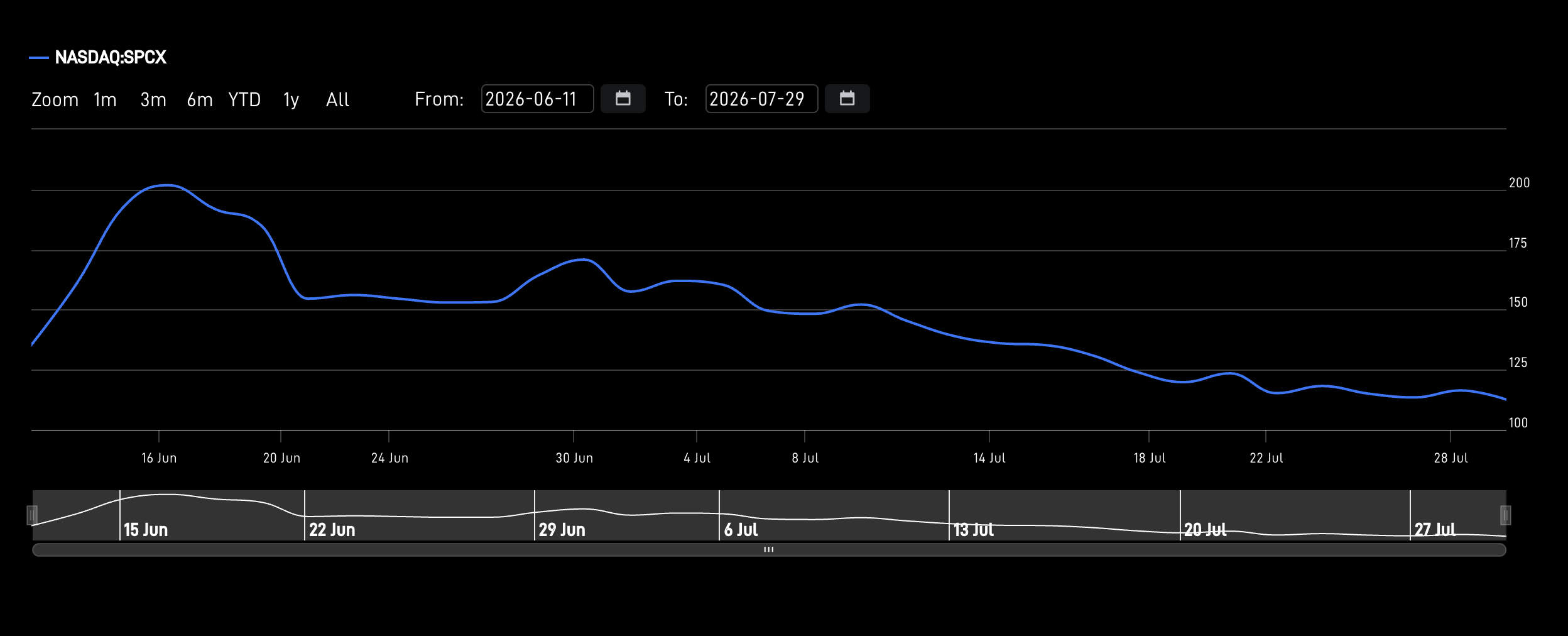
SpaceX (SPCX) Price
Source: SpaceX
SpaceX priced its initial public offering at $135 per share on June 11, 2026, selling more than 555 million Class A shares. Trading began on Nasdaq under the ticker SPCX on June 12, while the offering’s underwriters received an option to purchase up to approximately 83.3 million additional shares.
Investor enthusiasm initially pushed SpaceX stock above $200, with shares eventually reaching a post-IPO high of $225.64. That momentum did not last.
By the close of trading on July 29, SPCX had fallen to $112.55, leaving the stock about 50% below its peak and 16.6% below the $135 IPO price. It was also trading only around 5% above its current 52-week low of $107.01.
The latest trading data shows just how volatile the stock has become. On July 29, SpaceX shares traded between $110.35 and $117.59, while nearly 54 million shares changed hands. The stock ended the session down 3.32%.
Several price levels now matter.
The $107 to $110 range is the nearest support zone because it includes the stock’s recent low. If shares fall below that area, the next major psychological level would be $100.
On the upside, the $135 IPO price is likely to act as an important resistance level. Investors who bought during the offering and are currently sitting on losses may decide to sell if the stock recovers toward their original purchase price.
For bullish investors, the decline makes SpaceX significantly more attractive than it appeared above $200. The company’s long-term business opportunities have not disappeared simply because the stock price has fallen.
For bearish investors, however, the sharp reversal is evidence that SpaceX’s early valuation was driven by excessive excitement. The market may still be trying to determine what the company is worth based on earnings, cash flow and realistic growth expectations rather than its reputation.
The debate is no longer about whether SpaceX is an extraordinary company. It is about whether an extraordinary company automatically deserves an extraordinary stock valuation.
Why Is SpaceX Stock Falling?
SpaceX’s decline is not being driven by one disastrous headline. Instead, several concerns have converged at the same time, pushing investors to reconsider how much they are willing to pay for the company’s future growth.
1. The post-IPO valuation is being reset
SpaceX entered the public market with enormous expectations. The company priced its IPO at $135 per share, but intense demand quickly pushed the stock above $200 and eventually to a high of $225.64.
At those levels, investors were pricing in years of rapid growth from Starlink, higher launch activity and the eventual commercial success of Starship. That left almost no room for delays, disappointing financial results or weaker guidance.
The decline toward $112 suggests the market is now applying a more cautious valuation. SpaceX may still be a high-growth company, but investors increasingly want its financial results to justify the premium attached to the shares.
2. Investors are nervous before the first earnings report
SpaceX is approaching its first major earnings announcement as a publicly traded company. Until the company releases its second-quarter results on August 4, investors have limited information about how its operations are performing under public-market scrutiny.
The market will be looking for answers to several important questions:
-
How quickly is Starlink revenue growing?
-
Are launch operations becoming more profitable?
-
How much is SpaceX spending on Starship?
-
Is the company generating positive cash flow?
-
Will management provide clear financial guidance?
With so many questions still unanswered, some investors may prefer to reduce their exposure before earnings rather than risk a sharp post-results decline.
3. Potential share-unlock pressure is creating uncertainty
SpaceX employees, executives and early investors hold large amounts of stock. Under the IPO’s lock-up arrangements, some of these shares may gradually become eligible for sale.
The possibility of additional stock entering the market can weigh on the share price, even if insiders have not yet sold significant amounts.
Investors worry that early shareholders may use the public listing to realize profits accumulated over many years. If a large number of shares becomes available at the same time, the extra supply could make it more difficult for SPCX to recover.
4. Strong operational news has not been enough
SpaceX continues to make technical progress. Its latest Starship test included the deployment of 20 Starlink V3 satellites, an engine relight in space and a controlled splashdown of the upper stage.
Normally, those achievements might have lifted the stock. Instead, SPCX remained under pressure.
That reaction is important because it suggests investors are currently more focused on financial performance than engineering milestones. Successful launches support the long-term story, but public-market shareholders also want to see revenue, margins and cash flow.
SpaceX has not suddenly become a weaker company. The market is simply shifting from excitement about what the business could become to closer scrutiny of what it is earning today.
August Earnings Could Decide the Stock’s Next Move
SpaceX will release its second-quarter 2026 financial and operational results after the market closes on Tuesday, August 4. Management will then host a live audio webcast at 4:30 p.m. Eastern Time. Because SpaceX only began trading publicly on June 12, this will be its first quarterly earnings report as a Nasdaq-listed company.
The headline revenue and earnings figures will attract attention, but investors should look beyond a simple beat or miss. Five issues could determine whether SPCX rebounds or extends its post-IPO decline.
What investors should watch
-
Starlink growth: Investors will want updates on subscriber additions, international expansion and demand from aviation, maritime, government and enterprise customers.
-
Profit margins: Rapid revenue growth will be less impressive if operating costs are increasing just as quickly. The market will examine whether Starlink and launch operations are becoming more profitable at scale.
-
Starship spending: Starship is central to SpaceX’s long-term ambitions, but development and testing require substantial investment. Higher-than-expected costs could place additional pressure on near-term earnings and cash flow.
-
Free cash flow and capital expenditure: SpaceX must fund rocket development, satellite production, launch infrastructure and network expansion. Investors need to know whether its established businesses are generating enough cash to support those projects.
-
Management guidance: Forecasts for launch volume, Starlink demand, margins and future spending may influence the stock more than the reported quarterly numbers.
The tone of the earnings call will matter as well. Investors will listen for signs that management is confident about growth without underestimating the costs required to achieve it.
A strong report could help SPCX challenge its $135 IPO price. Weak margins, rising expenses or cautious guidance could send the stock back toward the $107–$110 support area—or potentially below $100.
August 4 will not be just another earnings date. It will be the market’s first real opportunity to examine the financial machinery behind the SpaceX story.
The Bull Case: Why $112 Could Be an Opportunity
The bullish argument begins with a simple observation: SpaceX is still pursuing the same enormous commercial opportunities it was when the stock traded above $200, but investors can now buy shares at roughly half the post-IPO peak price.
Several factors could support a recovery.
-
The sell-off has already reset expectations. At around $112, SpaceX is below its $135 IPO price and close to its recent low. Much of the early excitement has been removed from the valuation, potentially leaving more room for positive earnings surprises.
-
Starlink provides recurring revenue. Unlike individual rocket-launch contracts, Starlink generates subscription income from residential, business, aviation, maritime and government customers. Continued subscriber growth could make SpaceX’s financial results more predictable.
-
Starship continues to make technical progress. During its 13th test flight, Starship deployed 20 next-generation Starlink V3 satellites, completed an engine relight in space and achieved a controlled upper-stage splashdown. The booster experienced problems during its return, but the overall mission still demonstrated meaningful progress.
-
Regulatory changes could increase launch activity. On July 30, the FAA proposed streamlining parts of its commercial launch-licensing process by allowing certain statutory requirements to be waived when they are unnecessary for public safety or national-security protections. A faster approval process could help SpaceX increase launch frequency, although the proposal is not yet a final rule.
-
Major growth investors are buying the decline. ARK Invest purchased 105,108 SpaceX shares on July 29, worth approximately $12.23 million. The purchase does not guarantee a rebound, but it shows that some professional investors view the weakness as a long-term opportunity.
Wall Street’s most optimistic forecasts also remain far above the current price. Morgan Stanley initiated coverage with an Overweight rating and a $300 price target. Analyst Adam Jonas reportedly valued SpaceX’s core space and broadband operations at approximately $136 per share, before assigning additional value to its AI-related ambitions.
Analyst targets are not guarantees, especially for a newly listed and highly volatile stock. Still, the combination of a lower entry price, Starlink’s recurring revenue, Starship’s long-term potential and continued institutional buying explains why some investors see $112 as a launchpad rather than a warning sign.
The Bear Case: Why SpaceX Stock May Still Have Further to Fall
A 50% decline can make a stock look cheap, but price and value are not the same thing. Even at $112.55, SpaceX remains a highly valued company whose current share price assumes years of strong growth from Starlink, launch services and Starship.
That leaves little room for operational delays or disappointing financial results.
The main risks include:
-
Heavy capital spending: SpaceX must continuously fund Starship development, rocket manufacturing, satellite production, launch facilities and Starlink network expansion.
-
Uncertain profitability: Revenue may be rising quickly, but investors still need evidence that growth can translate into sustainable margins and free cash flow.
-
Starship execution risk: Starship could transform the economics of spaceflight, but it remains a developing system. Further delays or technical setbacks could increase costs and push commercial returns further into the future.
-
Post-IPO share supply: A portion of the shares held by employees and early investors may become eligible for trading around the company’s first earnings report. More available shares could create additional selling pressure, particularly if early holders decide to lock in gains.
-
Earnings volatility: SpaceX will release its second-quarter results after the market closes on August 4, 2026. Weak margins, higher-than-expected spending or cautious guidance could trigger another sharp decline.
SpaceX stock price forecast
With the stock closing at $112.55 on July 29, three short-term scenarios appear possible. These ranges are an analytical framework rather than guaranteed price targets.
| Scenario |
Possible price range |
What could drive it |
| Bear case |
$85–$105 |
Weak guidance, disappointing margins, elevated spending or heavy post-lock-up selling |
| Base case |
$105–$135 |
Healthy Starlink growth offset by high capital expenditure and limited near-term profitability |
| Bull case |
$135–$160 |
Strong revenue, improving cash flow and confident guidance from management |
Several technical levels could shape the next move:
-
$107.01: The current 52-week low and immediate support level
-
$100: A major psychological threshold
-
$135: The IPO price and an important recovery target
-
$160: A possible bullish target if earnings materially exceed expectations
A break below $107 could increase the risk of a move toward $100 or lower. In contrast, reclaiming the $135 IPO price would suggest that investors are beginning to rebuild confidence in the company’s public-market story.
The biggest danger for buyers is assuming that SpaceX must recover simply because the stock has already fallen so far. The company’s technology remains compelling, but the market may demand clearer proof that its ambitious projects can produce equally impressive financial returns.
Verdict: Is SpaceX Stock a Buy Before August Earnings?
At $112.55, SpaceX stock is undeniably more attractive than it was above $200. The company still has powerful long-term growth drivers, including Starlink’s recurring revenue, its dominant launch business and Starship’s potential to reshape the economics of spaceflight. However, a lower share price does not automatically mean the stock is cheap.
The August 4 earnings report will provide investors with their first detailed look at SpaceX’s quarterly financial performance as a public company. Starlink growth, operating margins, capital expenditure, free cash flow and management’s guidance could determine whether SPCX begins recovering or falls through its recent support levels.
For aggressive, long-term investors who can tolerate sharp price swings, the current sell-off may offer an opportunity to begin building a small position gradually. Buying in stages could reduce the risk of committing too much capital immediately before a highly unpredictable earnings event.
More cautious investors may prefer to wait. A strong report could push the stock back toward its $135 IPO price, while disappointing margins, rising Starship costs or weak guidance could send shares below the $107.01 recent low and toward the psychologically important $100 level. SpaceX’s latest completed closing price was $112.55 on July 29.
The bull case is built on SpaceX’s unmatched technology, expanding commercial opportunities and long-term growth potential. The bear case is built on valuation, heavy spending and the possibility that much of the company’s future success is already reflected in the share price.
Ultimately, the $112 sell-off may be a speculative entry point—but it is not yet a proven bargain.
Where to Trade SpaceX Stock With USDT
For traders looking to capture the momentum around SpaceX, Bitget provides several ways to gain exposure through stablecoins, whether the goal is long-term participation, active trading, or direct access to U.S. equities.
With rSPCX, SPCXUSDT perpetual futures, and Bitget Stock+, users can choose the product that best matches their strategy—all within one integrated trading ecosystem.
rSPCX: A simple way to follow SpaceX’s long-term growth
rSPCX is designed for users who want straightforward, spot-style exposure to SpaceX without using leverage.
The product aims to mirror the underlying stock on a 1:1 basis, including price movements, liquidity, dividends, and stock-split adjustments. Through the rSPCX/USDT pair, users can access SpaceX-linked exposure directly with USDT.
Key advantages include:
-
24/7 trading availability
-
Fractional access
-
No built-in leverage
-
USDT-based settlement
-
A simple spot-style trading experience
This makes rSPCX particularly attractive for users who believe in SpaceX’s long-term growth story and want to hold exposure through major developments in Starlink, Starship, launch services, and commercial space infrastructure.
SPCXUSDT: Trade SpaceX momentum with up to 100x leverage
For active traders, SPCXUSDT standard perpetual futures offer a more flexible and powerful way to trade SpaceX price movements.
Bitget allows eligible users to take both long and short positions with leverage of up to 100x, creating opportunities to respond quickly to major catalysts such as earnings results, Starship launches, regulatory updates, analyst forecasts, and sharp changes in market sentiment.
Key features include:
-
Up to 100x leverage
-
Long and short trading
-
USDT-margined settlement
-
24/7 market access
-
Fast exposure to SpaceX price movements
-
No need to purchase the underlying stock
For bullish traders, SPCXUSDT provides a way to amplify exposure when expecting a rebound or breakout. For more tactical users, the contract also makes it possible to adjust positions quickly as new information enters the market.
With SpaceX approaching a major earnings event and trading well below its recent high, SPCXUSDT could attract traders looking to position for increased volatility and a potential recovery.
Leverage can magnify both gains and losses, so position sizing and risk management remain essential.
Trade real U.S. stocks with Bitget Stock+
Users who prefer direct access to traditional equity markets can explore Bitget Stock+.
Through Stock+, eligible users can use USDC to trade real U.S.-listed stocks and ETFs, including fractional shares. The service is designed to connect the accessibility of stablecoins with the breadth of the U.S. stock market.
Bitget Stock+ offers:
-
Access to more than 10,000 real U.S.-listed stocks and ETFs
-
Fractional-share investing
-
USDC-based funding
-
Extended trading sessions
-
A streamlined experience inside the Bitget ecosystem
Together, Bitget’s product lineup gives users three distinct ways to participate:
-
rSPCX for spot-style, long-term SpaceX exposure
-
SPCXUSDT for active trading with leverage of up to 100x
-
Bitget Stock+ for direct access to real U.S. equities
By combining stablecoin settlement, around-the-clock trading, leveraged derivatives, and traditional stock access, Bitget positions itself as a versatile gateway for users who want to trade the SpaceX story in the format that best suits their strategy.
Product availability, leverage limits, and eligibility may vary by region and account status. Users should review the relevant terms and risk disclosures before trading.
The next SpaceX move could come fast. Register on Bitget and stay ahead of the market.
Disclaimer: The opinions expressed in this article are for informational purposes only. This article does not constitute an endorsement of any of the products and services discussed or investment, financial, or trading advice. Qualified professionals should be consulted prior to making financial decisions.


- Key Takeaways
- SpaceX Stock Has Fallen Back to Earth
- Why Is SpaceX Stock Falling?
- August Earnings Could Decide the Stock’s Next Move
- The Bull Case: Why $112 Could Be an Opportunity
- The Bear Case: Why SpaceX Stock May Still Have Further to Fall
- Verdict: Is SpaceX Stock a Buy Before August Earnings?
- Where to Trade SpaceX Stock With USDT