
Corporate Crypto-Treasury Firms Under Pressure as BlackRock Pushes New Staked Ether Fund

Quick Breakdown
- Corporate crypto-treasury firms face deep valuation pressures as their Ether holdings fall below cost basis.
- BitMine Immersion Technologies holds $10.7B in ETH but sits on a $3.7B unrealized loss.
- BlackRock’s move into staked Ether ETFs could intensify competition and threaten the economics of existing DATs.
Corporate treasuries struggle amid falling Ether valuations
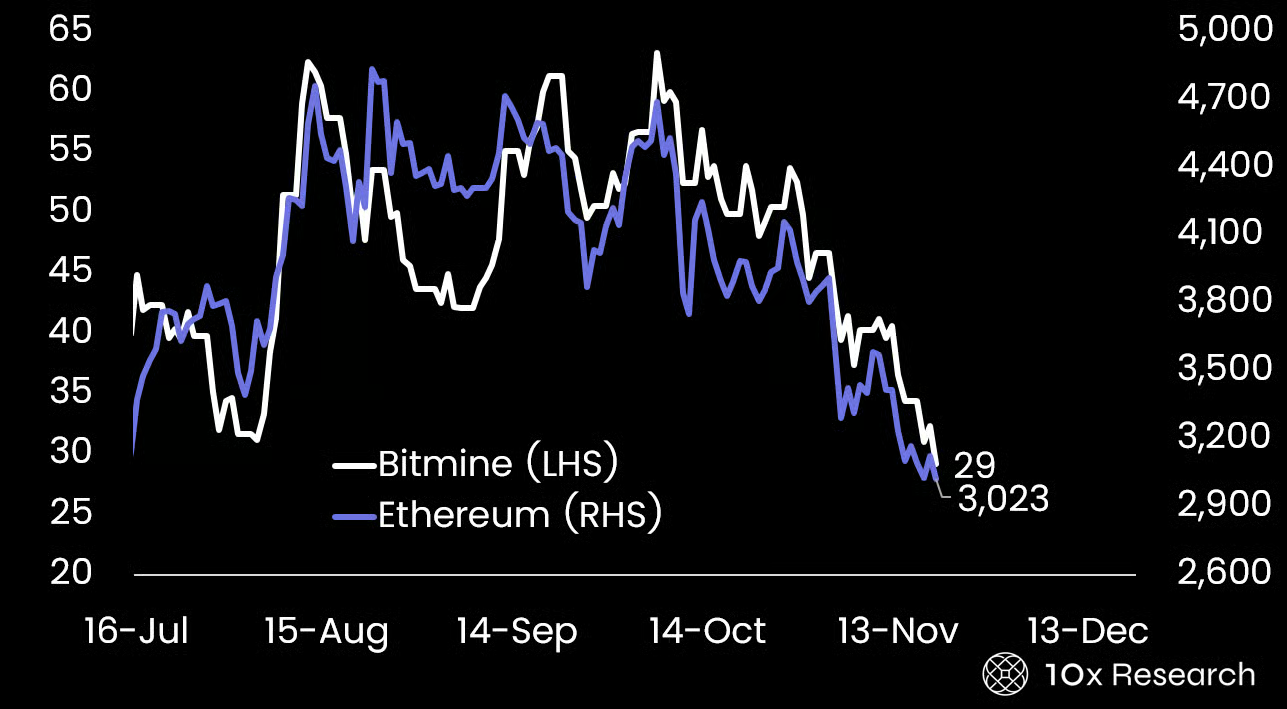
Concerns are growing over the long-term sustainability of corporate crypto-treasury firms as the value of their Ether holdings continues to slide. A new report from 10x Research highlights steep unrealized losses across the sector, with many investors now stuck in positions they can’t exit without major losses.
 Source:
10X Research
Source:
10X Research
BitMine Immersion Technologies, the largest corporate Ether holder, is bearing the biggest hit. The company is currently down around $1,000 per ETH, resulting in a cumulative unrealized loss of roughly $3.7 billion. BitMine holds about 3.56 million ETH, valued at approximately $10.7 billion, representing 2.94% of the total Ethereum supply. Its average cost basis stands at $4,051 per ETH.
10x Research founder Markus Thielen warned that the decline in net asset value is leaving shareholders in what he described as a “Hotel California scenario,” where investors are effectively trapped unless they accept steep losses. He argued that, unlike ETFs, digital-asset treasury firms (DATs) often layer on opaque, hedge-fund-like fees that quietly dilute returns.
mNAV declines signal capital raising challenges
The report also points to rapidly falling mNAV (market NAV) ratios, a key metric that compares a company’s enterprise value to the value of its crypto holdings. An mNAV above 1 enables companies to issue new shares to buy more digital assets , while values below 1 signal that securing fresh capital becomes harder.
BitMine’s basic mNAV is now 0.77, with a diluted mNAV of 0.92, indicating restricted room for expansion according to data from Bitminetracker. Other major DATs, including Strategy, Metaplanet, Sharplink Gaming, Upexi, and DeFi Development Corp, have seen similar declines.
BlackRock enters the arena with lower-cost staked Ether ETF
The challenges facing DATs are set to intensify as BlackRock steps deeper into the Ether market. The world’s largest asset manager has registered a new staked Ether ETF in Delaware, signalling a push toward Ethereum-based yield products.
BlackRock joins other asset managers, such as REX-Osprey and Grayscale, both of which launched staked ETH ETFs earlier this year.
Take control of your crypto portfolio with MARKETS PRO, DeFi Planet’s suite of analytics tools.”
Disclaimer: The content of this article solely reflects the author's opinion and does not represent the platform in any capacity. This article is not intended to serve as a reference for making investment decisions.
You may also like
The US market narrative undergoes a "dramatic reversal": shifting from "AI-driven deflation and controllable US debt" to "AI squeezing the bond market, and Bassen unable to control long-term interest rates"
Deutsche Bank points out that the market narrative regarding the U.S. economy has shifted from "AI drives down inflation" to "AI-related bond issuance pushes up U.S. Treasury yields," but pessimism may be overdone. The bank believes that the real risks underestimated by the market are security incidents in the AI ecosystem, failed IPOs, or underwhelming revenues, which could undermine the dollar and support the bond market. In addition, France's fiscal difficulties are putting new pressure on the euro.

Deutsche Bank: The "fifth wave of tech stock rally" in US stocks since late July has peaked, prepare for a "V-shaped reversal"
Deutsche Bank has downgraded its rating on US technology stocks from overweight to neutral, noting that the fifth round of tech stock rally since July 29 is approaching the upper boundary of the long-term trend channel. The current upside potential is only about 4 percentage points, while historical trends indicate downside risks could reach 16 percentage points. Funds are expected to rotate into other sectors, and the European market, with its lower tech exposure, is likely to benefit relatively. However, Deutsche Bank emphasized that the long-term outperformance trend of technology stocks remains unchanged.
How expensive is AI computing power rental in the US? "Spot price" is twice that of long-term contracts, and four times the return threshold for cloud service providers.
The short-term spot leasing price for AI computing power reaches as high as $40 to $50 billion per gigawatt per year, while the price for long-term contracts is only $20 billion per year, and the breakeven threshold for supercomputing cloud operators is around $12 billion per year. However, according to Goldman Sachs, the fundamental reason why hyperscale cloud providers like Google rent computing power at such significant premiums is that their in-house capacity cannot keep up; once their own capacity catches up, the spot premium will disappear.

Crypto prices
More


