
Stablecoins Gain Ground in Africa as Inflation and Remittance Costs Rise

Stablecoin adoption is rising across Africa as individuals and businesses search for faster cross-border payments and protection from rising prices. Speaking at the World Economic Forum in Davos, economist Vera Songwe said stablecoins are filling gaps left by costly remittance systems and weak local currencies. Growing usage is also drawing closer attention from regulators across the continent.

In brief
- Rising inflation and weak local currencies are pushing African households to adopt dollar-pegged stablecoins.
- High remittance fees and slow settlement times make stablecoins attractive for cross-border payments.
- Small and medium-sized businesses are driving everyday stablecoin use for trade and remittances across Africa.
- A Chainalysis report shows Sub-Saharan Africa among the fastest-growing crypto regions globally this year.
Stablecoins Fill Remittance Gaps as Inflation Erodes African Savings
Addressing a panel in Davos on Thursday, Songwe said remittances now play a larger role in African economies than foreign aid. Yet sending money across borders remains expensive. Many traditional transfer services charge around $6 per $100 sent, and settlement can take several days.
But stablecoins, on the other hand, allow funds to move within minutes at a far lower cost. And this helps families and small firms manage cash flow more efficiently.
Songwe said inflationary pressures since the COVID-19 pandemic have further driven adoption. Prices have risen by more than 20 % in roughly 12 to 15 African countries, eroding household savings and business capital.
Holding stablecoins gives users a way to store value without exposure to rapid depreciation of local currencies. For many, mobile access alone is enough to join the digital economy.
Capital Controls Push Africa’s SMEs Toward Stablecoins
During the discussion, Songwe stressed how access and usage break down across the continent :
- About 650 million Africans remain outside the formal banking system.
- Smartphones often provide the first point of entry to digital finance.
- Stablecoins allow savings in currencies less affected by local inflation.
- Small and medium-sized enterprises drive a large share of transactions.
- Remittances and trade payments dominate everyday use cases.
According to Songwe, activity is strongest in Egypt, Nigeria, Ethiopia, and South Africa. Each faces a mix of high inflation, currency pressure, or strict capital controls. Use by small businesses suggests stablecoins are serving daily commercial needs rather than short-term speculation.
Songwe chairs the Liquidity and Sustainability Facility and is a senior fellow at the Brookings Institution. She previously served as a UN under-secretary-general and led the UN Economic Commission for Africa.
Sub-Saharan Africa Ranks Among Fastest-Growing Crypto Regions, Chainalysis Says
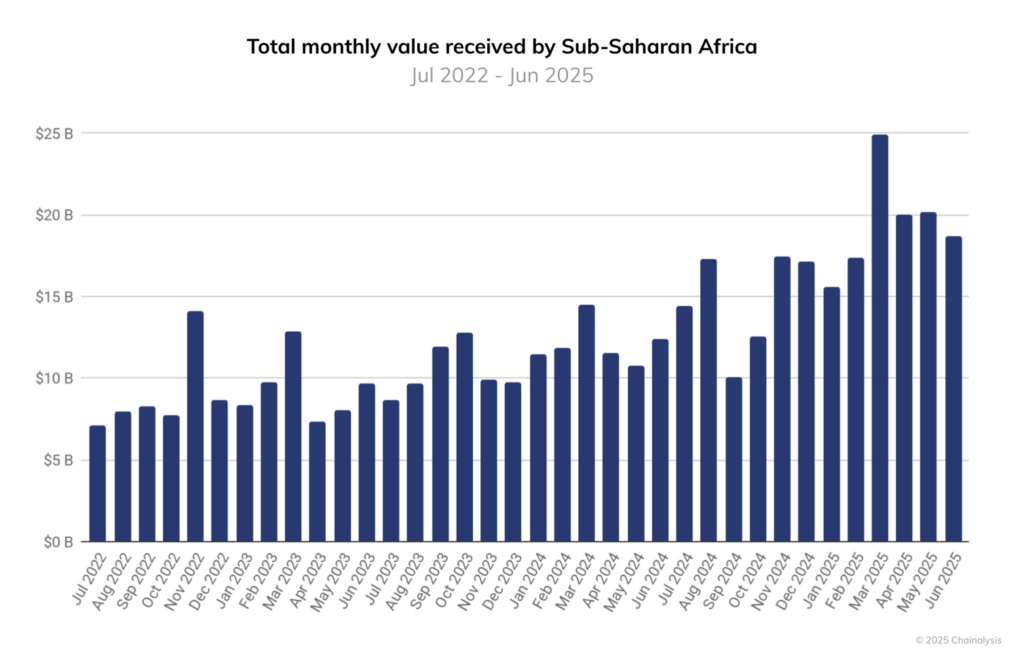
September report from Chainalysis found Sub-Saharan Africa to be among the fastest-growing crypto regions globally. On-chain value received in the region exceeded $205 billion between July 2024 and June 2025, marking a year-over-year increase of about 52% and placing it third worldwide.
Government responses, however, vary widely. In South Africa, the central bank has warned that crypto assets and stablecoins may pose financial stability risks as adoption rises. Nigeria introduced new rules in January requiring crypto platforms to link transactions to tax identification numbers, aiming to bring activity into the tax system.
Meanwhile, Ghana legalized crypto trading in December through new legislation. Bank of Ghana Governor Johnson Asiama said the framework allows innovation while providing authorities with tools to manage risk.
Maximize your Cointribune experience with our "Read to Earn" program! For every article you read, earn points and access exclusive rewards. Sign up now and start earning benefits.
Disclaimer: The content of this article solely reflects the author's opinion and does not represent the platform in any capacity. This article is not intended to serve as a reference for making investment decisions.
You may also like
Micron now earns more than Apple! Apple urgently needs chips, Micron holds pricing power.
Micron Technology reported a net profit of $37.7 billion in the fourth fiscal quarter, surpassing Apple's $29.8 billion for the same period, thus becoming the more profitable company for the quarter. The memory shortage has given Micron strong pricing power, with its CEO stating that they “cannot meet customer demand.” The revenue guidance for next quarter is as high as $61.5 billion. Meanwhile, Apple's gross margin continues to be pressured by persistent memory costs, having dropped from 49.3% to a guidance range of 46.5%.
The "Eye of the Storm" in the Global Economy: Debt Crisis in Developed Countries
The IMF warns that developed economies are becoming the "eye of the storm" for global debt risks. Countries such as the United States and France accumulated high levels of debt during periods of low interest rates, but now rising interest rates are pushing up repayment costs, and fiscal consolidation faces political resistance. BofA Securities points out that the United States is facing declining tax revenues, France has structural income decline issues, and the UK and Japan are also under pressure. The deteriorating debt sustainability of developed countries may impact global financial markets through shocks in interest rates and capital flows.

The US market narrative undergoes a "dramatic reversal": shifting from "AI-driven deflation and controllable US debt" to "AI squeezing the bond market, and Bassen unable to control long-term interest rates"
Deutsche Bank points out that the market narrative regarding the U.S. economy has shifted from "AI drives down inflation" to "AI-related bond issuance pushes up U.S. Treasury yields," but pessimism may be overdone. The bank believes that the real risks underestimated by the market are security incidents in the AI ecosystem, failed IPOs, or underwhelming revenues, which could undermine the dollar and support the bond market. In addition, France's fiscal difficulties are putting new pressure on the euro.
Crypto prices
More


