
Web3 dev hub introduces new onchain campaign platform

Web3 developer hub Ankr launched Forge to address the drop-off that often follows Web3 campaigns by linking participation with infrastructure demand.
Campaigns and quests have become common user acquisition tools in Web3. However, a widespread problem plaguing these platforms is that they generate reach but struggle to sustain participation.
A campaign may produce thousands of transactions and posts on social media, yet much of that activity usually disappears once the allocation period ends. Automated accounts and users operating multiple wallets can further distort the results, leaving projects with limited insight into whether they attracted genuine participants or temporary traffic.
Funding adds another challenge. Many programs distribute newly issued tokens without linking those distributions to the product’s commercial activity. This can cause a brief increase in transactions, followed by sell pressure and declining engagement.
Infrastructure tokens face a similar issue. Holders may support the networks behind applications while having little direct access to the ecosystems that use that infrastructure.
Campaign momentum kept alive
Ankr, a Web3 developer hub, has introduced Ankr Forge to connect its blockchain infrastructure network with ecosystem partners and ANKR holders. Partners can use Forge to set specific participation requirements, while users collect points based on the actions they complete.
Participation begins with wallet eligibility. Users connect an EVM-compatible wallet, hold the required amount of ANKR, and complete the available missions. Forge Points record that activity and determine each participant’s share of periodic Forge Drops or project allocations.
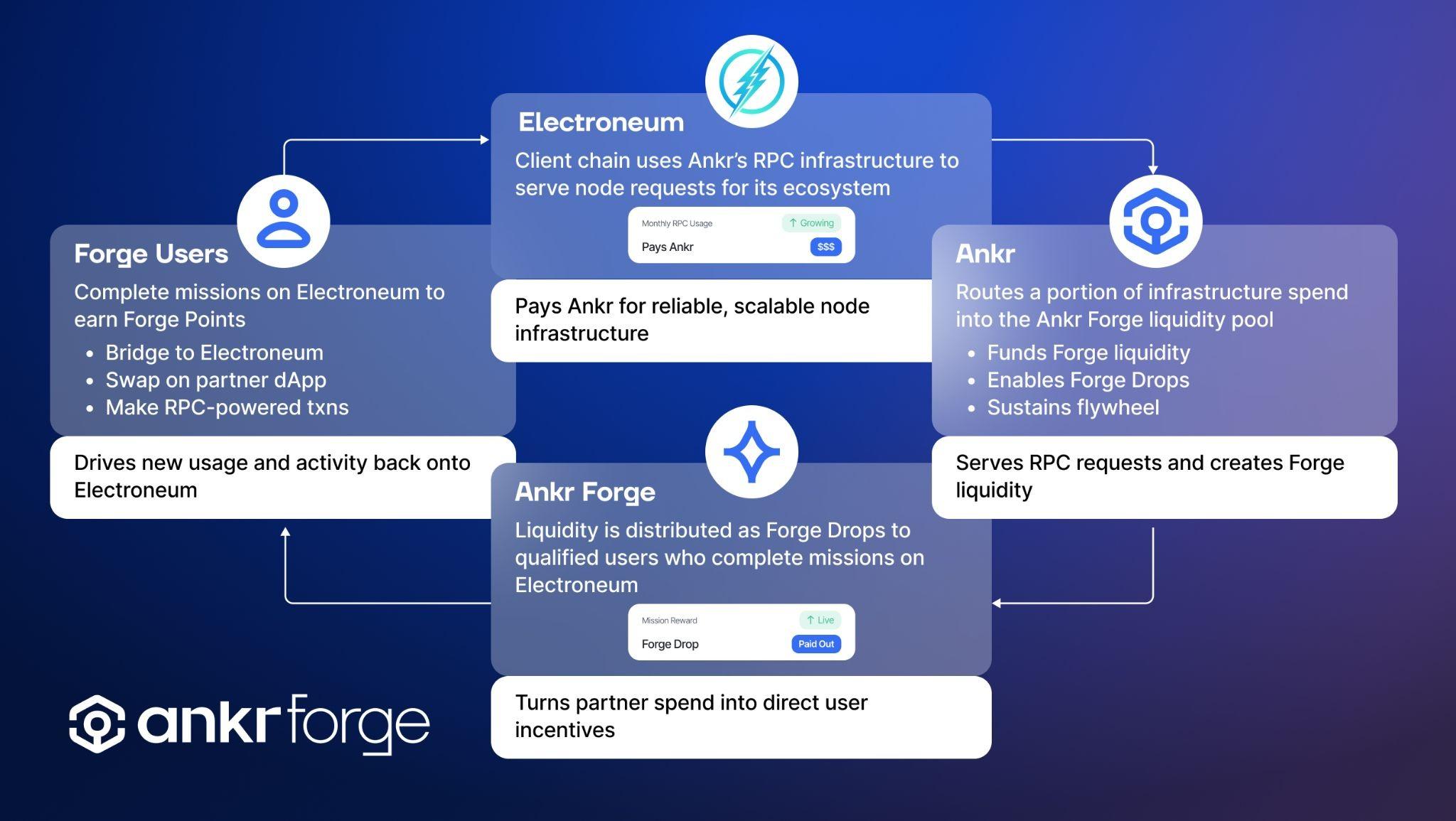
How Ankr Forge works. Source: Ankr
Forge currently features missions from Ankr and Electroneum, including basic social interactions and onchain tasks that involve bridging and swapping. The platform assigns greater weight to actions that require more time or direct product use.
This structure distinguishes one-off participation from continued involvement across the campaign by incentivizing long-term involvement at every turn. A social mission may bring a project to a user’s attention, while onchain missions encourage users to move further into ecosystems with more points granted for increased activity. Projects can use these varying missions to assess how users progress through an initiative without treating every completed action as equally meaningful.
Forge also draws on Ankr’s role as an RPC provider. The company reports processing more than 1 trillion RPC requests each month. Under the proposed structure, a portion of RPC spending connected to ecosystem partners may be used to purchase ANKR and support liquidity. Partners may also provide funding for their own Forge initiatives.
This creates a link between user allocations and the blockchain activity taking place across Ankr’s infrastructure, creating a flywheel effect as shown above. The model also gives projects another source of growth beyond newly issued tokens, while ANKR holders gain a route into ecosystems that rely on Ankr services.
Forge’s position close to the infrastructure layer may also help projects verify whether intended onchain actions were completed. Sybil activity remains a concern, particularly when participation carries the potential for rewards and Forge Drops. Requiring wallet eligibility and verifiable transactions can make disposable activity more costly, while time-based conditions add another barrier for automated accounts.
A vault with multiplier on the way
Forge is now live with Ankr and Electroneum missions. The next phase includes additional partner campaigns and Forge Vault, which is planned to apply point multipliers according to how much ANKR a participant locks and for how long. ValidatorFi is also planned as a way to connect supported validator staking with Forge participation.
Ankr’s broader aim is to develop Forge alongside its infrastructure network, creating a channel through which partner usage, token utility and community activity can reinforce one another. The meaningful benchmark will not be the number of missions completed during launch week. It will be whether campaigns produce repeat onchain users after the points have been counted.
Disclaimer: The content of this article solely reflects the author's opinion and does not represent the platform in any capacity. This article is not intended to serve as a reference for making investment decisions.
You may also like
Solana targets $147 as it breaks key resistance and eyes further gains
Ethereum holds key support, targets $3,000 after $2,550 resistance test
Injective rebounds from August low, eyes $15 target as bullish signals strengthen
Following its Record, Hunter Biden's Anti-Trump Memecoin Fell 99.8%
Crypto prices
More


