
Institution: De-dollarization trend rises again, gold price to reach $5,400 by next summer

Huitong Network August 28 News—— According to the UBS Chief Investment Office on Tuesday (August 25), gold is benefiting from the revived de-dollarization trades, and the worrying state of US fiscal policy may drive gold prices above $5,400 by next summer. Over the past month, the US Dollar Index has fallen by 2.4%, and gold has surged about 15% this month. In July, the central banks of major Asian countries increased their gold reserves by 20 tons, marking the largest monthly increase since October 2023. UBS expects the market to reduce its expectations of Fed rate hikes and recommends allocating assets to gold, broad commodities, and select currencies including the British Pound and Norwegian Krone.
Latest assessment from the UBS Group (UBS) commodities and foreign exchange analysts:
De-dollarization Returns, Dollar Index Falls 2.4% in a Month
The UBS Chief Investment Office wrote in a report on Tuesday (August 25): "Against the backdrop of renewed concerns about the US fiscal outlook, investors' attention to long-term de-dollarization—the structural shift away from the US dollar—has recently intensified. Over the past month, the US Dollar Index (DXY) has declined by 2.4%."
UBS believes that the US dollar may receive some short-term support from Middle East tensions and high oil prices, "but we think the trend of diversification away from the dollar, and the medium- to long-term depreciation trend, will remain intact. Supporting factors include: persistent concerns about the US fiscal trajectory, uncertainty in trade policy, and growing evidence that many countries are diversifying their reserves away from the dollar." Analysts suggest that investors should consider allocating assets to gold, broad commodities, and select global currencies to benefit from diversification.
Gold Up 15% This Month, Driven by Both Central Bank and ETF Demand
UBS emphasized gold’s potential in the current environment, stating that the ongoing upside for gold remains significant. The Chief Investment Office wrote: "Gold is a clear beneficiary of de-dollarization, as investors regard bullion as a reliable store of value and an alternative to traditional reserve currencies. Gold prices have risen by about 15% this month, and we expect prices to continue climbing as the US dollar comes under further pressure."
UBS also expects the market to scale back expectations of Fed rate hikes, which will further support higher gold prices. Analysts noted: "Recent data indicate sustained demand for precious metals, with inflows into gold ETFs resuming and central bank purchases remaining robust. In July, the central banks of major Asian countries added 20 tons to their gold reserves—the largest monthly increase since October 2023.
Beyond Gold: Diversifying into Commodities and Currencies
UBS also recommends looking beyond gold to the broader commodity sector for the benefits of diversification. They wrote: "Gold is not the only asset that preserves value when traditional currencies weaken. Broad exposure to commodities can provide additional sources of long-term returns. If rising inflation expectations challenge equities and bonds, it can also help protect portfolios. Oil demand remains strong, and we expect it to keep growing over the coming years, especially in emerging markets. Industrial metals should also benefit from long-term demand associated with electrification, energy transition, and ongoing global AI infrastructure build-outs."
The Chief Investment Office also suggests diversification among other currencies. Analysts said: "We believe the current environment favors selectively allocating to higher-yielding currencies, including the British Pound and Norwegian Krone. We are also positive on the New Zealand Dollar due to the central bank’s hawkish stance, and on major Asian currencies due to strong export-driven forex inflows. Some emerging market currencies may also offer arbitrage opportunities." They added: "As the structural shift away from the dollar continues, we believe allocations to gold, broad commodities, and select currencies can support returns and help manage portfolio risk."
Medium-Term Scenario: Challenging $5,000 in H1 2027
In mid-August, UBS strategists stated that declining real interest rates would lead investors back into gold this year, while a weakening dollar and strong central bank demand would also provide support. In this client report, the Swiss banking giant noted that gold prices have successfully broken above the $100 trading range of recent months, surpassing the $4,250 per ounce resistance area for the first time in two months. They wrote: "Reported institutional buying from Asian countries and ETF inflows have supported the latest moves, while recent coordinated intervention by the US and Japanese governments to stabilize the Yen could also help reduce the risk of a sell-off in US Treasuries."
Strategists warned: "Short-term risks still exist—especially if US economic data remains strong, oil prices continue fuelling inflation fears, or markets keep pricing in a more hawkish Fed rate path." But they stated: "Although the near-term backdrop may remain volatile, the medium- to long-term gold case continues to be supported by several persistent drivers.
UBS expects that declining real interest rates will help reignite investment demand for precious metals. Analysts stated: "We expect inflation to gradually ease, allowing the Fed to keep rates unchanged this year and return to easing in 2027. This should create a more favorable backdrop for gold, as policy rate expectations turn lower, potentially pressuring real yields, dragging down the dollar, and fostering renewed investment demand for gold."
Dual Tailwinds: Weaker Dollar and Ongoing Central Bank Gold Buying
The weakening US dollar and continued diversified capital flows are also strong medium-term tailwinds for gold. They wrote: "While the dollar may remain resilient in the near term, the massive US fiscal and external deficits, as well as already high investor allocations to dollar assets, imply that there is scope for renewed weakness. Historically, a weaker dollar has been a strong tailwind for gold, and a renewed focus on diversification away from the dollar should benefit precious metals."
Meanwhile, ongoing sovereign gold purchases continue to provide a firm price floor for the market. They stated: "Even when private investment demand is subdued, central bank demand has remained a key pillar of support. We expect annual central bank purchases to remain high, fuelled by the long-term desire to reduce dollar asset exposure." UBS noted that central banks bought 289 tons of gold in the second quarter, and their internal forecast for 2026 is for annual purchases between 750 and 1,000 tons. "Although these flows alone may not be sufficient to drive prices sharply higher, they help stabilize the market and offset drags from weaker segments such as jewelry demand."
Short-Term Volatility vs. Long-Term Logic: Dips as Opportunities
This Swiss bank recommends that investors distinguish the short-term trading risks in gold from its long-term investment logic. Analysts said: "Periods when gold falls towards $4,000 per ounce or below may ultimately prove to be opportunities to establish strategic exposure. For investors who prefer physical assets, we continue to believe that allocating a mid-single-digit proportion of gold in a well-diversified portfolio makes sense."
It is worth noting that on May 26 this year, UBS had cut its gold price forecast for 2026, citing high US Treasury yields and a strong dollar as ongoing headwinds. UBS analysts Dominic Schnider and Wayne Gordon wrote at the time: "The market is rediscovering the concept of opportunity cost, and with real yields staying high, gold's non-yielding nature once again becomes a more significant consideration." Now, as fiscal concerns and de-dollarization trades return, UBS's stance has clearly turned bullish.
Conclusion
From the cautious downgrade in May to the current $5,400 target, the shift in UBS's attitude reflects the market's reassessment of the de-dollarization narrative. Persistent fiscal deficits, structural dollar weakness, and ongoing central bank gold buying form the most solid foundation for gold's medium-term prospects; meanwhile, cooling expectations for Fed rate hikes could be the spark for the next rally.
In an era when fiat currency purchasing power continues to be eroded, a combination of gold, commodities, and select global currencies is increasingly becoming the common choice for capital seeking to hedge uncertainty.
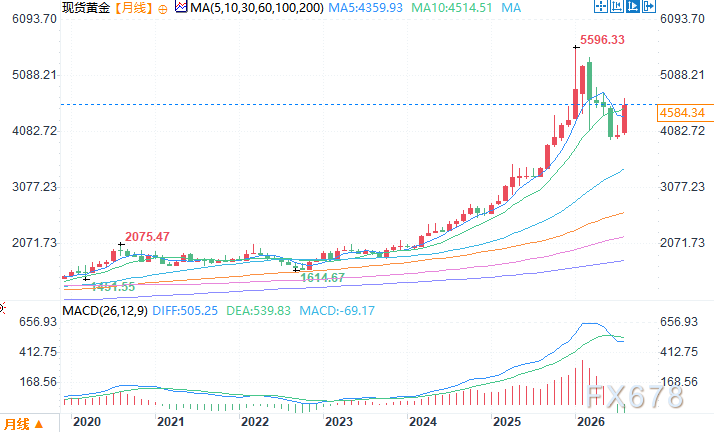
Spot gold monthly chart Source: Yihuitong
Eastern 8th Zone, August 28, 13:50 Spot Gold quoted at $4,574.34 per ounce
Disclaimer: The content of this article solely reflects the author's opinion and does not represent the platform in any capacity. This article is not intended to serve as a reference for making investment decisions.
You may also like
Tonight, can Walsh save US Treasuries? It may determine the fate of the AI bull market.
Bank of America warns that long-term US Treasury yields are currently leading a global bubble, becoming the "Achilles' heel" of the AI bull market. Tonight’s Jackson Hole meeting is a crucial battle over interest rate control. Waller’s speech would offer a "successful playbook" if it achieves a bull flattening of the yield curve—that is, anchoring the short end with credible hawkish signals on inflation while sending dovish hints for long-term bonds to support the Treasury’s bond buyback plan. If this fails, global assets will face a sharp revaluation.
Market Awaits Walsh's Speech for Guidance; Korean Stocks Close Down 1.79%, Marvell Falls Over 7% After Hours, Gold Pulls Back Slightly, US Treasuries Under Pressure
The Korea Composite Stock Price Index closed down 1.79%, Nasdaq 100 futures fell 0.2%, and Marvell dropped over 7% in after-hours trading, dragging down market sentiment. U.S. Treasury yields maintained Thursday’s gains, with the 2-year yield holding steady at 4.23%. The market remains highly cautious about persistent inflation and the outlook for U.S. fiscal policy, keeping a close watch on the direction of long-term interest rates.
Ethereum holds above $2,500 as US ETF inflows hit $697 million
Ethereum price outlook turns bullish as ETF inflows support $2,800 target

Crypto prices
More


