
Lululemon plunges! Comparable sales see first decline since the pandemic, full-year guidance cut again, new CEO faces challenges | Earnings Report Insights

Lululemon's growth dilemma continues to deepen.
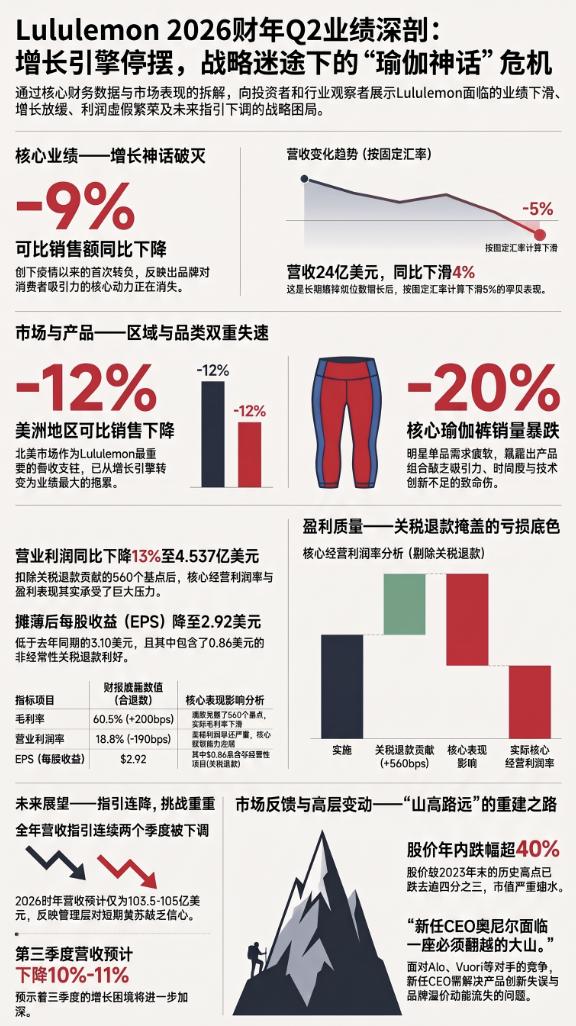
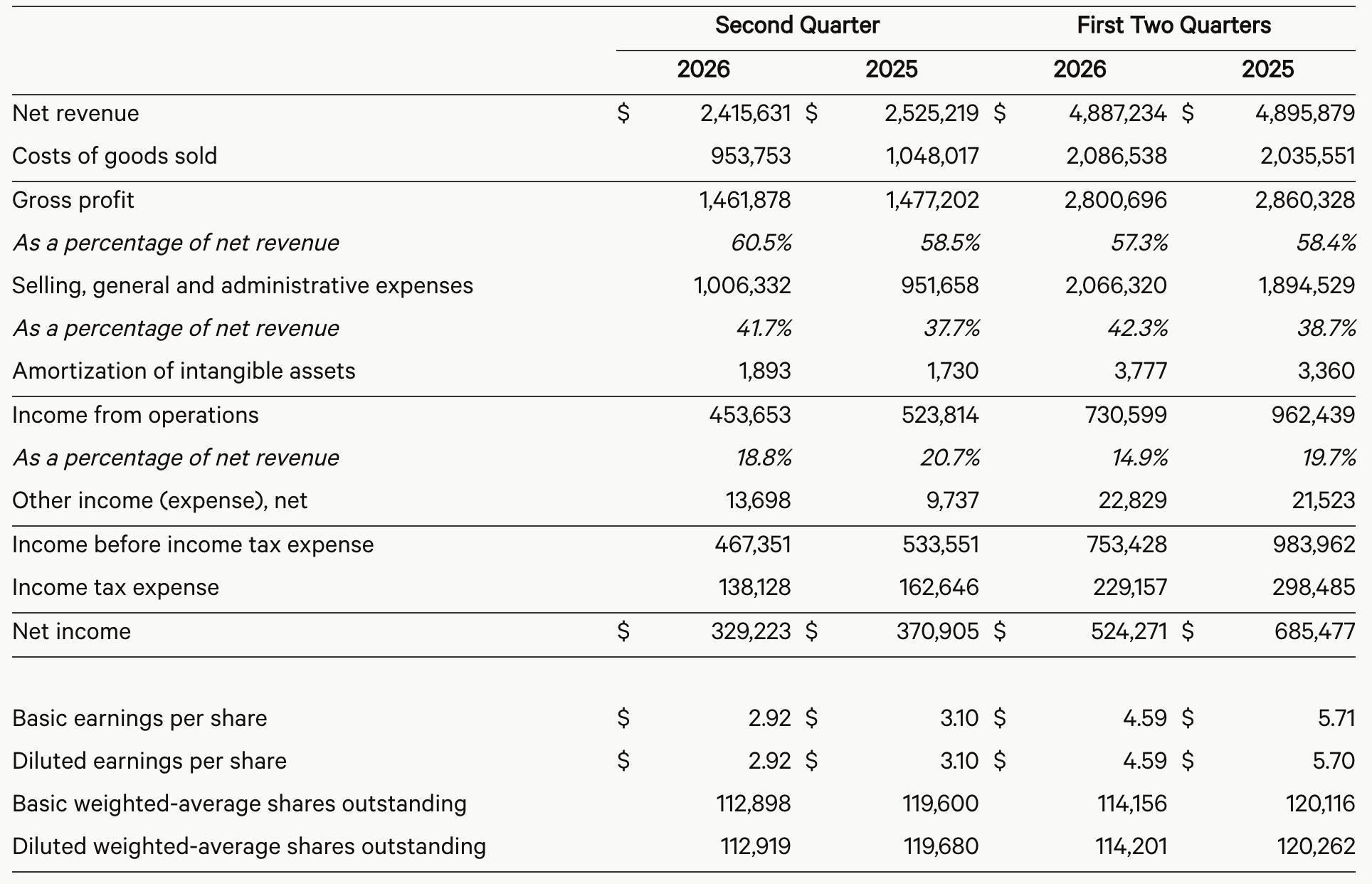
On Thursday local time, sports apparel brand Lululemon Athletica announced its results for the second quarter of fiscal 2026: revenue fell 4% year-over-year to $2.4 billion, down 5% at constant exchange rates; comparable sales dropped 9%, or 10% on a constant currency basis, marking the first decline since the pandemic.
Meanwhile, the company once again lowered its full-year performance guidance. Fiscal 2026 revenue is expected to be $10.35-10.5 billion, below the forecast range provided in June; adjusted full-year earnings per share are expected to be $9.48-9.73. The company had already cut its full-year outlook in June, meaning guidance has now been revised downward for the second consecutive quarter.
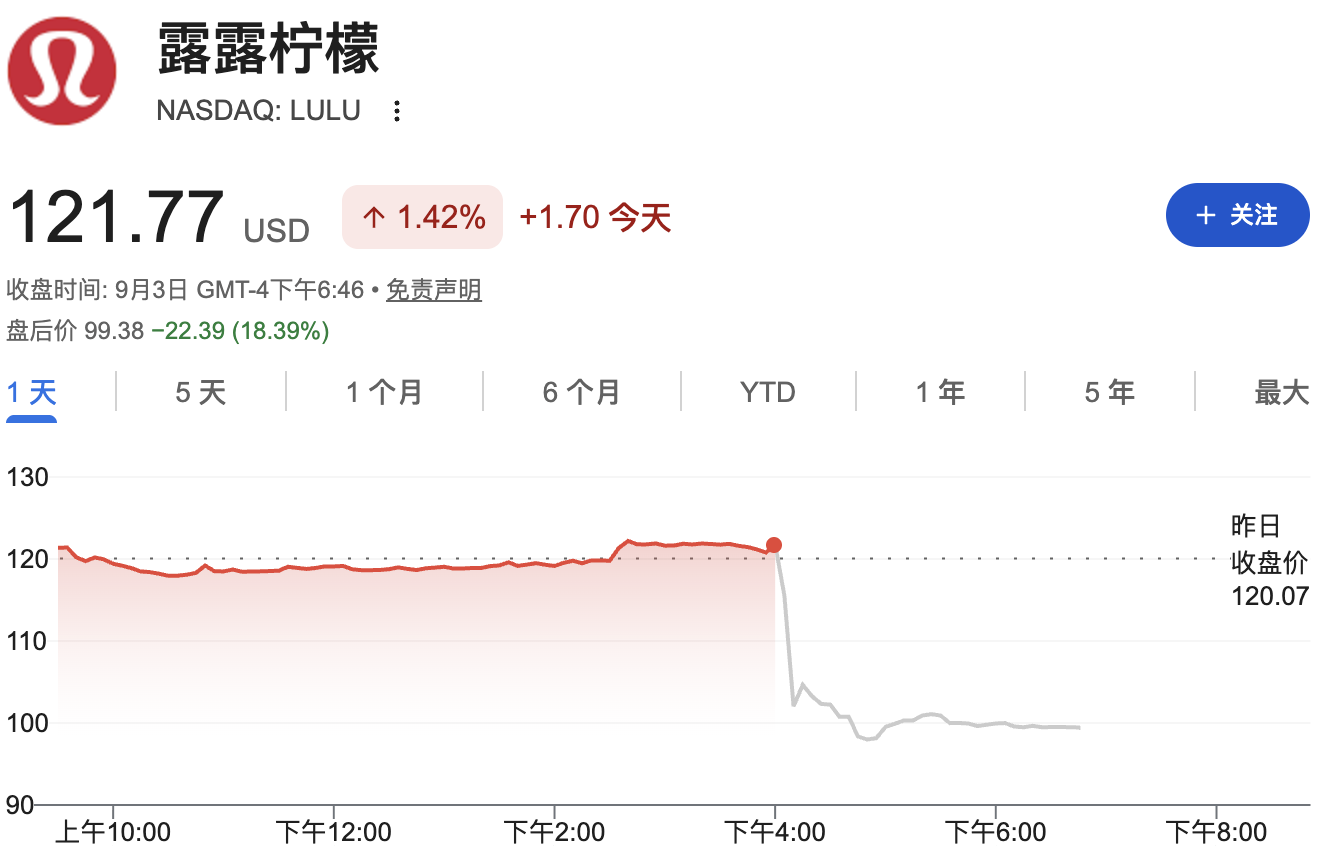
After the earnings announcement, Lululemon's stock fell more than 20% after hours. As of Thursday's close, the company's share price had fallen more than 40% year to date and is down more than three quarters from the all-time high set at the end of 2023.
Lululemon is about to welcome its new CEO, Heidi O’Neill. This means that when O’Neill officially takes over next week, she will be facing not just slowing growth, but multiple issues such as brand competitiveness, product innovation, and management reconstruction.
Comparable Sales Turn Negative for the First Time, North American Market is the Biggest Drag
The key metric to watch for Lululemon in the second quarter is comparable sales.
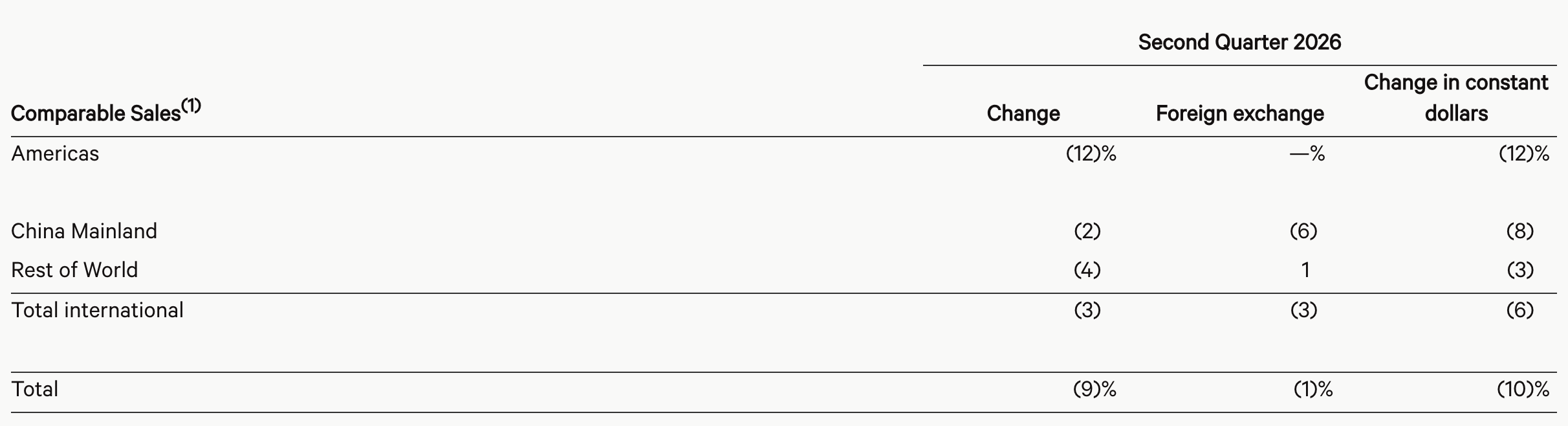
The company's comparable sales in the second quarter dropped 9% year-over-year, significantly worse than market expectations. In the Americas, comparable sales fell 12%, and in international markets, they fell 3%; in constant currency terms, Americas dropped 12%, and international dropped 6%.
Looking at revenue, the Americas saw an 8% year-on-year decline, while international market revenue grew 4%, or 2% at constant currency.
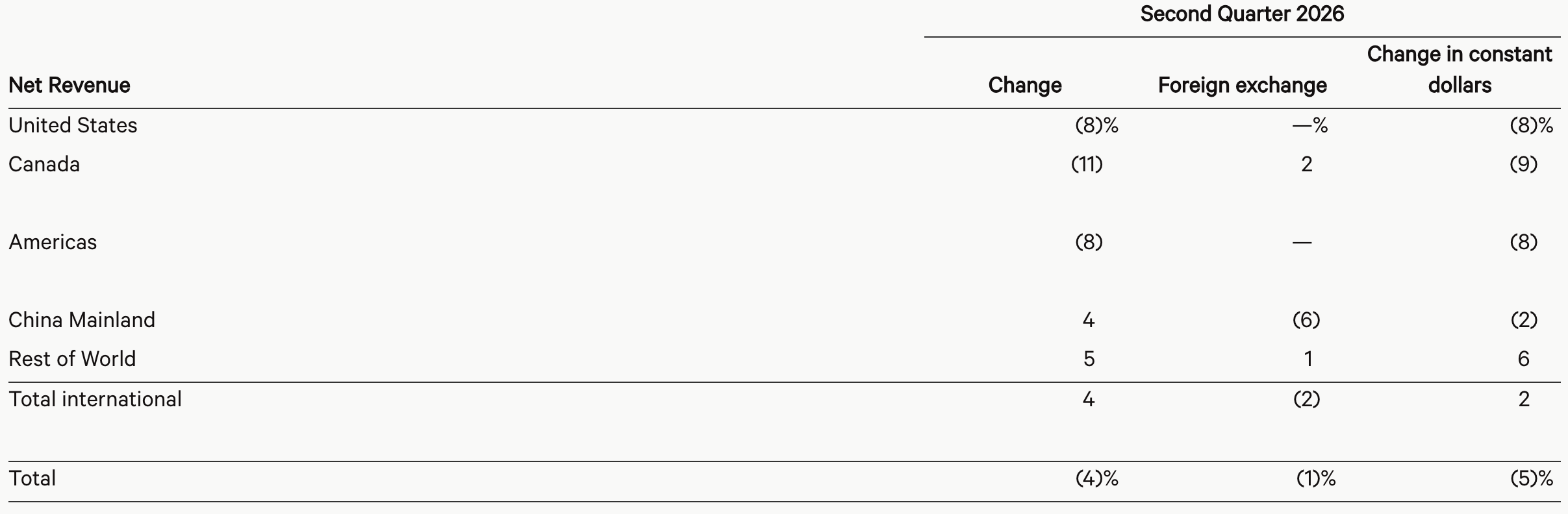
This means Lululemon's current core issue is focused on its most important market: the Americas. The North American market, which has driven the company's rapid growth for years, is now becoming its largest performance drag.
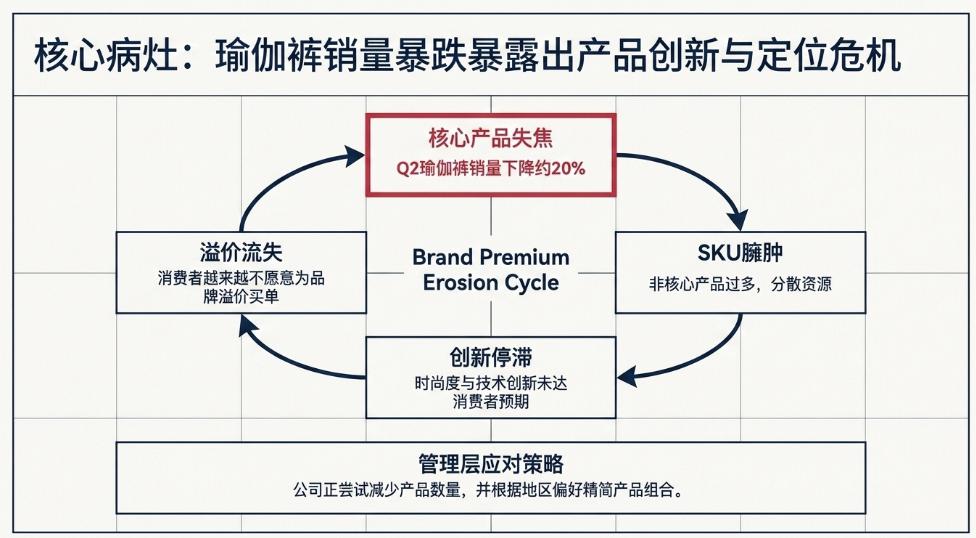
Product performance is equally concerning. Company executives revealed that yoga pants sales in the second quarter fell by about 20%. Facing weakening demand, the company is trying to reduce the number of products, and offer more curated product mixes tailored to regional consumer preferences.
Interim Co-CEO and CFO Meghan Frank said the company is in a “challenging and dynamic environment” and that management is working to drive growth by strengthening products, increasing marketing investments, and strictly controlling costs.
However, the market is not optimistic about whether these adjustments can have a quick effect.
Gross Margin Propped Up by Tariff Refund, Core Profitability Still Under Pressure
On the profit side, Lululemon’s second quarter gross profit dropped 1% year-over-year to $1.5 billion, but the gross margin superficially increased by 200 basis points to 60.5%.
But this improvement does not entirely reflect the company’s business conditions.
During the quarter, the company received an IEEPA tariff refund of $134.5 million and related interest of $4.1 million, which boosted Q2 gross margin by 560 basis points, and increased EPS by $0.86.
Excluding this factor, the company’s profit performance is much weaker.
Operating profit fell 13% year-over-year to $453.7 million, with an operating margin down 190 basis points to 18.8%, among which the tariff refund contributed the same 560 basis points margin increase.
Diluted earnings per share for the second quarter were $2.92, down from $3.10 a year earlier; this includes $0.86 from tariff refunds and related interest.
In other words, even with a one-time tariff refund significantly boosting both margin and EPS, Lululemon’s core operating performance remains under pressure.
On inventory, the company ended the quarter with $1.7 billion in inventory, a 1% year-over-year decrease; in unit terms, inventory decreased 7%, indicating the company has begun to actively control inventory levels.
Full-Year Guidance Cut Again, Third Quarter Outlook More Weak
Lululemon’s outlook for near-term performance has further weakened.
The company predicts third-quarter revenue of $2.29-2.32 billion, down 10%-11% year-over-year; earnings per share expected to be $0.93-0.98.
For the full year, the company expects fiscal 2026 revenue of $10.35-10.5 billion, down 5%-7% year-over-year; full-year EPS is expected to be $9.48-9.73.
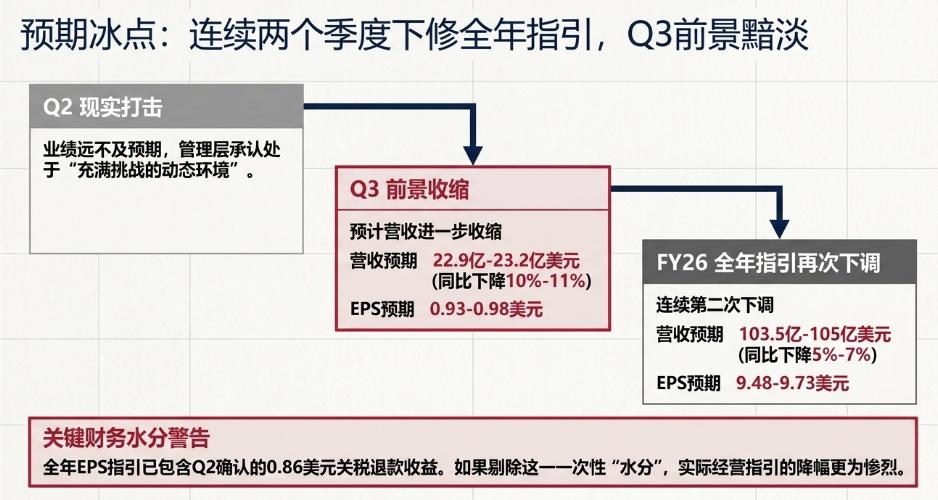
Notably, the full-year EPS guidance already includes the $0.86 per share tariff refund and related interest confirmed in Q2, but does not include any potential future tariff refunds.
This means, excluding the one-time benefit from the tariff refund, the real pressure on Lululemon's core operations is even more apparent.
The company also stated that the current guidance does not factor in the impact of future stock repurchases.
In the second quarter, Lululemon repurchased 2.7 million shares for a total of $330 million. As of the end of the quarter, the company had $1.4 billion in cash and cash equivalents, with an additional $593.7 million in available revolving credit.
New CEO Faces "A Steep Mountain", Product Innovation Is the Biggest Challenge
Lululemon’s problems have begun to extend from financials to brand and management.
Incoming CEO O’Neill is a former Nike executive. She was appointed as Lululemon CEO over four months ago, but will officially take over next week.
Jefferies analyst Randal Konik’s team put it bluntly in a report: “New CEO O’Neill faces a mountain she must climb.” The firm believes that Q2 results show Lululemon’s brand momentum is fading quickly, with an accelerating loss of market share.
One of O’Neill’s first tasks after taking office will be to reverse Lululemon’s competitive disadvantage in the athletic apparel market, recapturing market share from rivals like Alo and Vuori.
At the same time, the company also needs to address product missteps, over-reliance on discounts, and continued management churn.
Bloomberg Intelligence senior analyst Poonam Goyal even stated that Lululemon’s performance was “outright terrible,” with no obvious signs of improvement in the near term.
She noted that even with O’Neill formally taking over next week, the company’s core issue remains product innovation, which is not a problem that can be solved overnight.
Neil Saunders, Managing Director at GlobalData, believes Lululemon’s current product lineup “lacks appeal,” contains too many non-core products, and fails to meet consumer expectations in terms of fashion and design, while lacking technical innovation. In this context, consumers are increasingly unwilling to pay a brand premium.
Lululemon is Undergoing a True Strategic Reset
From the latest earnings release, Lululemon’s problem is no longer simply quarterly performance volatility.
Comparable sales turned negative for the first time, the North American market saw double-digit declines, core product yoga pants suffered a steep drop in sales, full-year guidance was revised down twice in a row, and worries over discounts and product innovation—all point to a deeper issue: Lululemon’s previous model of relying on brand premium and product innovation to drive growth is losing some momentum.
The company still holds $1.4 billion in cash, 825 stores, and strong brand recognition, meaning O’Neill is not starting from scratch. However, as competing brands such as Alo and Vuori continue to expand, consumer demands for product design and innovation are ever higher, and Lululemon must re-prove the value of its brand premium.
Interim Co-CEO Frank stated during the earnings call that the company “knows there is still a lot of work ahead,” and management is applying lessons learned this year to future global operations.
For the incoming O’Neill, the real test is just beginning: how to win back consumers through product innovation, marketing, and channel strategy—without further eroding the brand premium—and stop further market share from shifting to Alo and Vuori.
Judging from this earnings report and the latest guidance, it is clear that Wall Street has yet to see a turning point.
Disclaimer: The content of this article solely reflects the author's opinion and does not represent the platform in any capacity. This article is not intended to serve as a reference for making investment decisions.
You may also like
Energy crisis forces strategic transformation: Toyota (TM.US) plans to introduce hydrogen energy into parts logistics and factory supply chain
As alternative fuels gain popularity following the Iran war, Toyota Motor Corporation is considering using hydrogen to power trucks that transport auto parts.

Decoding Bitcoin’s September trap: Is drop to $52K looming for BTC?

ARB price surges 50% in a week as ArbitrumDAO income hits $6.19 million
Following CrowdStrike and Palo Alto, another cybersecurity winner emerges in the era of AI inference! Zscaler (ZS.US) enters the trillion-dollar race with a sales pipeline surging by 75%.
Zscaler's fourth-quarter results exceeded Wall Street expectations. The company's CEO stated that Zscaler's proxy security tools have shown initial growth momentum. Since the beginning of this year, Zscaler's share price has fallen by 20%, while the share prices of other cybersecurity companies have repeatedly hit new highs during the same period.

Crypto prices
More


