
Gold prices rebound sharply but with limited upside; AI performance drags down US economic growth expectations

Huitong News, October 9th—— OpenAI’s performance fell short of expectations, leading to concerns in the market about the US economic growth rate. Combined with easing tensions in the Middle East, gold prices saw a sharp rebound! However, the rebound remains limited.
On Friday (October 9), during the Asian and European sessions, gold prices rebounded sharply, mainly due to the US stock market decline and Trump’s statement that he will not go to war with Iran this month. Previous articles have continuously highlighted opportunities in gold—whether readers have seized them or not is unknown. Currently, gold is trading around 4186.
The trend is clear: the US 10-year Treasury yield has declined significantly, while gold prices rebounded; however, the 2-year Treasury yield remained virtually unchanged.
In brief: The market has not changed its view on the US economy and Federal Reserve policy over the next one or two years; it has simply downgraded expectations for long-term US economic growth, mostly for reasons unrelated to inflation.
Main Line: Easing AI Expectations Weigh on Long-Term Growth Outlook
The initial trigger came from OpenAI.
The market is worried that the speed of AI commercialization and computing power demand expansion is not as fast as previously imagined.
The market previously expected AI to significantly boost the long-term US economic growth rate, but this expectation is now cooling.
With lower long-term growth expectations, yields on long-dated bonds such as the 10-year Treasury move lower.
Meanwhile, short-term economic conditions have changed little, and the Federal Reserve's near-term plans for raising or cutting rates remain unchanged, so the 2-year Treasury yield, which represents short-term policy expectations, stays steady.
Supporting Factors: Easing Middle East Tensions, Oil and Dollar Moving Together
The easing of oil price pressures supports the outlook for the European economy, while the euro’s strength drags down the dollar index.
The weaker dollar also gives gold prices a breather.
Note: Easing Middle East tensions is only a supporting factor—not the main story behind the current drop in long-dated US Treasuries. Just one month of easing is unlikely to change inflation trends over ten years.
Gold itself does not generate interest; the biggest opportunity cost of holding gold is the US 10-year Treasury Inflation-Protected Securities yield (TIPS).
When long-term real yields fall, the opportunity cost of holding gold decreases. Combined with a weaker dollar, these twin positives have fueled the gold price rebound.
Key Variables for Gold Prices Ahead
AI industry growth expectations: These correspond to market judgments on long-term US economic growth.
If expectations for AI commercialization and capital expenditure on computing power continue to soften, long-term US Treasury yields will likely face further pressure—supporting gold. If AI data beats expectations and long-term growth expectations warm up, long-term Treasury yields will climb and gold will come under pressure.
Oil price expectations: The Middle East has only seen a short-term easing; risks of renewed conflict remain.
If tensions flare up again and oil prices surge, the market will return to trading a stagflation theme, causing a shift in trading logic. If oil prices remain stable, the dollar and gold will continue to track long-term real yields.
Summary and Technical Analysis:
The main storyline is the cooling of AI expectations, lowering growth forecasts and pushing down long-dated Treasury yields;
Easing Middle East tensions reduce oil price surge risks, while a stronger euro and weaker dollar further support gold prices.
For gold’s future movement, the key is whether the AI industry faces further negative news. It is necessary to watch both the growth trend of AI and the US economy, as well as changes in oil prices.
Currently, the US stock market has rebounded sharply. AI’s short-term contribution to the economy and its funding demand are still hard to dismiss, so interest rates may stay high and gold’s upside may be limited.
Technically: Spot gold finds support at the bottom of the range, with the 5-day moving average turning upward, but the head-and-shoulders neckline and the 10- and 20-day moving averages above still form a bearish pattern, capping the gold price. Therefore, the space for gold’s rebound may be limited.
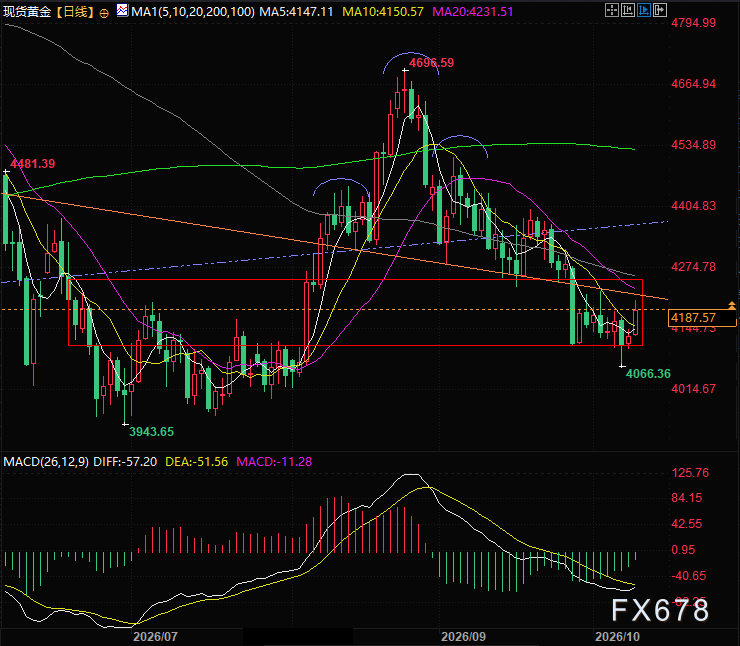
(Spot gold daily chart, source: Yihuixun)
At 17:28 (GMT+8), spot gold was last quoted at $4,187 per ounce.
Disclaimer: The content of this article solely reflects the author's opinion and does not represent the platform in any capacity. This article is not intended to serve as a reference for making investment decisions.
You may also like
3 Undervalued Altcoins With Major Q4 2026 Upside Potential
Litecoin hovers near $64.20, $67 and $80 key levels in recovery structure
The Altcoin Bottom Could Be In: 4 Cryptos Worth Risking as OTHERS Breaks a Multi-Year Trend

Delta Air Lines (DAL.US) financial report reveals how the airline industry’s “energy consumption eats into profits”! Q3 revenue hits a record high, but high oil prices lower profit outlook
Delta Air Lines’ adjusted fuel expenses in the third quarter increased by 62% year-on-year, with the adjusted operating profit margin dropping from 11.1% to 9.4%. Therefore, this performance and outlook report demonstrates the operational resilience of this aviation giant under high oil prices, but has yet to indicate a renewed expansion in profit margins.
Crypto prices
More


