
3 Best Crypto Stocks with 120%+ Upside, According to Analysts

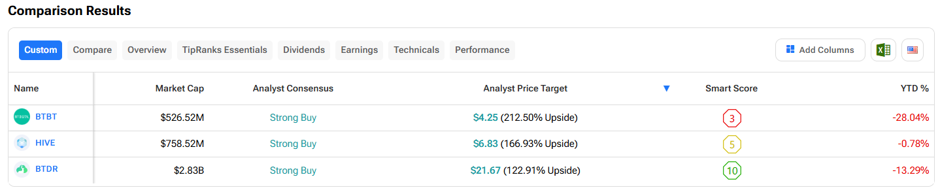
Using TipRanks’ Stock Comparison Tool, we identified three crypto-related stocks with a “Strong Buy” consensus rating and more than 120% upside potential over the next 12 months.
HIVE Digital (HIVE) offers Bitcoin mining exposure, Bit Digital (BTBT) focuses on Ethereum staking, while Bitdeer Technologies (BTDR) is expanding into AI and high-performance computing (HPC) infrastructure. Together, these companies offer different ways to participate in the industry’s growth, although all three stocks can be highly volatile.
Bit Digital – Bit Digital focuses on buying and staking Ethereum (ETH-USD) to earn rewards. It also provides AI computing and data center infrastructure through its subsidiary, WhiteFiber. Staking means using digital coins to help run and secure a blockchain network, earning rewards in return.
Promotion
70% Off TipRanks
- Unlock powerful investing tools with TipRanks Premium to make smarter, more confident investment decisions
- Subscribe to TipRanks Smart Investor Newsletter, and discover new investing opportunities with data-backed stock picks
Over the last three months, all four Wall Street analysts covering BTBT stock have rated it a Strong Buy. Their 12-month average Bit Digital price target indicates an upside of more than 212%.
HIVE Digital – HIVE Digital operates renewable energy-powered data centers primarily focused on Bitcoin mining. The company is also expanding its GPU infrastructure business to support AI and cloud-computing workloads, providing exposure to both the cryptocurrency and AI infrastructure markets.
In the last three months, five Wall Street analysts covering HIVE stock rated it a Buy, with one assigning a Hold rating, resulting in a Strong Buy consensus. Their 12-month average HIVE Digital price target indicates an upside of 166.9%.
Bitdeer Technologies – Bitdeer Technologies is a Bitcoin mining company that also develops mining machines and provides infrastructure services to other cryptocurrency mining businesses. The company recently signed a 10-year agreement for a 67MW AI data center in Malaysia, with full capacity expected by Q2 2027. The addition will take Bitdeer’s secured AI data center capacity to 273.5MW, about 78% of its 350MW target.
Over the last three months, nine Wall Street analysts covering BTDR stock have rated it a Buy and one analyst rated it a Hold, resulting in a Strong Buy consensus. Their 12-month average Bitdeer price target indicates an upside of nearly 123%.
Disclaimer: The content of this article solely reflects the author's opinion and does not represent the platform in any capacity. This article is not intended to serve as a reference for making investment decisions.
You may also like
TSMC's Q3 Revenue Represents a Slightly Larger-Than-Typical Beat, Wedbush Says
10:36 AM EDT, 10/09/2026 (MT Newswires) -- Taiwan Semiconductor Manufacturing's (TSM) Q3 revenue of NT$1.494 trillion ($46.77 billion) represented a roughly 3% beat versus the brokerage's prior estimate and consensus, compared with a 1% beat in the previous quarter, Wedbush said in a Friday note. With revenue ahead of the range, Wedbush expects the quarterly gross margin to at least meet the 66% midpoint of TSMC's 65% to 67% guidance and is more likely to exceed its 66.0% estimate given better utilization rates, according to the research note. Looking ahead, Wedbush expects Q4 sales of NT$1.599 trillion and sales growth of 41% in US dollars or 43% in Taiwanese dollars. Additionally, its gross margin estimate of 65.3% sits below the consensus estimate of 66.1%, with Wedbush saying it would not be surprised if Q4 gross-margin guidance ticks modestly lower on account of headwinds the chipmaker has previously mentioned. Wedbush maintained its outperform rating with an NT$3,000 price target. Price: 453.01, Change: -4.98, Percent Change: -1.09
BUZZ-Delta Air Lines shares fall after sharply lowering full-year earnings guidance
Latest Updates October 9 – ** Delta Air Lines (DAL.N) shares fell 3% to $79.67 ** Delta Air Lines (DAL) (link) lowered its full-year adjusted profit forecast due to soaring jet fuel prices ** Peer companies United Airlines (UAL.O) and Alaska Airlines (ALK.N) shares both fell about 2.8%, while American Airlines (AAL.O) was down 2.4% ** The U.S. airline now expects 2026 adjusted earnings per share to be between $5.10-$5.60, compared to a previous expectation of $6.5-$7.5 per share ** The midpoint of the current range is $5.35 per share, below analysts’ expectation of $5.46 per share — according to data compiled by LSEG ** DAL expects its full-year fuel costs to increase by about $6 billion, up from the previous forecast of a $4 billion increase ** The company’s third-quarter adjusted earnings per share were $1.72, missing the $1.75 estimate, marking its first quarterly profit miss in two years ** Analysts tracking DAL on average give it a "Buy" rating ** As of Thursday's close, Delta Air Lines (DAL) has risen 18.4% year-to-date, the highest gain among major U.S. competitors (For the convenience of non-native English speakers, this Reuters report is automatically translated into several other languages. Due to possible errors or missing context in machine translations, Reuters makes no guarantee as to the accuracy of the translated text, which is provided for reader convenience only. Reuters is not responsible for any damage or loss caused by the use of automated translation features.)
Interpretation - What is the low-frequency spectrum obtained by SpaceX for Starlink Mobile?
Harshita Mary Varghese, Reuters, October 9 - SpaceX SPCX.O has agreed to acquire a portfolio of low-band spectrum licenses covering the entire United States, in a deal reportedly valued at $8 billion. The company is seeking to expand its business beyond satellite internet and become a major competitor in the U.S. mobile market. SpaceX revealed its plans to enter the mobile service sector during its first earnings call in August. This announcement briefly weighed on the company’s stock price, and shares of the three major U.S. wireless carriers—AT&T, T-Mobile, and Verizon—were also affected as investors assessed the potential competitive threat. What is low-band spectrum? Low-band spectrum refers to radio waves that travel further and penetrate buildings better compared to higher frequencies, making them suitable for wide-area mobile network coverage. In contrast, mid-band and high-band spectrums can transmit more data at faster speeds but have a smaller coverage area. SpaceX has agreed to purchase up to 14 MHz of paired 800 MHz low-band spectrum licenses from Grain Management and plans to develop a hybrid architecture for Starlink Mobile, combining terrestrial infrastructure with satellite connectivity. How is the U.S. spectrum licensing system structured? Commercial spectrum is a scarce resource in the U.S., regulated by the Federal Communications Commission (FCC), which typically allocates licenses for specific frequencies and geographic areas via auctions or other authorization processes. License holders must comply with technical rules and deployment requirements, and transfers of licenses usually require regulatory approval before obligations are fulfilled. The spectrum license deal recently struck by SpaceX is pending FCC approval. Which low-band spectrum do the three major carriers hold? AT&T’s low-band spectrum includes the 700 MHz and 850 MHz bands, as well as 600 MHz spectrum licenses acquired this July through the purchase of EchoStar. Verizon holds spectrum in the 700 MHz and 850 MHz bands, while T-Mobile’s low-band holdings include 600 MHz and 700 MHz spectrum. What are the plans for STARLINK MOBILE? The company plans to integrate these spectrum licenses into its next-generation satellite system, while also deploying terrestrial radio equipment and antennas on communication towers and rooftops. The FCC this week approved Starlink Mobile’s application for its second-generation (Gen2) satellite constellation, authorizing SpaceX to launch 15,000 satellites globally optimized for the 2 GHz spectrum.

Crypto prices
More


