
Eli Lilly Soars! GLP-1 Lifts ISRG, DXCM & TMO — U.S. Healthcare Shifts from Safe Haven to Growth Goldmine
 2026/10/22 03:22
I. Sector Overview: Defense + Growth Double Play, New Focus of Capital Rotation
In the second half of 2026, the US healthcare sector (XLV) has significantly outperformed the broader market, with year-to-date gains of nearly 17% and multiple new all-time highs. Against a backdrop of high volatility in tech and AI, healthcare has become a core beneficiary of capital rotation.
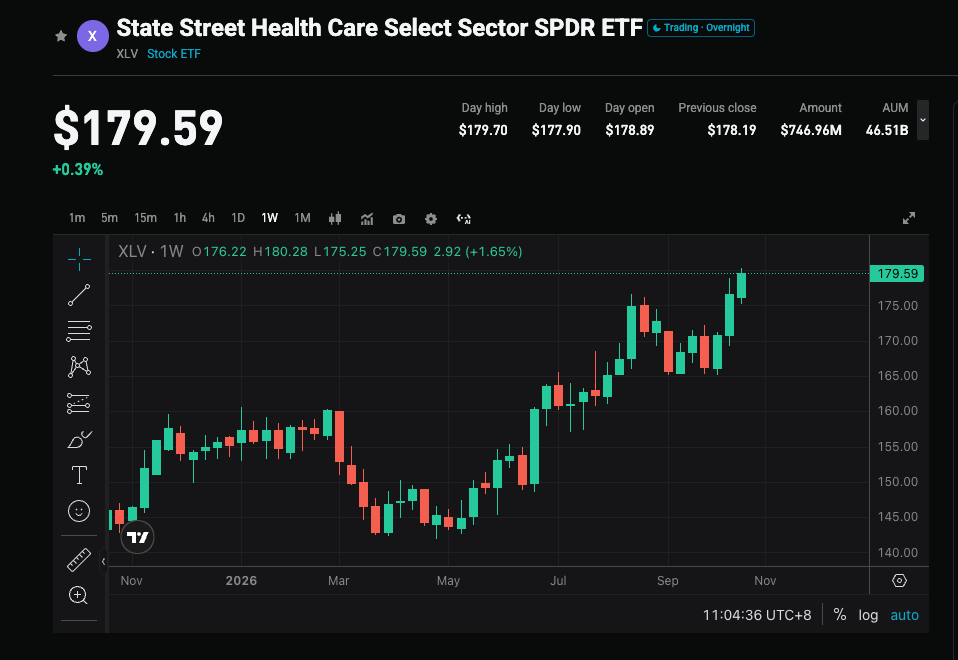
Three key drivers:
- Explosive GLP-1 growth: The metabolic disease market has been revalued to around $150 billion. Eli Lilly has successfully overtaken Novo Nordisk with tirzepatide and established clear leadership.
- Policy risks largely cleared for now: Drug price negotiations and tariff threats have remained broadly manageable, and the market’s previous pessimism has been largely priced in.
- M&A wave filling the patent cliff: To address more than $300 billion in brand-drug patent expirations between 2028–2030, industry M&A activity has picked up again, with full-year deal volume expected to approach that figure.
Potential challenges: Ongoing Medicare drug price negotiations, patent cliff pressure on major drugmakers, high valuation volatility in biotech, and intensifying competition from Chinese innovators in oncology and ADCs.
Core view: The healthcare sector is shifting from a pure “defensive asset” to a “defense + growth” hybrid. The current strength is driven by capital seeking certainty.
II. Core Stocks: Leaders Pull Ahead, Opportunities Emerging in Sub-Sectors
1. Big Pharma: Steady Core Holdings
- Eli Lilly (LLY): Absolute leader, market cap now in the $1.1–1.2 trillion range. Up about 19% year-to-date and nearly 60% over the past year. Strong GLP-1 product line; 2026–2028 sales CAGR expected to exceed 13%.
- AbbVie (ABBV): Dual growth engines Skyrizi and Rinvoq continue to ramp; shares are approaching all-time highs.
- Johnson & Johnson (JNJ): Diversified and stable; revenue target aiming for the $100 billion mark.
- Merck (MRK): Facing the Keytruda patent cliff, but still attractive due to its oncology pipeline and M&A activity.
- UnitedHealth (UNH): Managed-care margins are recovering; clear beneficiary.
2. High-Attention / Higher-Beta Names
- Gilead (GILD) / Amgen (AMGN): Recently more active; potential near-term catalysts.
- Moderna (MRNA): Has seen notable rebounds on specific catalysts.
3. MedTech & Life Science Tools
- Intuitive Surgical (ISRG): Leader in surgical robotics; benefits from rising adoption of minimally invasive surgery.
- Dexcom (DXCM) / Insulet: Direct beneficiaries of chronic disease management and spillover monitoring demand from GLP-1s.
- Thermo Fisher (TMO) / Danaher (DHR): Recovery in R&D and bioprocessing demand is supporting a rebound in life science tools.
4. AI Drug Discovery & Data Platforms
- Recursion / Tempus: Smaller-cap names with high beta on clinical milestones and partnerships, but high volatility risk remains.
III. Investment Strategy: Stock Selection Matters More Than Sector Allocation
Long-term support:
- Aging populations and rising chronic disease burden are structural.
- Innovative drugs (metabolic, oncology, immunology, gene therapy) still have structural growth room.
- AI is improving drug discovery and clinical trial efficiency.
Near-term valuation view: The sector has recovered from extreme pessimism and still trades at a valuation discount to the S&P 500. However, leading names (especially Eli Lilly) are no longer cheap. Pipeline data and sales execution need to be watched closely.
Positioning suggestion – “Core + Satellite” approach:
- Core: Large-cap pharma such as LLY, ABBV, and JNJ for steady growth and defensive characteristics.
- Satellite: Smaller positions in biotech or device names with clear catalysts to capture upside elasticity.
Summary: In 2026, US healthcare is no longer just a pure safe-haven. It has become a structural opportunity driven by clearer policy visibility and the delivery of innovation. Only companies that can navigate the patent cliff and keep innovating are likely to continue outperforming in the coming years.
Wishing everyone smooth trading~
Risks: Policy on drug pricing turns out worse than expected, key clinical data disappointments, patent cliffs materialize faster than anticipated, and geopolitical risks from intensifying US-China biotech competition.
Disclaimer: The content of this article solely reflects the author's opinion and does not represent the platform in any capacity. This article is not intended to serve as a reference for making investment decisions.
You may also like
Gold declines to one-week low, below $4,100 on Fed hike bets as bulls shrug off weak USD
Goldman Sachs Maintains "Buy" Rating on Lam Research (LRCX.US): Q3 Results Meet Expectations, 2027 WFE Outlook Exceeds $200 Billion
Goldman Sachs maintains its "Buy" rating on Lam Research Group, with a target price of $380.
Crypto prices
More


