
SK Hynix Q3 2026 Earnings Highlights: Revenue Tops 100 Trillion Won for the First Time, Operating Profit Surges 632% YoY to Record High, Announces Epic ~100 Trillion Won Shareholder Return Plan
 2026/10/28 06:19
🔥 US Stock Hotspot Radar is Live! Content: 3 major themes + 6 selected stocks + 7 key events. Where are this week’s opportunities? Click the link to see all 22 trading directions in one chart →
Core Views
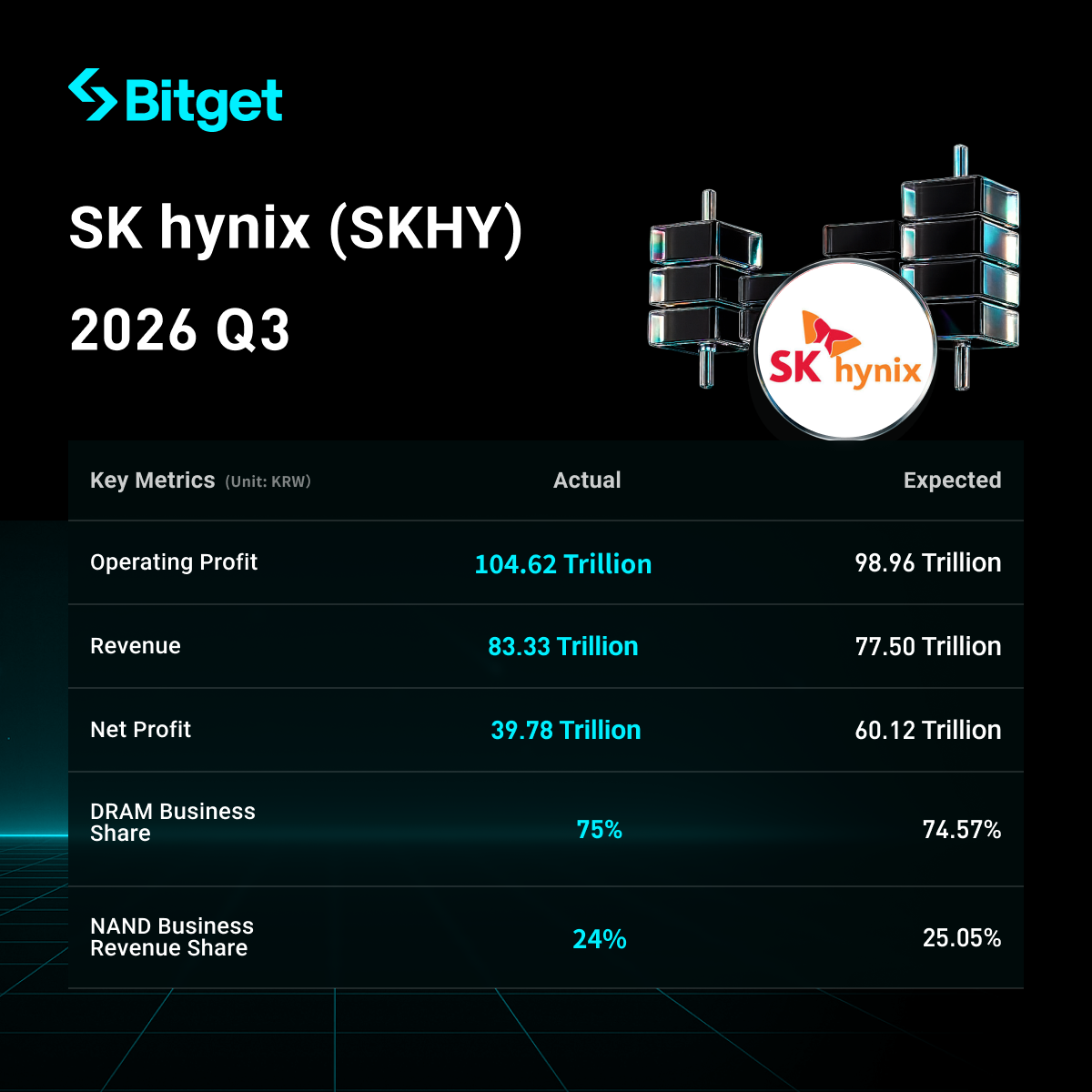
SK hynix delivered a record-breaking third-quarter 2026 (3Q26) performance. Quarterly revenue surpassed 100 trillion Korean won for the first time, while operating profit jumped roughly sevenfold year-over-year to a new all-time high, with an operating margin of approximately 80%. The results were driven by strong AI-related demand for HBM and server memory, along with rising product prices. Net profit, however, came in well below expectations, primarily due to foreign-exchange losses and other non-operating items. The company simultaneously announced a massive shareholder return program totaling about 100 trillion won (~$75 billion) for fiscal 2026. The market responded positively, with the share price rising sharply. Management remains optimistic on the long-term outlook, expecting the memory supply shortage to persist through 2030 and stating that DRAM and HBM capacity is effectively sold out through 2029.
Detailed Breakdown
1. Overall Revenue and Profit Performance
- Revenue: 104.6155 trillion won, up 32% QoQ (from 79.3187 trillion won in Q2) and up 328% YoY (from 24.4489 trillion won in Q3 2025). This marks the first time quarterly sales exceeded 100 trillion won. The result beat market expectations (Futunn-cited consensus of ~97.34 trillion won, a beat of ~7%; other consensus such as FnGuide around 98.23 trillion won).
- Operating profit: 83.3338 trillion won, up 38% QoQ (from 60.5426 trillion won in Q2) and up 632% YoY (from 11.3834 trillion won in Q3 2025), setting a new record. It exceeded expectations (Futunn-cited consensus of ~76.27 trillion won, a beat of ~9%; LSEG SmartEstimate around 76.7 trillion won). Operating margin reached ~80% (up 3–4 percentage points QoQ and sharply higher than ~47% a year earlier).
- Net profit: 39.7756 trillion won, up 216% YoY (from 12.5975 trillion won in Q3 2025) but down 58% QoQ (from 93.9226 trillion won in Q2), for a net margin of 38%. This was significantly below expectations (Futunn-cited consensus of ~60.73 trillion won, a miss of ~35%).
- Other items: Cash and cash equivalents stood at 114.5 trillion won at quarter-end (up 26.5 trillion won QoQ), borrowings at 15.8 trillion won (down 2.8 trillion won QoQ), and net cash at 98.7 trillion won. The company recorded an FX loss of approximately 11.6–11.63 trillion won (driven by the U.S. dollar/Korean won exchange rate falling ~12% as the won strengthened), along with valuation losses on investment assets and other non-operating items (total non-operating deficit on the order of ~32.6 trillion won). This extends the streak of record quarterly revenue and operating profit to six consecutive quarters.
2. DRAM and HBM (Core AI Memory Business) Performance
- DRAM results were driven by a significant increase in server DDR5 sales and the start of HBM4 shipments.
- HBM4 shipments began in earnest and are expected to become the mainstream product from the fourth quarter, surpassing HBM3E in both shipment volume and revenue. The company plans to ramp M15X to maximum capacity by year-end to boost HBM4 output.
- DRAM average selling prices rose in the high-20% range quarter-over-quarter.
- Management stated that DRAM and HBM production capacity is effectively sold out through 2029 (the next three years). HBM demand is roughly twice the volume the company can supply. Long-term agreements (LTAs) have been secured with 14 major customers (including leading global cloud service providers), covering more than 50% of planned production capacity for 2027–2028. Contracts are typically five years and include mechanisms that reflect market conditions within agreed price ranges.
3. Other Business Segments (NAND)
- In NAND, sales of 321-layer TLC enterprise solid-state drives (eSSDs) expanded, and high-value-added products for data centers grew across the board.
- NAND average selling prices rose in the mid-20% range quarter-over-quarter.
- The company plans to raise the share of the 321-layer process to more than half of domestic production capacity in the fourth quarter to increase supply of high-performance, high-capacity eSSDs. Over the medium to long term, it aims to develop NAND into a core solution that enhances the throughput and cost efficiency of AI services based on HBF and system-optimization technologies.
4. Shareholder Return Plan and Capital Expenditure Outlook
- Total shareholder returns for fiscal 2026 are approximately 100 trillion won: cash dividends of 30 trillion won or more, plus share repurchases and cancellations of 60 trillion won or more (including the 40 trillion won buyback announced in August, which was completed last week and will be cancelled). The company has committed to returning 50% or more of free cash flow.
- Q3 specifics: Cash dividend of 14 trillion won (20,000 won per share, consisting of 10,000 won reflecting improved quarterly results and a 10,000 won special dividend from Kioxia investment gains); new 20 trillion won share repurchase (approximately 10 trillion won earmarked for shareholder returns to be fully cancelled, and roughly 10 trillion won allocated to employee compensation, which is excluded from the shareholder-return total). Most of the realized gains from the Kioxia investment will be returned to shareholders via special dividends.
- Capital expenditure: Investment is expected to increase significantly next year (with Yongin Phase 1 entering full-scale operation and expanded domestic and overseas infrastructure spending), but the scale and timing will be adjusted flexibly based on customer demand, product competitiveness, profitability, and investment efficiency. The company emphasized accelerating capacity expansion to sustain growth momentum. It previously suspended plans to list its U.S. subsidiary Solidigm due to shareholder opposition and regulatory scrutiny.
5. Future Outlook and Demand Guidance
- The memory chip supply shortage is expected to persist through 2030 due to technical challenges in leading-edge processes and the long lead times required for new capacity. The structural supply-demand imbalance is set to continue. Quarterly earnings have not yet peaked, and the upward trend is not expected to reverse at least before 2027.
- DRAM market demand is projected to grow in the mid-20% range year-over-year in 2027, while NAND demand growth is expected in the high-teens percentage range. The global AI data-center infrastructure market is expected to grow steadily, driven in the near term by enterprise and personal AI and in the medium to long term by physical AI (autonomous driving, robotics, etc.).
- HBM4 is expected to become the mainstream product in Q4. As memory prices rise and the shortage intensifies, PC and smartphone shipment volumes are expected to decline. The company expressed strong confidence in its long-term profitability and plans to accelerate capacity expansion and product competitiveness.
6. Market Background and Investor Concerns
- Core tension: The AI supercycle is driving robust demand and pricing for HBM and high-value memory, but a large gap appeared between operating profit and net profit, mainly due to foreign-exchange losses, Kioxia-related tax/investment accounting, one-time non-operating items, and the accounting impact of the large shareholder-return program. Investors need to distinguish operating quality from reported net profit.
- Market reaction: Following the earnings beat and the epic capital-return announcement, the share price rose as much as ~9.4% (or more than 8%) intraday, outperforming the KOSPI (which rose ~6% that day). The stock had come under pressure after Q2 results, but this report eased some concerns that the cycle had peaked.
- Investor focus areas: Duration of the supply shortage, HBM competition (including with Samsung), sustainability of capital returns, the impact of currency volatility on earnings quality, and potential weakness in traditional end markets (PCs and smartphones) due to higher prices. Analysts noted that better-than-expected results in the recent AI earnings season have often failed to reignite previous levels of market euphoria, but the company’s locked-in customer base and sold-out capacity provide improved visibility.
Disclaimer: This content is for reference only and does not constitute investment advice.
Disclaimer: The content of this article solely reflects the author's opinion and does not represent the platform in any capacity. This article is not intended to serve as a reference for making investment decisions.
You may also like
Allies are not buying anymore! U.S. Treasury purchases by pro-U.S. countries plunged 60% in the first eight months; Japan plummeted 99%, South Korea recorded net selling
Nowadays, even Washington's closest partners are no longer consistently willing to pay for the US deficit.

Ripple XRP News: Garlinghouse Celebrates OCC Charter As Bessent Promises CLARITY Act Workaround At Swell

Crypto prices
More


