
AI Sell-Off Spirals? Dow Enters Correction Territory Intraday as Nasdaq Erases Its Year-to-Date Gains—What Is the Market Repricing?
The AI story is far from over, but the market is no longer willing to pay a premium for every growth narrative.
According to the supplied intraday market figures for Friday the 20th, selling pressure continued to intensify across U.S. equities. The Nasdaq Composite fell approximately 3.3%, wiping out its year-to-date gains and leaving it down roughly 0.6% for the year. The S&P 500 declined about 2%, while the Dow Jones Industrial Average dropped more than 10% from its record closing high, entering correction territory during the session.
Technology remained at the epicenter. The sector fell more than 5% on the day, bringing its weekly decline to approximately 10.5%. Semiconductor stocks were hit particularly hard: AMD fell around 11%, Nvidia dropped more than 7%, and Micron plunged over 12%.
This is more than a pullback in a handful of popular stocks. With high-growth shares and major indexes under pressure simultaneously, traders need to revisit a crucial question: Is this a valuation reset, or a broader retreat from risk?
Our View: The Market Is Not Rejecting AI—It Is Raising the Bar for Earnings Delivery
Previously, the core logic behind the AI rally was “invest first, monetize later.” As long as companies continued increasing spending on computing capacity, the market was willing to price in future growth.
But when valuations already reflect substantial optimism, strong demand alone may not be enough to drive share prices higher. Investors are beginning to ask:
-
When will massive capital expenditures translate into free cash flow?
-
Can customers generate sufficient commercial returns from their AI investments?
-
If funding costs remain elevated, can existing growth valuations still be justified?
In our view, the more important feature of this correction is a shift in the market’s pricing criteria: from “How fast can growth accelerate?” to “Can that growth actually be delivered?”
The AI industry’s long-term potential does not make every AI stock attractive at any price. Industry prospects and near-term share prices need to be assessed separately.
What Does Tech’s Underperformance Tell Us?
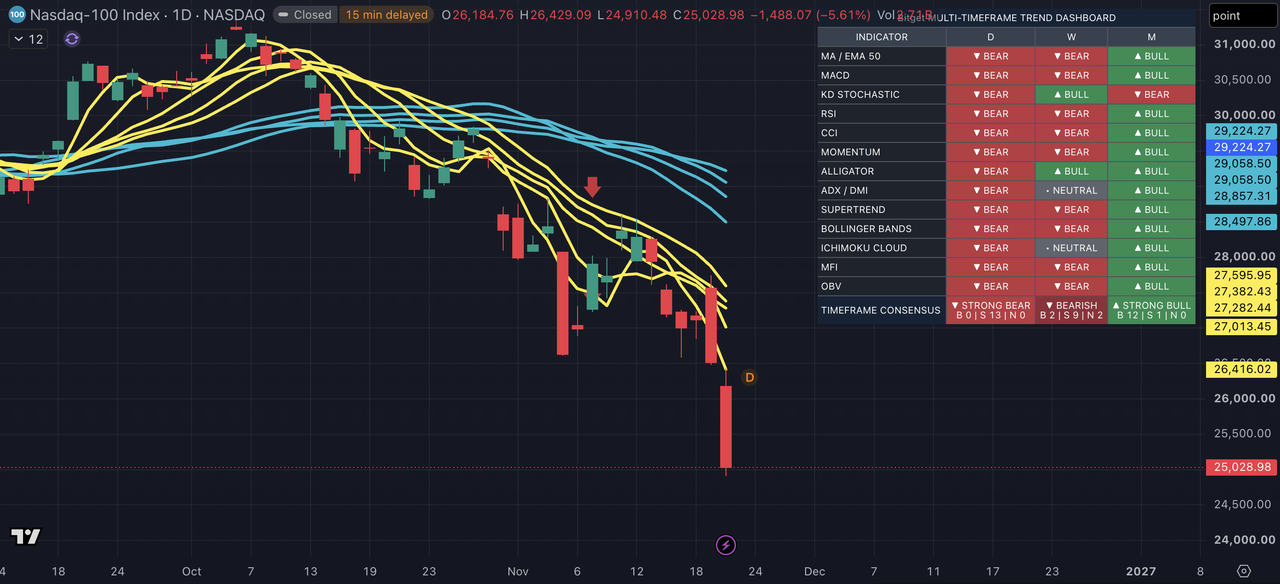
The supplied intraday figures show the Nasdaq and semiconductor stocks falling significantly more than the Dow, suggesting that high-growth assets carrying elevated expectations are facing greater pressure.
Our interpretation is that market participants may be reducing exposure to volatile technology positions, rather than simply trading on news about individual companies.
The risk in this environment is clear: Share prices can continue falling because of valuation compression and position adjustments, even before corporate fundamentals deteriorate meaningfully.
Likewise, a sharp bounce after a steep decline does not necessarily signal a trend reversal. Short covering and short-term inflows can make a rebound appear stronger than the underlying buying demand.
That makes two mistakes particularly easy to commit: rushing to buy simply because prices have fallen sharply, and chasing short positions after a major sell-off.
Watch These Three Signals Before Calling a Turning Point
1. Can Semiconductor Stocks Stabilize First?
Nvidia, AMD, and Micron are important barometers of sentiment toward the AI trade. If major semiconductor stocks continue making new swing lows, any rebound in technology shares still warrants caution. If they stop breaking below previous lows on negative news, it becomes worth watching for signs of stronger buying support.
2. Is the Rebound Broadening Beyond a Few Index Heavyweights?
A rising index does not necessarily mean the broader market is recovering. If a rebound depends on a handful of large-cap stocks while most shares remain weak, it may lack staying power. More convincing improvement would include an increase in the number of advancing stocks and stabilization across multiple sectors.
3. Are Interest Rate Expectations Still Weighing on Valuations?
High-growth stocks are particularly sensitive to funding costs. Upcoming inflation data, U.S. Treasury yields, and Federal Reserve policy signals could all influence whether technology valuations regain support.
Our central view: A sustainable stabilization requires more than lower prices—it requires expectations to become credible again.
For CFD Traders, Managing Volatility Matters as Much as Direction
When U.S. equities enter a rapid correction, trading should be about more than guessing whether the next candlestick will rise or fall. Traders should define in advance what would justify an entry, what would invalidate their view, and how much they can afford to lose.
If you choose to participate through CFDs, pay particular attention to the following:
-
Adjust position sizes to volatility: Higher volatility can produce larger gains or losses for the same position size.
-
Plan exit conditions in advance: Avoid waiting until a position is losing money to decide whether to cut the loss.
-
Watch for price gaps and slippage: Stop-loss orders may not execute at the specified price.
-
Account for trading costs: Spreads, overnight financing charges, and margin requirements can all affect trading outcomes.
CFDs allow traders to take both long and short positions, but shorting is not inherently safer than going long, and leverage does not improve the accuracy of a trading decision.
Turn Market Volatility Into a Disciplined Trading Plan
This correction in AI stocks is reminding the market that a compelling story cannot replace a reasonable valuation, and a long-term trend cannot eliminate short-term risk.
Rather than rushing to call the bottom, assess market signals first and choose a trading approach that fits the conditions.
Want to trade U.S. equity markets through CFDs? Visit Bitget CFD to explore the U.S. equity-related products available in your region, review contract specifications and fees, and build your long and short trading plan. Set your risk limits first—then execute your trades.
All trading education provided by Bitget is for educational purposes only and should not be considered financial advice. The strategies and examples shared are for reference only and may not reflect actual market conditions. CFD trading involves significant risk, including the potential loss of capital. Past performance does not guarantee future results. Please conduct thorough research and ensure that you understand the risks involved. Bitget is not responsible for any trading decisions made by users.


- Our View: The Market Is Not Rejecting AI—It Is Raising the Bar for Earnings Delivery
- What Does Tech’s Underperformance Tell Us?
- Watch These Three Signals Before Calling a Turning Point
- For CFD Traders, Managing Volatility Matters as Much as Direction
- Turn Market Volatility Into a Disciplined Trading Plan