
Gold Plunges 9.4% in a Week: As the Battle for $3,500 Begins, Is This a Buying Opportunity or a Pause Before Further Losses?
Stocks are falling, but gold has failed to provide a safe haven—and is being sold off alongside them. This time, the market may be rushing not into gold, but into cash.
Gold prices extended their decline on last Friday the 20th, with spot gold falling around 3% to $3,514.08 per ounce. Prices touched an intraday low of $3,502.49, marking a 14-month low. Gold lost approximately 9.4% over the week, its worst weekly performance in eight months.
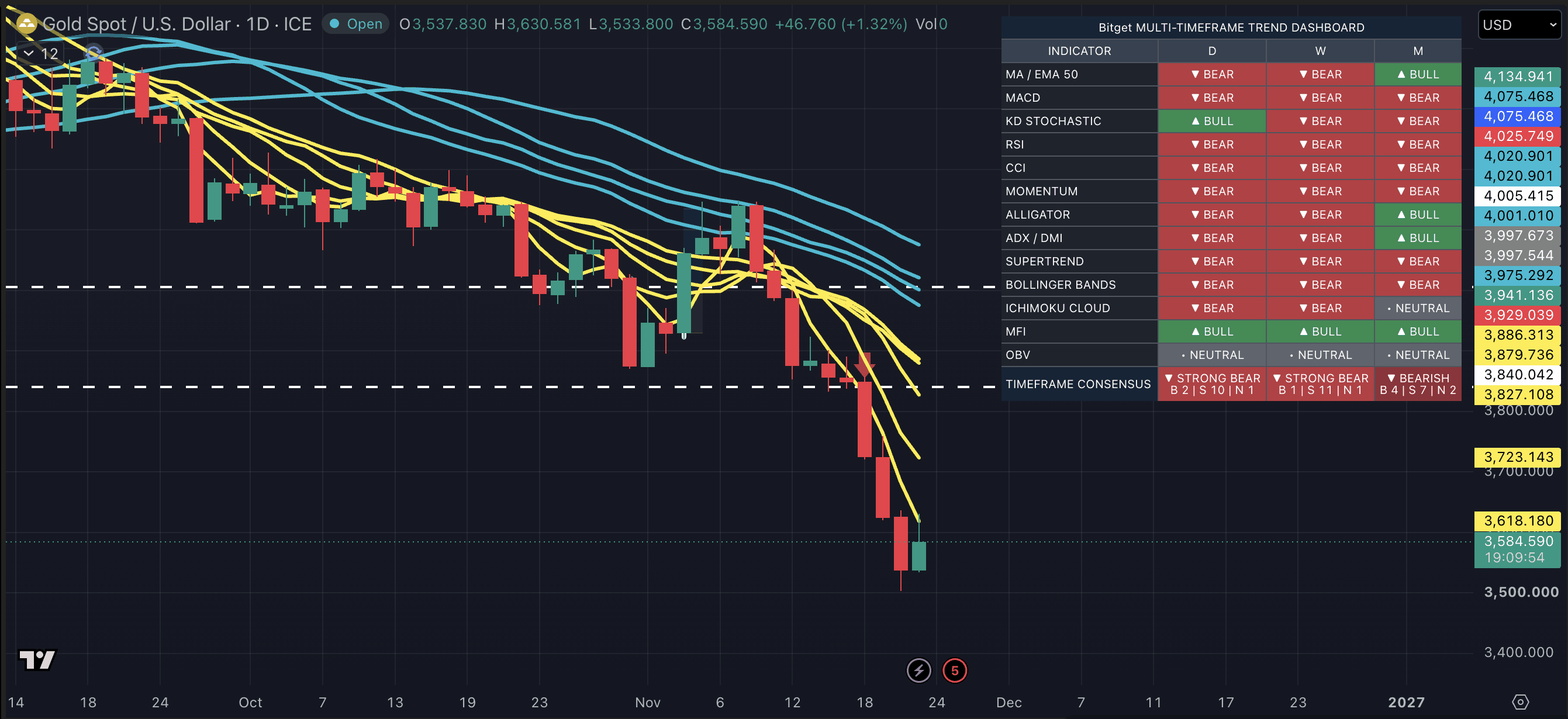
Selling pressure also spread to other precious metals. Spot silver fell 4.1%, while platinum and palladium declined 3.4% and 2.1%, respectively. This suggests the sell-off is not simply an adjustment in individual gold positions, but reflects broader capital outflows across precious metals.
In our view, the key issue is not whether gold can still serve as a safe haven. It is that, in the short term, interest-rate pressures and demand for cash are outweighing safe-haven demand. For traders, understanding where the selling pressure comes from matters more than guessing where the bottom will be.
Why Is Gold Falling? Three Forces Are Adding Pressure
1. Rising Rate-Hike Expectations Are Repricing the Cost of Holding Gold
Federal Reserve officials continue to send hawkish signals, prompting markets to increase their bets on a December rate hike and pushing the U.S. dollar and Treasury yields higher.
Gold pays no interest. As yields on U.S. dollar-denominated assets become more attractive, the opportunity cost of holding gold rises. A stronger dollar also makes gold more expensive for buyers using other currencies.
Our view is that a more sustained recovery in gold requires more than the argument that prices have “already fallen a lot.” The interest-rate outlook also needs to stop becoming less favorable. Beyond monitoring Treasury yields, traders should track real yields—yields adjusted for inflation expectations—to assess interest-rate pressure on gold more fully.
2. An AI Stock Sell-Off May Turn Gold into a Source of Cash
Market turbulence does not necessarily prompt investors to increase their gold allocations immediately.
When losses on equity positions widen or accounts face margin calls, investors may prioritize selling highly liquid assets to cover cash shortfalls. Gold can therefore fall alongside stocks.
Being a safe-haven asset does not mean being immune to losses. During periods of deleveraging, market participants often address funding pressures first and reassess asset values later. If this selling pressure persists, stock-market weakness alone may not be enough to trigger a gold rebound.
3. Physical Buying Is Returning, but Financial-Market Selling Has Not Necessarily Ended
The sharp decline in gold prices has attracted physical buying in markets including India and China, suggesting that lower prices are stimulating some demand.
However, physical buyers and leveraged investors operate on different timelines. Physical buyers may accumulate gradually, while financial-market participants can cut positions aggressively within a short period.
We therefore view the recovery in physical demand as a potential source of support, not proof that a bottom has been confirmed.
Our Core View: Look for Stabilization Before Trying to Buy the Bottom
A 9.4% weekly decline can easily create the impression that a rebound is due. Yet a sharp sell-off may be followed by short covering—or by a brief bounce before prices resume their decline.
The difference depends on whether the conditions driving the sell-off have changed.
We will be watching three signals:
-
Is the dollar cooling? If the dollar remains strong, gold’s upside may still be limited.
-
Have yields stopped rising? If interest-rate pressure persists, a recovery in gold may remain a short-term bounce.
-
Has gold stopped making new lows? Whether prices hold above the previous low after a rebound and gradually establish higher lows is more informative than a single day of gains.
We do not see “it is cheaper now” as a reason to enter a trade. We consider signs that selling pressure is losing its grip to be a more meaningful signal to monitor.
Around $3,500, Watch the Battle Between Buyers and Sellers—Do Not Assume Guaranteed Support
Based on the quoted prices provided, gold has approached $3,500 per ounce. This round number may serve as a short-term psychological level, but a round number alone does not guarantee strong buying interest.
Two scenarios are worth watching:
Scenario One: Gold holds around $3,500 while the dollar and yields both ease.
If gold retests the area without making a new low, conditions for a short-term rebound may gradually improve. However, a bounce is not the same as a trend reversal. Traders still need to watch for a more stable price structure to develop.
Scenario Two: Gold breaks below $3,500 and fails to reclaim it on a rebound.
This could suggest that sellers remain in control. Repeatedly trying to call the bottom in this environment can turn a planned short-term trade into a losing position held without a clear exit plan.
These levels provide a framework for observation, not instructions to buy or sell. Any trading assessment must also account for the relevant timeframe and the latest market conditions.
For CFD Traders, Direction Matters—but Risk Management Matters More
Gold CFDs allow traders to express bullish or bearish views, but the ability to trade both directions does not guarantee profits in either. When volatility increases, leverage also magnifies the risk of losses.
Before opening a position, answer at least three questions:
-
What would invalidate the trade idea? Define the point at which your thesis no longer holds before deciding whether to enter.
-
How much can you afford to lose on a single trade? Work backward from your acceptable loss to determine position size, rather than letting available leverage dictate your exposure.
-
Are the holding costs reasonable? Check spreads, overnight financing charges, and margin requirements, and be aware of slippage risk around major economic data releases.
Our conclusion is that gold’s sharp decline may create trading opportunities that require careful assessment—not a low-price guarantee that makes risk irrelevant. Rather than rushing to bet on the exact bottom, establish clear scenarios, entry and exit conditions, and money-management rules first.
Visit Bitget CFD to Follow Gold’s Next Move
Ready to turn your gold-market insights into a structured trading plan? Visit Bitget CFD to explore gold quotes and contract specifications, assess long and short strategies based on your market outlook, and define your position size and risk limits before placing a trade.
All trading education provided by Bitget is for educational purposes only and should not be considered financial advice. The strategies and examples shared are for reference only and may not reflect actual market conditions. CFD trading involves significant risk, including the potential loss of capital. Past performance does not guarantee future results. Please conduct thorough research and ensure that you understand the risks involved. Bitget is not responsible for any trading decisions made by users.


- Why Is Gold Falling? Three Forces Are Adding Pressure
- Our Core View: Look for Stabilization Before Trying to Buy the Bottom
- Around $3,500, Watch the Battle Between Buyers and Sellers—Do Not Assume Guaranteed Support
- For CFD Traders, Direction Matters—but Risk Management Matters More
- Visit Bitget CFD to Follow Gold’s Next Move