
February 5 Financial Morning Brief: Stronger US Dollar Index Limits Gold Price Gains, This Week's Nonfarm Payroll Report Delayed, US-Iran Nuclear Talks Drive Oil Prices Higher

FX678, February 5th—— On February 5 (GMT+8), during the Asian morning session, spot gold traded around $5,004/oz. Gold prices spiked and then retreated on Wednesday, influenced by the US dollar index strengthening to a one-week high and investors choosing to take profits after a recent record rally.
On Thursday (February 5, GMT+8), during the Asian morning session, spot gold traded around $5,004/oz. Gold prices spiked and then retreated on Wednesday, affected by the US dollar index rising to a one-week high and investors choosing to take profits after a record-breaking surge; US crude oil traded near $64.33/barrel, with oil prices rising on Wednesday, mainly driven by news related to US-Iran nuclear negotiations.
Key Focus Today
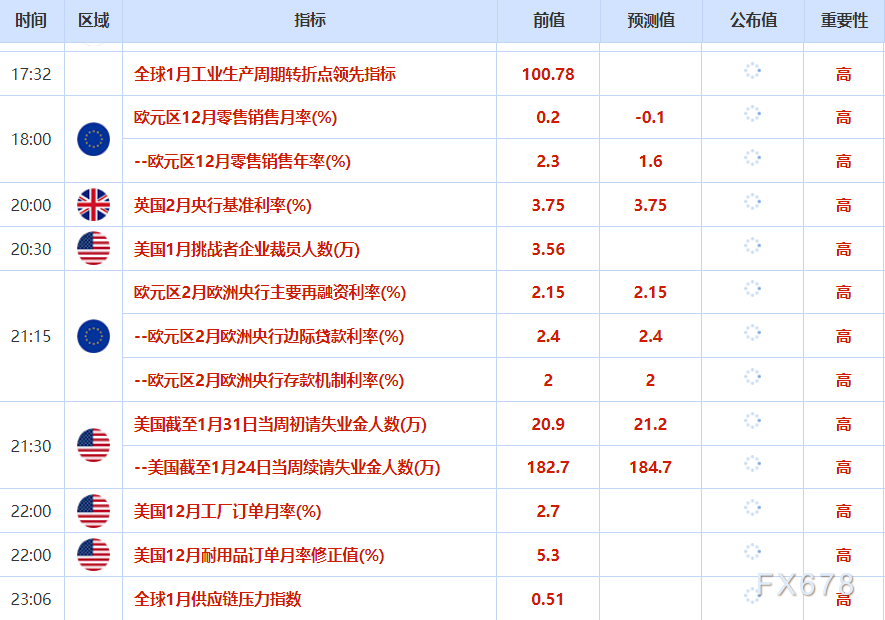
Bank of England Governor Bailey holds a monetary policy press conference; European Central Bank President Lagarde holds a monetary policy press conference; Atlanta Fed President Bostic participates in a dialogue on monetary policy.
Stock Market
US stocks closed mixed on Wednesday, with concerns over overvaluation of artificial intelligence (AI)-related stocks hitting the tech sector hard. The S&P 500 index closed down 0.51% at 6,882.72 points; the Nasdaq index plunged 1.51% to 22,904.58 points. In contrast, the Dow Jones Industrial Average rose 0.53% to 49,501.30 points.
Chipmaker AMD shares plummeted 17% as its revenue forecast disappointed the market, further fueling concerns about its competitiveness against Nvidia in AI. Nvidia shares also fell 3.4%, and the Philadelphia Semiconductor Index tumbled 4.4%. AI data company Palantir dropped nearly 12%, erasing the previous day's gains. Other software companies, such as Snowflake and Datadog, also continued to decline. Market analysts believe uncertainty about the scale of AI infrastructure investment and the pace of tool adoption has fueled doubts about overheated valuations and triggered sell-offs.
Against this backdrop, funds rotated into relatively undervalued sectors with smaller gains in recent years. The S&P 500 Value Index rose for a fifth consecutive day, while the Growth Index fell. Although the broad index closed lower, seven out of the S&P 500's 11 sectors gained, with the energy sector surging 2.25% and materials up 1.8%.
In terms of individual stocks, Alphabet, Google's parent company, fell nearly 2% before its after-hours earnings report, but rebounded after announcing a significant increase in AI investment. Pharma giant Eli Lilly jumped about 10% as its 2026 profit forecast exceeded expectations, helping limit the S&P 500's decline. Super Micro Computer soared 13.8% after raising its full-year revenue forecast.
Market trading was active, with a total volume of 24.6 billion shares. On the economic data front, US private sector employment growth in January was below expectations. The January nonfarm payrolls report, originally scheduled for Friday, has been postponed due to the partial government shutdown.
Gold Market
Gold prices spiked and then retreated on Wednesday, with spot gold ultimately closing down 0.3% at $4,924.89/oz, after jumping more than 3% intraday. The pullback was mainly due to the US dollar index strengthening to a one-week high and investors taking profits after a record rally.
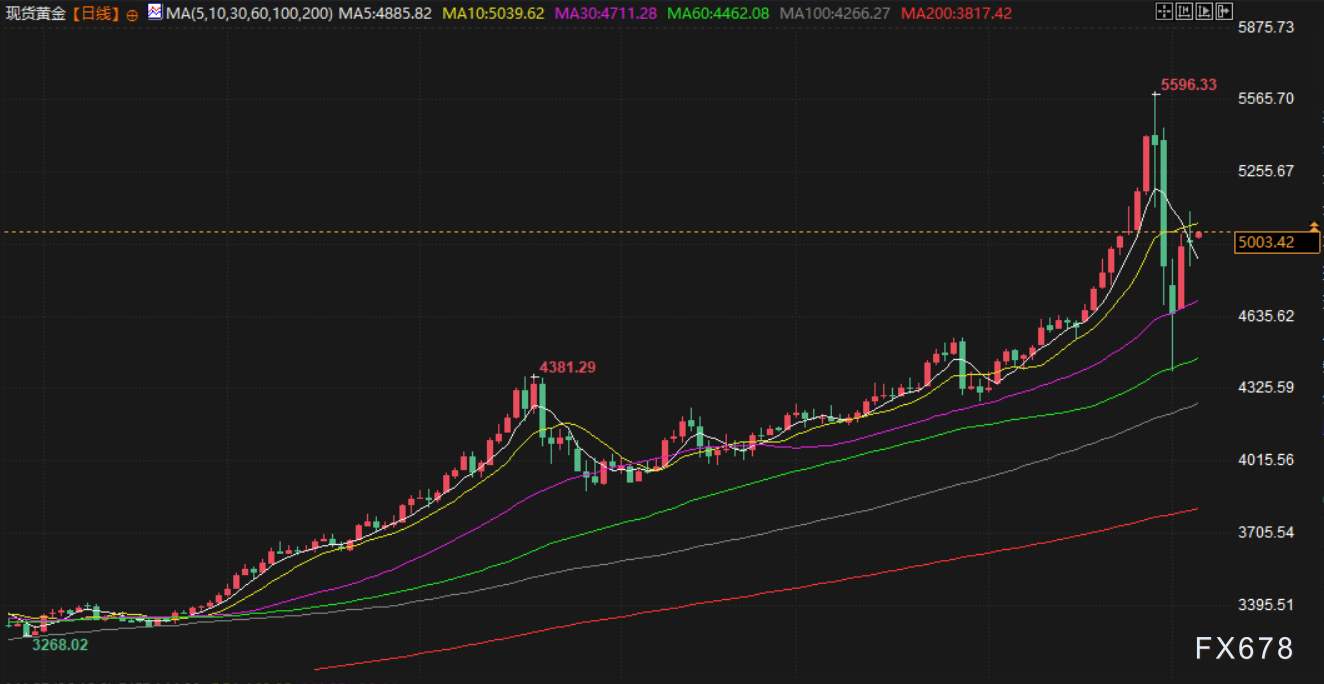
Market analysis pointed out that the dollar's rebound has increased the cost of dollar-denominated gold for international buyers, exerting direct pressure. David Meger, Director of Metals Trading at High Ridge Futures, said the market remains in a profit-taking phase after record highs and that the consolidation process is "not yet completely over."
On the geopolitical front, despite a series of important diplomatic interactions that day—including imminent US-Iran talks and calls between major world leaders—these events failed to provide sustained safe-haven support for gold prices, indicating the market is reassessing the geopolitical risk premium.
On the economic data side, the US January ADP private payrolls rose by only 22,000, well below the market expectation of 48,000, providing an early signal of a possible slowdown in the US labor market. However, the more authoritative US January nonfarm payrolls report has been delayed until February 11 due to the government shutdown. The absence of this key data has left the market in a wait-and-see mode, awaiting clearer guidance on economic policy.
Other precious metals showed mixed performance: spot silver rose 1.3% to $86.08/oz. Despite a significant pullback from last week's all-time high, silver is still up more than 20% year-to-date, showing much greater volatility than gold. Platinum and palladium also posted modest gains.
Oil Market
Oil prices rose on Wednesday, mainly driven by news related to US-Iran nuclear negotiations. Brent crude futures settled at $69.46/barrel, while US crude futures settled at $65.14/barrel.
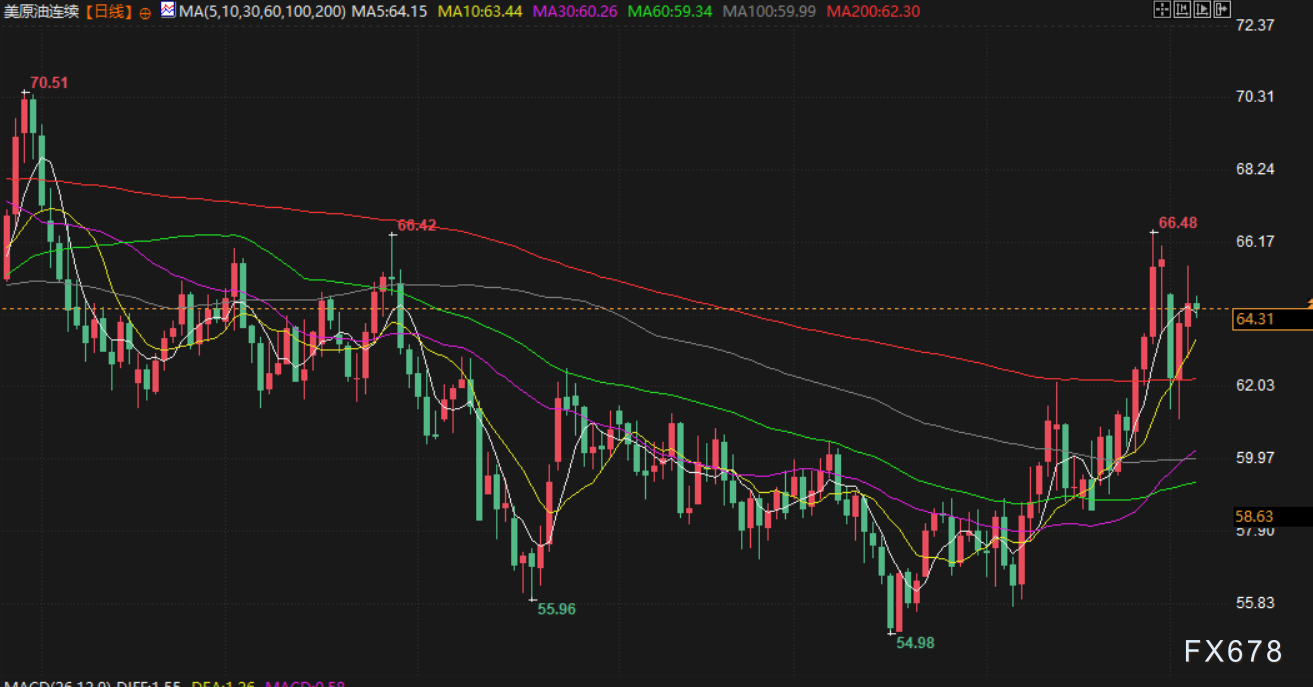
Oil prices were highly volatile during the day. Initially, media reports that the scheduled US-Iran talks on Friday might be called off pushed up the geopolitical risk premium. Later, a US official confirmed that the US-Iran nuclear talks would still take place as planned on Friday in Oman. Ongoing concerns about potential disruption of oil shipments through the Strait of Hormuz remain a key factor supporting oil prices above fundamentals. Analysts noted that if the situation escalates, not only would Iran's own oil supply be at risk, but its control over this key waterway would also pose a threat to global oil flows.
On the fundamentals, US Energy Information Administration data showed that crude oil inventories fell by 3.5 million barrels last week, a larger drop than analysts expected but smaller than the decline reported earlier by industry group API, which limited further upside for oil prices. Meanwhile, India's crude oil imports from Russia continued to decline in January.
Forex Market
The US dollar rose against the yen on Wednesday, with the yen falling for a fourth consecutive session. Japan is about to hold elections, and the result is expected to favor Prime Minister Sanae Takaichi in advancing her fiscal and defense spending plans. Meanwhile, the dollar also strengthened slightly against most major currencies, such as the euro and pound.
The Institute for Supply Management (ISM) reported that US services activity remained steady in January, but rising input costs could indicate a rebound in recently slowing services inflation. This data is closely watched, as the partial US government shutdown (which ended Tuesday night) has delayed the release of key employment data originally scheduled for Friday until next week, increasing uncertainty about the Fed's rate path.
Steve Englander, Global Head of G10 FX Research at Standard Chartered Bank, noted that the dollar remains stuck in a recent range, as traders evaluate whether the tech-led stock market drop is classic risk aversion (which typically supports the dollar) or a sign of deterioration in the tech sector—a core part of the US economy.
The yen fell 0.7% against the dollar at the New York close, at 156.82 yen, after having hit its lowest since January 23. Since January 30, the yen has dropped more than 2%. Earlier, Prime Minister Sanae Takaichi touted the benefits of yen depreciation in a campaign speech, triggering yen selling. Although she later retracted her remarks, markets remain concerned that the mixed signals could undermine efforts to support the yen.
Joel Kruger, Market Strategist at LMAX Group, said the market is being driven by three factors: Japanese election risk, cooling eurozone inflation, and renewed focus on US growth and employment momentum. The dollar enjoys moderate support, while the yen is distinctly weak. Market focus is entirely on economic activity and employment data for guidance on future prospects.
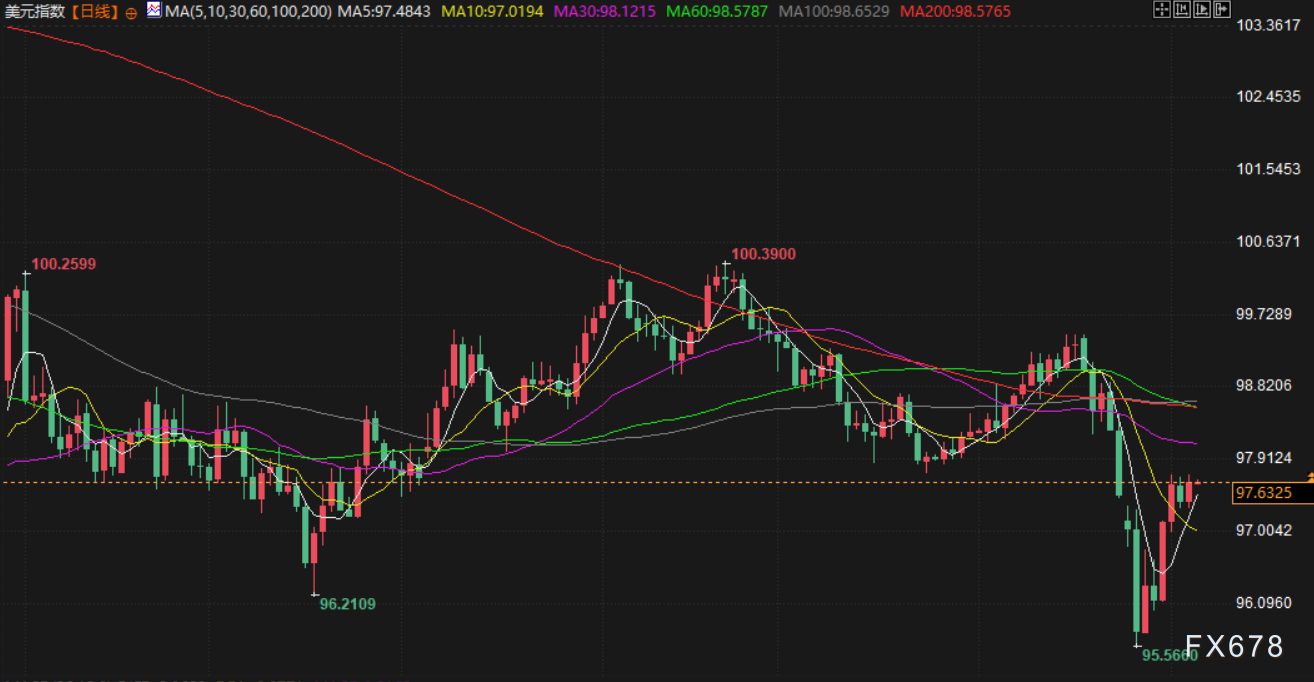
The US dollar index rose 0.24% to 97.63. The Australian dollar fell 0.37% against the US dollar to $0.6996, after surging in the previous session due to an RBA rate hike.
The euro fell 0.11% against the dollar to 1.1806. Investors are closely watching whether the European Central Bank will mention euro valuation as a policy factor in its Thursday decision. Last week, the euro hit a four-and-a-half-year high of 1.2084, and policymakers have expressed concern over its rapid appreciation, warning it could drag inflation—already below the 2% target—even lower.
Analysts pointed out that recent euro-dollar movement has been almost entirely driven by dollar sentiment, with yield spread factors playing a secondary role.
International News
New York and New Jersey have filed a lawsuit in federal court, accusing the Trump administration of unlawfully and politically retaliatorily freezing federal funds for a $16 billion rail tunnel project. (CCTV News)
On February 4 local time, after several Middle Eastern leaders urgently lobbied the Trump administration in the afternoon to abandon its threat to withdraw from the talks, the US-Iran nuclear negotiations scheduled for the 6th were restored and will be held in Oman. The US had earlier rejected Iran's proposal to move the meeting from Istanbul, Turkey, to Oman. Reportedly, the deadlock raised widespread concerns across the Middle East, with fears that Trump might turn to military action. At least nine countries in the region contacted the White House at the highest level, strongly urging the US not to cancel the meeting. A US official said, "They asked us to continue the meeting and hear what Iran has to say. We have told the Arab countries that if they insist, we will hold the meeting. But we are very skeptical." Another US official said the Trump administration agreed to hold the meeting out of "respect" for the US's regional allies and "to continue seeking diplomatic avenues." (CCTV News)
US Republican Senator Tim Scott said Federal Reserve Chairman Jerome Powell did not commit a crime while answering questions at a Congressional hearing last summer. "I think he made a serious error in judgment. He was not prepared for that hearing. I do not think he committed a crime at the hearing," Scott said in a Fox Business interview Wednesday. At the June hearing, Scott repeatedly questioned Powell about the Fed's $2.5 billion headquarters renovation project. Subsequently, allies of President Donald Trump accused Powell—without evidence—of lying in his testimony. Powell is under criminal investigation by the US Department of Justice, focusing on his answers at the Congressional hearing. The Fed Chair said the investigation was actually driven by government frustration over interest rate issues.
The Russian Foreign Ministry issued a statement on the evening of the 4th, stating that on September 22, 2025, Russian President Putin publicly proposed that Russia and the US voluntarily observe the weapons limits stipulated by the New START Treaty for at least one year after its expiration. However, so far, Russia has not received any formal response from the US to this proposal through bilateral channels. This means Russia's proposal has been deliberately ignored. In this situation, Russia believes that all parties are no longer bound by any obligations or reciprocal statements under the New START Treaty and are, in principle, free to choose their subsequent steps.
A joint statement shows that the US and EU will sign a memorandum of understanding within the next 30 days to strengthen the security of the critical minerals supply chain. The US and EU will identify and support projects in mining, recycling, processing, and refining. Trade initiatives may include coordinated trade policies, price floors, standards-based markets, price differential subsidies, or offtake agreements.
On February 4 local time, US Secretary of State Rubio said that peace talks between Ukraine and Russia had made some progress, but the remaining topics were "the most difficult parts" and breakthroughs are unlikely in the short term. Rubio said that compared with the same period last year, the Trump administration had made "significant progress" in advancing Russia-Ukraine negotiations. He said that comparing the list of unresolved issues from last year to the number still outstanding now, it is clear the list has "significantly shortened." However, Rubio also emphasized that while the number of unresolved items has decreased, those left are the most complex and difficult to handle.
Domestic News
The China Federation of Logistics and Purchasing announced today (5th) the bulk commodity price index for January. According to the index performance, corporate expectations remain optimistic, production activity continues to expand, and the bulk commodity price index has risen for nine consecutive months, reaching the highest level in three and a half years. In January 2026, China's bulk commodity price index was 125.3, up 6.3% month-on-month. Among 50 key bulk commodities monitored by the China Federation of Logistics and Purchasing, 33 saw month-on-month price increases in January. Among them, lithium carbonate, refined tin, and refined nickel led the gains, rising 48.4%, 20.2%, and 19.5% month-on-month, respectively. (CCTV)
The China Federation of Logistics and Purchasing released the January 2026 China Logistics Prosperity Index today (5th), showing that logistics business maintained an expansion trend. In January, the China Logistics Prosperity Index was 51.2%; the total business index, new orders index, logistics service price index, fixed asset investment index, employment index, and business activity expectation index all remained above the 50% expansion threshold. (CCTV News)
Disclaimer: The content of this article solely reflects the author's opinion and does not represent the platform in any capacity. This article is not intended to serve as a reference for making investment decisions.
You may also like
Trending news
MoreCrypto prices
More





