
Kalshi founder provides update on Iran's Khamenei market carveout

Tarek Mansour, the co-founder of prediction market Kalshi, provided an update, following the platform’s decision to void some positions that were opened after the death of Iran’s Supreme Leader Ayatollah Ali Khamenei was confirmed.
“We don’t list markets directly tied to death. When there are markets where potential outcomes involve death, we design the rules to prevent people from profiting from death. That is what we did here,” Mansour said in a post on X.
Iranian state media reported the death early Sunday, after an attack launched by Israel and the United States a day earlier.
Kalshi is reimbursing all fees from the “Ali Khamenei out as Supreme Leader” market, and will pay traders with positions open before Khamenei died according to the “last-traded price before his death,” Mansour said.
Additionally, users who opened positions after the death of Khamenei were reimbursed the difference between the higher price paid for entry and the last traded price.
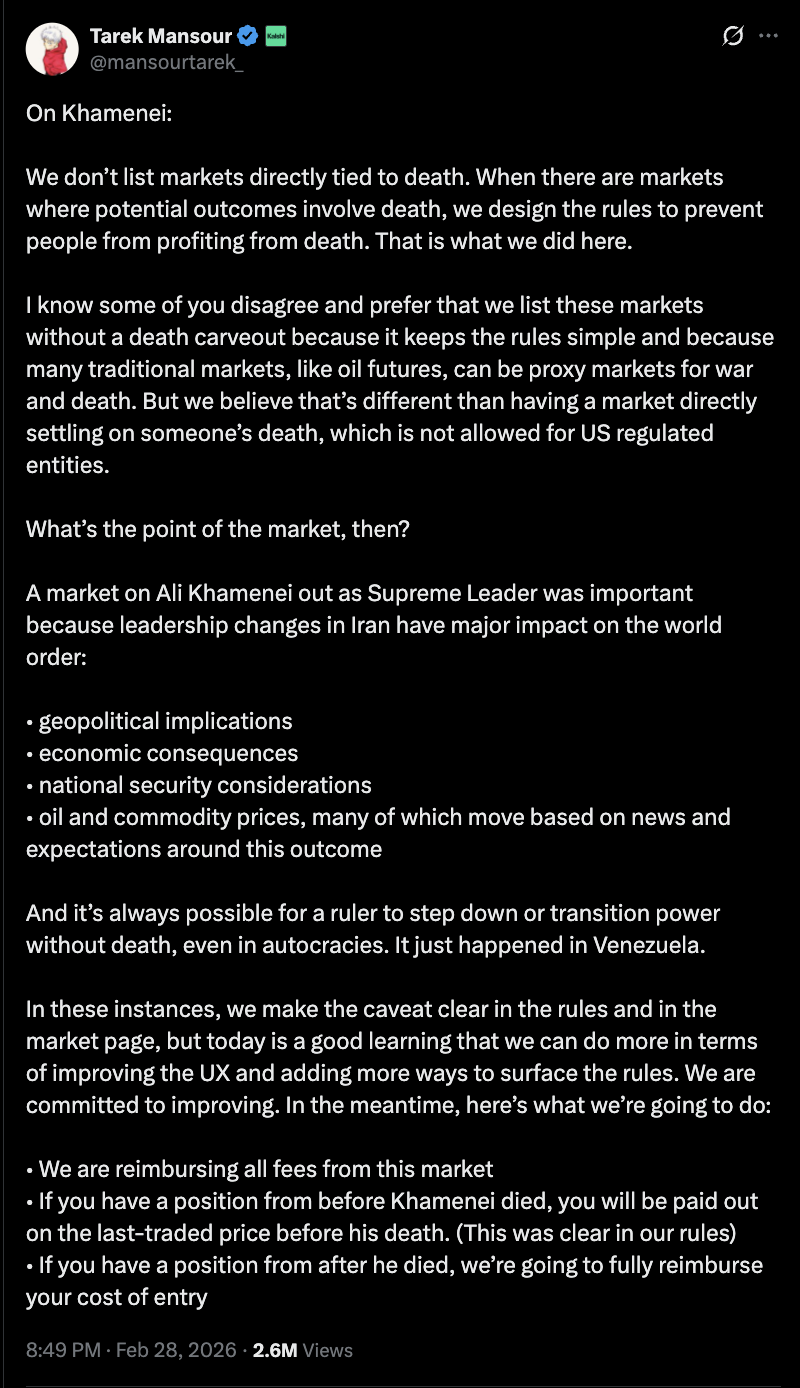 Source:
Tarek Mansour
A Kalshi spokesperson told Cointelegraph that the platform’s policy on not allowing “death markets” is clear and long-standing.
The platform reiterated the policy on Saturday, and Mansour said that the death carveout stipulations were clearly stated in the rules for the market. However, the decision sparked backlash from users online, who accused the platform of curtailing user profits.
 The prediction market for the ouster of the Iranian Supreme Leader. Source:
Kalshi
Related: Kalshi bans US politician over alleged insider trading violation
Suspicions of insider trading activity on prediction market platforms rise amid geopolitical tensions
In February, six traders on rival prediction market Polymarket netted about $1 million betting that the US would initiate a strike on Iran before the end of the month.
All six wallets were created in February, mostly bet on markets related to a strike on Iran, and some of the positions were filled hours before the first explosions were heard over the Iranian capital of Tehran, according to Bloomberg.
The trading patterns raised suspicion of insider trading activity among onchain investigators and analysts.
In January, US President Donald Trump announced that the individual who leaked information tied to the raid and capture of former Venezuelan President Nicolás Maduro had been arrested by US law enforcement.
The comments fueled speculation from onchain analysis platform Lookonchain that the leaker Trump was referencing may have been linked to winning bets on Polymarket placed shortly before the US raid in Caracas.
Magazine: Astrology could make you a better crypto trader: It has been foretold
Disclaimer: The content of this article solely reflects the author's opinion and does not represent the platform in any capacity. This article is not intended to serve as a reference for making investment decisions.
You may also like
Big Week Ahead: Ripple Heads to NYC With Wall Street Heavyweights

 VIPOil Risk Premiums and rToken Dividend Arbitrage Strategies
1. This week we focus on cross-asset positioning under an energy shock and arbitrage opportunities in tokenized-stock cash dividends. We recommend assessing market direction separately from income sources. Higher oil can weigh on growth valuations, lift inflation expectations, and spark expectations of Fed rate hikes, putting pressure on equities and crypto. 2. rToken net cash dividends can be distributed separately, but buying spot, shorting a perpetual, and holding across the record date does not automatically create an arbitrage. First confirm ex-dividend eligibility, platform snapshots, after-tax amounts, and the corporate-action rules for the short leg. Then compare funding fees, spreads, and execution costs. A dividend arbitrage strategy can be applied to STRC. 3. Next week's Fed decision and major technology earnings are key. Lower policy uncertainty can help restore risk appetite, but a sustained rebound still needs confirmation from rates, cloud growth, capital expenditure, and free cash flow. Our base case is a monthly-timeframe rebound in risk assets and crypto as earnings season, the Fed meeting, and the midterm elections pass and uncertainty recedes. Assets in focus: BTC, ETH, SOL, WTI, ASML, MSFT, GOOG, AMZN, CAT, and STRC

Goldman Sachs Names One Trade to Hedge an AI Market Shock
Big Tech Earnings Are a No-Win Test as Investors Punish Both Capex Cuts and Hikes

Crypto prices
More


