
Webster Financial's Shares Fall 1.01% Despite Earnings Beat Volume Drops to $370M Ranking 359th

Market Snapshot
Webster Financial Corporation (WBS) closed March 2, 2026, with a 1.01% decline, trading at $71.40 per share. The stock’s volume dropped 47.49% to $370 million, ranking 359th in market activity. Despite exceeding Q4 2025 earnings and revenue forecasts—posting $1.59 EPS and $746.2 million revenue—the stock fell 1.83% following the report. The decline contrasts with the company’s strong fundamentals, including a 10% year-over-year EPS growth, 8% loan growth, and a 13% increase in tangible book value per share.
Key Drivers
The stock’s underperformance on March 2, 2026, reflects a mix of short-term analyst sentiment shifts, broader market dynamics, and strategic uncertainty. Despite outperforming earnings expectations, Webster’s shares faced pressure from downgraded analyst ratings. Truist Financial, UBS Group, and Morgan Stanley all reduced their price targets or ratings to “Hold” or “Neutral,” citing cautious outlooks for the regional banking sector. The average analyst price target of $74.36 implies a potential 4% upside, but the mixed guidance signals skepticism about near-term momentum.
A critical factor lies in the company’s strategic bets. Webster’s acquisition of SecureSave and its focus on non-traditional banking verticals highlight its ambition to outgrow the industry. However, the projected 5-7% loan growth and 4-6% deposit growth for 2026, while robust, may not align with investor expectations for accelerated expansion. The HSA Bank partnership, expected to drive $1–2.5 billion in incremental deposits over five years, remains a long-term catalyst but may not offset immediate concerns about margin compression or competitive pressures.
The company’s financial health appears resilient, with a 22.67% net margin and $760.48 million in quarterly revenue. Yet, the 1.01% intraday decline coincided with broader market jitters over interest rate uncertainty and regional bank fragility. While Webster’s net interest margin (NIM) is forecasted to stabilize at 3.35%, the sector’s sensitivity to rate cuts and credit risk remains a drag. Additionally, the 2.2% dividend yield, though attractive, may not justify the stock’s valuation for growth-oriented investors.
Analyst reports further underscore the divide. Weiss Ratings maintained a “Buy (B-)” rating, citing Webster’s disciplined growth strategy, while Santander and others trimmed their outlooks. The 4 “Buy” and 12 “Hold” ratings from 16 analysts reflect a consensus of cautious optimism. However, the downgrade from Truist and UBS—both major names in banking coverage—suggests a recalibration of expectations. This shift could amplify volatility as investors reassess the stock’s risk-reward profile in a post-earnings environment.
Long-term fundamentals remain intact. Webster’s 10% return on equity (ROE) and $3 billion revenue target for 2026 position it as a mid-sized bank with solid growth prospects. Yet, the immediate reaction to its Q4 results highlights the market’s focus on execution risks. The company’s guidance for $7.33 billion in revenue by April 2026, coupled with a 3.35% NIM, hinges on maintaining loan growth and managing deposit costs. Any deviation from these targets could trigger further skepticism, particularly as regional banks face heightened scrutiny from regulators and investors.
In conclusion, Webster’s stock performance on March 2, 2026, reflects a tug-of-war between its strong earnings and strategic initiatives and the broader market’s cautious stance toward regional banks. While the company’s financial metrics and growth plans are sound, the downgrade in analyst sentiment and macroeconomic headwinds have tempered investor enthusiasm. The path forward will depend on its ability to execute on strategic partnerships, sustain loan growth, and navigate interest rate volatility—a balancing act that remains central to its valuation.
Disclaimer: The content of this article solely reflects the author's opinion and does not represent the platform in any capacity. This article is not intended to serve as a reference for making investment decisions.
You may also like
STMicroelectronics' Approach to Wearable Sensors: Evaluating Market Penetration and Growth Potential
Gulf Carrier Stocks Plunge Amid Operational Paralysis: Assessing the Financial Shock
XRP Just Flushed All Weak Hands. Market Strategist Says Time to Pump
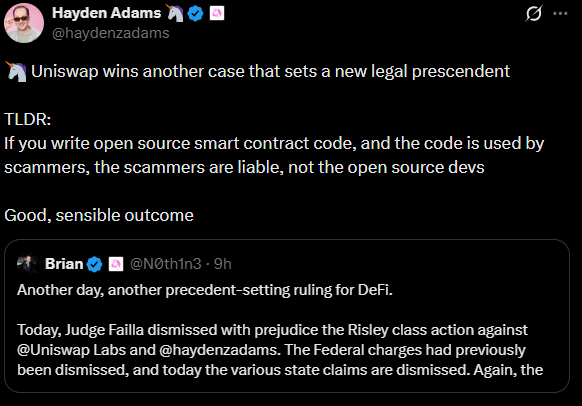
‘Scammers are liable’: Uniswap CEO reacts to landmark court dismissal
Trending news
MoreCrypto prices
More





