
3 Leading Regional Banks to Consider Investing in as Industry Conditions Improve

Outlook for Major Regional Banks: Trends and Opportunities
Asset quality among leading regional banks is anticipated to remain under pressure in the short term due to ongoing economic headwinds. However, as the Federal Reserve moves to reduce interest rates, these banks are likely to see improvements in net interest income (NII) and profit margins as funding costs stabilize and eventually decrease. Coupled with steady economic expansion, these factors are expected to boost loan demand.
Efforts to restructure and grow their businesses, alongside continued investment in digital transformation, are set to further strengthen these institutions. Notable players such as U.S. Bancorp, The Bank of New York Mellon Corporation, and Northern Trust Corporation are particularly well-positioned to benefit from these trends.
Industry Overview
The major regional banks sector comprises the largest U.S. banks by asset size, many of which operate on a global scale. Their financial performance is closely tied to the overall health of the economy. Due to their involvement in complex financial transactions, these banks must adhere to strict regulations from the Federal Reserve and other authorities. In addition to traditional lending, which generates NII, these banks offer a broad spectrum of services—including credit cards, mortgages, wealth management, and investment banking—to both domestic and international clients. Fees and commissions from these services represent a significant portion of their revenue.
Key Trends Shaping the Regional Banking Sector
- Interest Rate Environment: The Federal Reserve has implemented significant rate cuts—75 basis points in 2025 and 100 basis points in 2024—in response to inflation and a softening labor market. Lower rates are expected to ease funding costs and gradually improve lending conditions. Although there may be short-term pressure on NII and margins, banks are likely to benefit as macroeconomic uncertainties and geopolitical tensions diminish.
- Loan Demand Recovery: The Fed’s aggressive policy in 2021 and 2022 dampened loan demand amid recession fears. However, projections indicate that U.S. economic growth will pick up, and as borrowing costs fall and macroeconomic clarity improves, loan demand should rebound. This will likely support expansion in NII and net interest margins.
- Strategic Restructuring: Regional banks are diversifying their business models and reducing reliance on NII. Investments in technology, artificial intelligence, and digital platforms, as well as strategic partnerships and acquisitions, are driving growth. Many banks are also streamlining operations and exiting less profitable segments to enhance efficiency and profitability.
- Asset Quality Concerns: Economic uncertainty, trade policy ambiguity, and renewed geopolitical risks have heightened inflationary pressures, potentially impacting borrowers’ ability to repay. In response, banks are increasing loan-loss reserves to guard against defaults. While prudent lending and resilient clients have helped maintain asset quality, some credit metrics have surpassed pre-pandemic levels.
Industry Ranking and Performance
The major regional banks group, part of the broader finance sector, currently holds a strong position with a Zacks Industry Rank of #21, placing it in the top 9% of over 240 industries. This ranking, based on the average Zacks Rank of its constituent stocks, suggests the sector is poised for outperformance in the near term. Historically, industries in the top half of Zacks’ rankings outperform those in the bottom half by more than two to one.
Recent trends in earnings estimates further support a positive outlook. Over the past year, consensus earnings projections for 2026 and 2027 have been revised upward by 2.7% and 2.9%, respectively. Before highlighting specific investment opportunities, let’s review the sector’s recent stock performance and valuation metrics.
Stock Market Performance
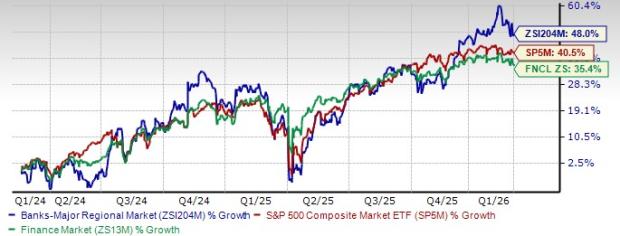
Over the last two years, the major regional banks sector has delivered a 48% gain, outpacing both the S&P 500 composite (up 40.5%) and the broader finance sector (up 35.4%).
Valuation Insights
One way to assess the sector’s valuation is by examining the price-to-tangible book value (P/TBV) ratio, a common metric for banks. The sector’s current trailing 12-month P/TBV stands at 2.55x, compared to a five-year range of 1.85x to 3.21x and a median of 2.38x. This is significantly lower than the S&P 500’s P/TBV of 12.32x, indicating a substantial discount.

While finance stocks typically trade at lower P/TBV ratios, comparing the sector to the broader finance group provides context. The finance sector’s P/TBV is 6.00x, still above the major regional banks’ ratio, highlighting the sector’s relative value.

Top Regional Bank Stocks to Consider
U.S. Bancorp (USB)
Based in Minneapolis, U.S. Bancorp serves the Midwest and Western U.S. with a wide range of banking and investment services. The company has grown through strategic acquisitions, enhancing its digital capabilities and diversifying its revenue streams. Recent deals include the purchase of Salucro Healthcare Solutions, MUFG Union Bank’s regional operations, and several fintech platforms. In January, U.S. Bancorp agreed to acquire BTIG for $1 billion, expanding its investment banking and capital markets presence.
The bank’s NII has been on an upward trend, supported by portfolio repositioning, reduced deposit migration, lower rates, and stable funding costs. U.S. Bancorp has also seen steady growth in loans and deposits by deepening relationships with existing clients and attracting new ones.
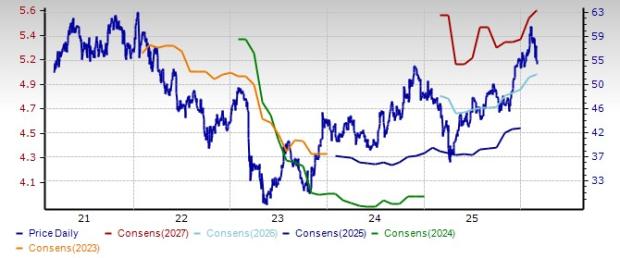
Capital returns remain robust, with a 4% dividend increase in September 2025 and a $5 billion share repurchase program announced in 2024. With a market cap of $84.9 billion and a Zacks Rank #2 (Buy), earnings are projected to grow by 8.9% in 2026 and 11.4% in 2027. The stock has climbed 10.6% over the past six months.
The Bank of New York Mellon Corporation (BK)
Operating in 35 countries, BNY Mellon serves a diverse global clientele, including financial institutions, corporations, government entities, and high-net-worth individuals. Despite recent rate declines, interest rates remain above 2020-2021 lows, supporting NII and margins as funding costs stabilize.
BNY Mellon continues to innovate, launching new products, digitizing operations, and forming strategic partnerships. The introduction of a Stablecoin reserves fund aims to facilitate institutional adoption of digital assets, boosting fee income. In 2024, the company acquired Archer Holdco, a technology-driven managed account solutions provider, strengthening its wealth management business. Plans are also underway to launch Alts Bridge, a comprehensive data and software platform.
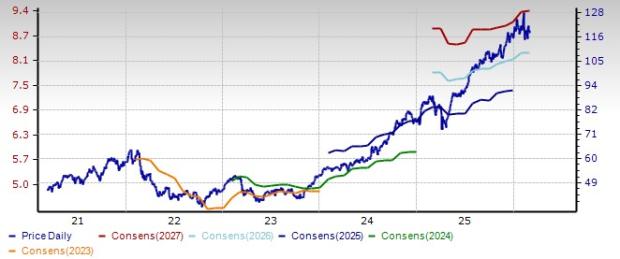
With a market cap of $82.1 billion and a Zacks Rank #2, BNY Mellon is expanding internationally and enhancing its service offerings. Earnings are forecasted to rise by 10.9% in 2026 and 12.5% in 2027, with the stock up 13.7% over the last six months.
Northern Trust Corporation (NTRS)
As of December 31, 2024, Northern Trust managed $177.1 billion in assets, providing wealth management, asset servicing, and banking solutions to a broad client base. The company’s revenue has grown at a 5.7% compound annual rate over the past five years, fueled by increases in both non-interest and net interest income. With an expanding client base, loan activity is expected to rebound, and the asset servicing segment is poised for further growth.
Cost management is a priority, with initiatives focused on workforce optimization, vendor consolidation, real estate rationalization, and process automation. These efforts are designed to boost productivity and achieve financial targets.
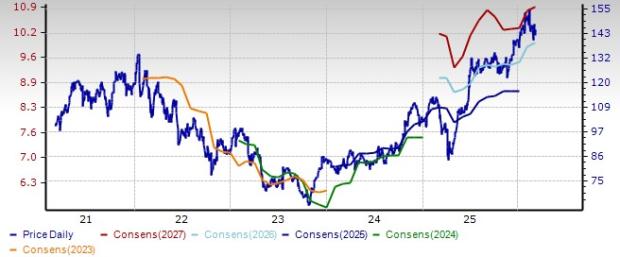
Northern Trust continues to return capital to shareholders, raising its dividend by 7% in 2025 and maintaining a 25-million share repurchase program. The company’s debt-to-equity ratio and liquidity position support ongoing capital distributions. With a market cap of $27 billion and a Zacks Rank #2, earnings are projected to grow by 10.1% in 2026 and 9.4% in 2027. The stock has gained 11.7% in the past six months.
Free Report: Capitalizing on the Next AI Boom
The upcoming wave of artificial intelligence innovation is set to generate substantial wealth for early investors, potentially adding trillions to the global economy and transforming daily life. While the initial surge in AI stocks may be slowing, the next phase will spotlight new, innovative companies poised for rapid growth.
Zacks’ report, AI Boom 2.0: The Second Wave, highlights four emerging companies that could become leaders in the next stage of AI advancement.
Additional Resources
- For the latest stock recommendations from Zacks Investment Research, access the 7 Best Stocks for the Next 30 Days.
- U.S. Bancorp (USB): Free Stock Analysis Report
- The Bank of New York Mellon Corporation (BK): Free Stock Analysis Report
- Northern Trust Corporation (NTRS): Free Stock Analysis Report
Disclaimer: The content of this article solely reflects the author's opinion and does not represent the platform in any capacity. This article is not intended to serve as a reference for making investment decisions.
You may also like
How does MetLife's stock performance stack up against other insurance companies?
Why Peter Thiel’s Founders Fund walked away from an Ether treasury bet
Rising energy prices from the Iran war could help Russia pay for fighting in Ukraine
Target shares climb 7% following announcement of ambitious long-term growth plan
Trending news
MoreCrypto prices
More





