
Warning! Iran is just a fuse, the crash of the South Korean stock market is the real "time bomb" for the global market

According to Zhihui Finance, while the world’s attention is focused on the situation in Iran, South Korea’s KOSPI index has plummeted by 20% in just two trading days.
As a bellwether of the Korean stock market, such drastic fluctuations in this index carry significant implications for U.S. investors. South Korea sits at the heart of the artificial intelligence (AI) hardware ecosystem. As speculative positions in this sector are rapidly unwound, the shockwaves could quickly ripple across Western markets.
So, should investors be worried at this moment, or is this actually a buying opportunity to scoop up undervalued Korean stocks?
Event Recap
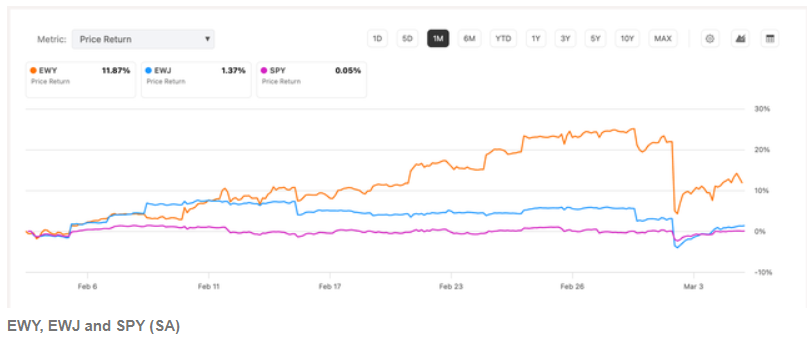
This wave of sell-offs began when the Korean KOSPI index plunged more than 7% in a single day, followed by another 12% drop the next day. The wild volatility triggered circuit breakers, leading to multiple trading halts.
The numbers tell the story: over the past year, Korean stock prices—exemplified by Korean ETF iShares MSCI (EWY.US)—had more than doubled. The driving force was AI hardware giants like Samsung Electronics and SK Hynix, which have a large weight in the index. These stocks also led the latest decline.
What ignited this wave of selloffs? Trade economist James Foord believes there were two main catalysts: exposure to energy risks and the cascading effect of leveraged funds.
Energy Shock
South Korea has ample reason to be considered one of the world's most technologically advanced countries. Yet technology is not omnipotent, as the country’s domestic energy production is virtually zero.
In fact, South Korea is one of the world’s largest importers of oil and liquefied natural gas (LNG), which is undoubtedly a fatal weakness in its economic structure. Korean industry is highly susceptible to energy market price fluctuations, and it’s hard to find effective hedges in the short term.
As the Middle East conflict intensifies, Asian LNG prices have soared to $25.40 per million British thermal units, doubling in just one week. Meanwhile, major supplier Qatar has suspended some output, heightening supply tightness.
For a nation whose economic lifeblood depends entirely on manufactured exports, this is a heavy blow. Persistently high energy prices will keep eating into corporate profits, and may even trigger depreciation of the local currency.
This has forced investors to re-evaluate their positions in South Korea and is likely at the root of the current sell-off.
Leverage Crisis
Yet the real catalyst behind the escalation was leverage.
Foord points out that South Korea has one of the world's most aggressive retail investor cultures. In recent years, margin debt in its stock market has surged, reaching around 32 trillion won (about $22 billion) earlier this year.
Driven by the strength of chip stocks, this leverage trading model had repeatedly succeeded, attracting even more leveraged funds and creating a self-reinforcing cycle.
However, when a market is saturated with crowded leveraged trades, any minor disruption can trigger a large-scale sell-off—exactly what is playing out now.
Once the first margin calls were issued, a chain of forced liquidations was set off, and the wave of selling became unstoppable.
Why It Matters to U.S. Markets
On the surface, the Korean stock crash might seem like a regional issue. But for those following global investment trends over the past two years, the spillover effects are obvious.
South Korea is a crucial link in the global semiconductor supply chain, with its companies providing core components to nearly all major AI infrastructure manufacturers.
This directly impacts a long list of American companies: chip manufacturing firms like Nvidia (NVDA.US) and AMD (AMD.US) are at the forefront; other tech giants like Apple (AAPL.US) and even Microsoft (MSFT.US) are also at risk due to potential supply chain disruptions.
In this tech-driven era, it's arguably harder to name a U.S. company that would not be affected by Korean supply chain interruptions. Korean firms underpin the supply base for numerous U.S. tech giants, which also account for a large portion of the S&P 500 index.
In addition, Korean investors hold substantial positions in global stocks, especially U.S. tech stocks. Should they face margin pressure at home, they may be forced to sell overseas assets for cash.
This is reminiscent of the Japanese carry trade unwinding that rocked U.S. markets last year. In fact, the current trends in Korean, Japanese, and U.S. stock markets are showing high correlation.
Energy Is the Underlying Issue
Taking a broader perspective, the deeper logic behind this episode is not about South Korea per se, but energy itself.
Foord emphasizes that industrial powerhouses like South Korea are especially sensitive to energy price shocks. If oil and natural gas prices keep rising sharply, it could set off a chain reaction: higher production costs, a weaker currency, shrinking profit margins, and eventually, systematic flight from equities.
This is precisely the script that’s currently playing out in the market.
What Should Investors Watch Next?
The ultimate outcome depends on where energy prices go from here—which in turn hinges on the duration of geopolitical conflict.
From a fundamental perspective, the bullish thesis remains intact. The AI development cycle is far from over, and demand for memory chips remains strong. As leverage and excessive speculation are flushed out, Foord believes this may be a good time to buy at a discount and patiently await a reversal.
However, if the sell-off persists, its ripple effects could extend far beyond Seoul.
Disclaimer: The content of this article solely reflects the author's opinion and does not represent the platform in any capacity. This article is not intended to serve as a reference for making investment decisions.
You may also like
AUD/JPY gains ground to near 111.00 as BoJ signals prolonged rate hold
Analyzing whether Decred’s [DCR] buyers will push price towards $36.7 liquidity
![Analyzing whether Decred’s [DCR] buyers will push price towards $36.7 liquidity](https://img.bgstatic.com/spider-data/97d640990b18dfb322bfae019209378c1772780625458.png)
A former researcher at OpenAI invests billions in energy and Bitcoin

Trending news
MoreCrypto prices
More





