
Big Tech shares were considered pricey. Then the AI trend shifted the market.

Big Tech Stocks Face Valuation Reset Amid AI Spending Concerns
For much of the last ten years, investors have paid steep premiums to own shares in the world’s largest technology firms. However, as enthusiasm for artificial intelligence cools, skepticism is taking hold and valuations are shifting.
Major technology companies have lagged behind the broader market for several months, weighed down by worries over soaring investments in AI and a shift toward industries that typically benefit from economic growth. Since the end of October, an index tracking the so-called Magnificent Seven has dropped 6%, while the S&P 500 has remained mostly unchanged—a stark contrast to 2023 and early 2024, when these tech giants outperformed the S&P 500 by a wide margin.
Top Stories from Bloomberg
Following the recent slide, many tech titans are now trading at valuations not seen in years. For example, Nvidia is valued at just over 21 times projected earnings, nearly matching the S&P 500 and well below its decade average of 35. Amazon’s shares are priced at 23 times forward earnings, half of their 10-year average. Excluding Tesla, the group—which also includes Alphabet, Apple, Meta, and Microsoft—trades at 23 times estimated profits, the lowest since the market’s tariff-driven volatility in April.
This abrupt change has caught many investors off guard, especially after years when these companies commanded hefty premiums due to rapid growth and market dominance. Some analysts see this as a logical outcome as firms like Amazon continue to pour massive sums into AI infrastructure.
“The transformation in the market is remarkable,” said Brett Ewing, chief market strategist at First Franklin Financial Services. “The Magnificent Seven have been completely repriced, shifting from asset-light, cash-rich businesses to companies rapidly investing in physical assets.”
Despite these changes, many of the factors that made these stocks appealing—such as strong profit growth—are still present. According to Bloomberg Intelligence, the Magnificent Seven are expected to grow earnings by 19% in 2026, compared to 12% for the rest of the S&P 500. However, their profit growth is slowing, partly because their enormous AI investments are filling their balance sheets with depreciating assets and reducing free cash flow.
AI Investments Reshape Tech Giants’ Financials
Amazon, Microsoft, Alphabet, and Meta are projected to spend a combined $618 billion on capital expenditures in 2026, up from $376 billion in 2025. As a result, their collective free cash flow is forecast to fall to $94 billion this year, down from $205 billion in 2025 and $230 billion in 2024.
“These companies are fundamentally different than they were just a few years ago. Capital spending, asset maintenance, and the balance between physical and intangible assets all matter now,” Ewing noted. “They warrant new valuation multiples and expectations.”
This shift is most evident in Amazon’s stock, which once boasted one of the highest valuations among large tech firms due to rapid revenue growth and aggressive expansion. Now, Amazon trades near its lowest valuation on record. Microsoft’s shares, at 22 times forward earnings, are at their lowest since 2022.
Conversely, Apple stands out, trading at 29 times expected earnings—well above its 10-year average of 22. Unlike its peers, Apple is not heavily investing in AI infrastructure but is instead partnering with Google to add AI features. While this strategy initially weighed on Apple’s stock, improving revenue growth has since boosted investor confidence. Apple’s capital expenditures are projected at just $13.4 billion this fiscal year, less than 7% of Amazon’s expected spending.
According to Lisa Shalett, chief investment officer at Morgan Stanley Wealth Management, the recent selloff in some tech stocks reflects deep investor skepticism about the sustainability of current AI spending levels.
“It’s clear the market is starting to differentiate between companies with durable earnings growth and those whose profits may have peaked,” Shalett explained.
Nvidia is a prime example: despite a strong earnings report, its valuation has dropped sharply over the past four months, and the stock remains 11% below its late October high.
Still, Brett Ewing of First Franklin believes the long-term outlook for Big Tech remains positive, even if the near-term is uncertain.
“I don’t think the era of Big Tech dominance is over,” he said. “These companies are still massive and incredibly capable. I’m optimistic about their future, but as an investor, I’m holding off on adding more right now.”
Tech Chart of the Day
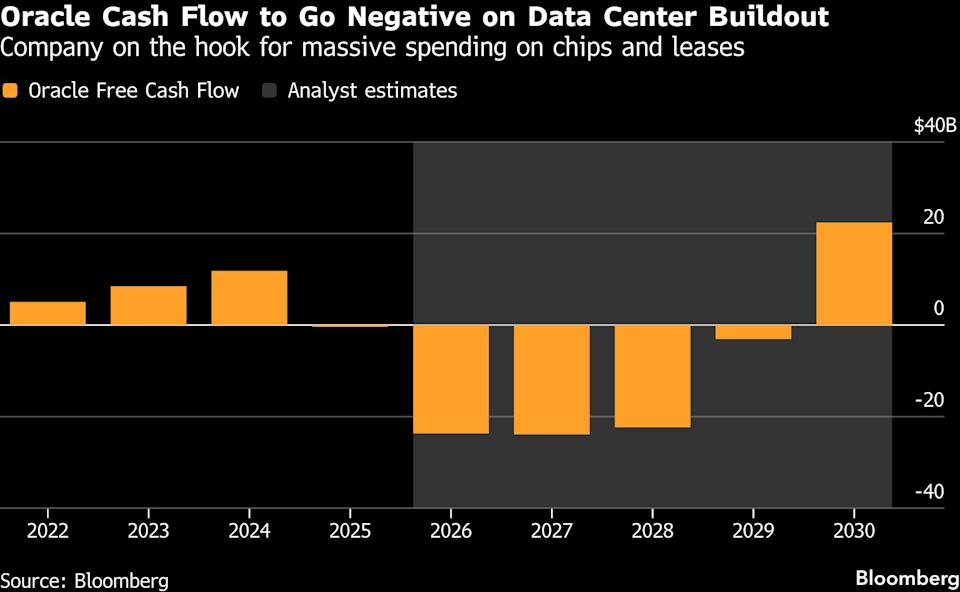
Oracle is preparing to cut thousands of jobs as it grapples with a cash crunch brought on by its large-scale expansion of AI data centers.
Latest in Technology
- Nvidia, long the leader in AI hardware, may soon face increased government involvement as the Trump administration considers a more direct role in the industry.
- Anthropic PBC has pledged to legally challenge the Pentagon’s decision to label it a supply chain threat, escalating tensions with the Trump administration over AI security.
- SoftBank Group is seeking up to $40 billion in loans, mainly to fund its investment in OpenAI, marking its largest dollar-denominated borrowing ever.
- Shares of Rohm Co. soared 18%—the biggest jump in 26 years—after receiving a takeover proposal from Denso Corp.
Reporting assistance by Brody Ford and David Watkins.
Most Popular from Bloomberg Businessweek
©2026 Bloomberg L.P.
Disclaimer: The content of this article solely reflects the author's opinion and does not represent the platform in any capacity. This article is not intended to serve as a reference for making investment decisions.
You may also like
Wingstop’s Executive Stock Sale Raises Investor Concerns Amid Restaurant Industry Downturn
BlackRock's $25M Loan Write-Off: A Niche Loss or a Signal for Private Credit?
Air freight companies rush to lessen the effects of the Iran conflict
Trending news
MoreCrypto prices
More





