
Price and Sentiment Diverge: Three Uncommon Buying Indicators Appear

Taking Advantage When Fear Dominates the Market
Significant market bottoms are often characterized by intense volatility, widespread pessimism among investors, and weak market participation. Recent examples include the dramatic downturns during the ‘Liberation Day’ and COVID-19 bear markets, both marked by sharp volatility spikes and overwhelming negativity. Occasionally, however, these extreme technical and sentiment signals can appear even when the S&P 500 and other major indices remain close to their record highs. That’s exactly the situation we’re witnessing now: despite the S&P 500 and Nasdaq being less than 6% below their peaks, investor anxiety is running high. Here are three notable indicators suggesting a market rebound may be near.
McClellan Oscillator Shows Deep Oversold Conditions
Market breadth, which measures the level of participation in market moves, can reveal when selling pressure has reached an extreme. When advancing stocks become scarce, it often indicates panic selling is nearly exhausted. The McClellan Oscillator tracks the net difference between advancing and declining stocks on the NYSE or S&P 500. According to Subu Trade (@SubuTrade), “even though the S&P 500 is within 5% of its all-time high, the McClellan Oscillator is extremely oversold. Historically, this scenario has occurred ten times before, and each time the S&P 500 was higher a month later, averaging a 3.2% gain.”
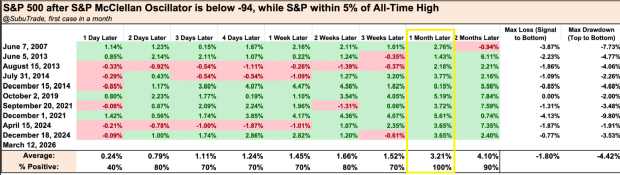
Source: @subutrade
Just yesterday, the NYSE McClellan Oscillator dropped to its lowest point since the ‘Liberation Day’ bottom in April 2025.
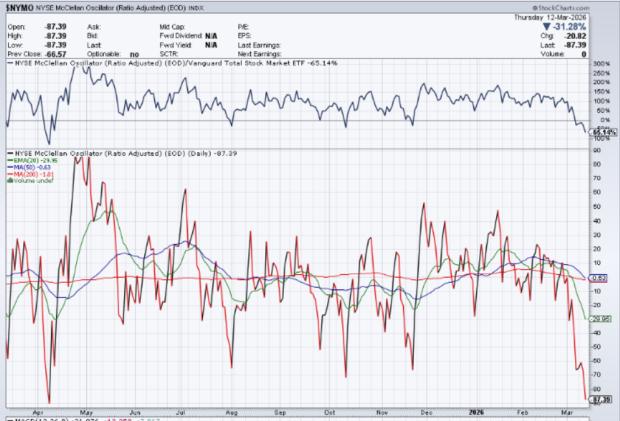
Source: StockCharts.com
Fear & Greed Index Signals “Extreme Fear”
The CNN Fear & Greed Index aggregates seven different metrics to assess investor sentiment, including market momentum, stock price strength and breadth, options activity, junk bond appetite, volatility, and demand for safe assets. Despite only a mild pullback in stocks, the index has registered its first “Extreme Fear” reading of 2026.
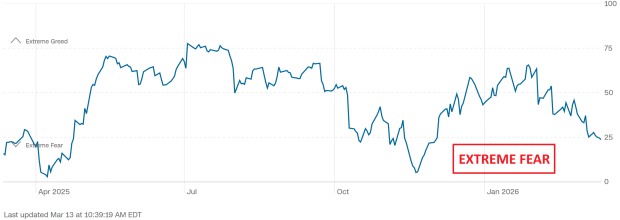
Source: CNN
Active Investors’ Market Exposure Hits Multi-Year Lows
The National Association of Active Investment Managers (NAAIM) survey reflects the average equity exposure reported by its members. Recently, this measure fell to its lowest level since May 2025, indicating that professional investors have become extremely cautious.
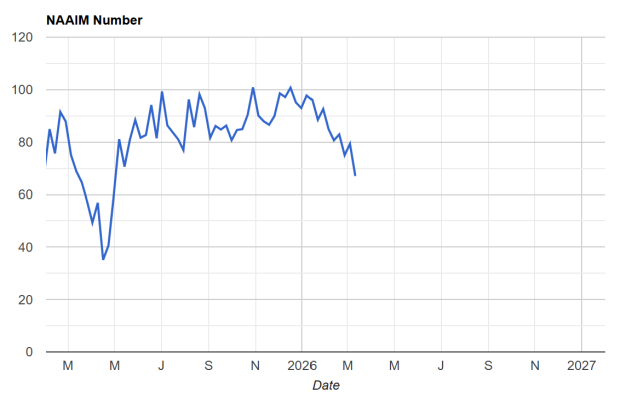
Source: NAAIM
Where Are the Opportunities?
These indicators point to a likely continuation of the market’s upward trend. Investors may want to focus on stocks that have demonstrated resilience during the recent downturn. In particular, companies involved in AI infrastructure have shown strong fundamentals and technical performance. Notable names in this space include Nebius (NBIS), IREN (IREN), Sandisk (SNDK), Micron (MU), and Bloom Energy (BE).
Key Takeaway
History shows that the best buying opportunities often arise when technical indicators are stretched to extremes and investor sentiment is overwhelmingly negative. With both breadth and sentiment measures at such levels, now is a critical time for investors to stay alert.
Introducing Zacks Top 10 Stocks for 2026
Act quickly to access our exclusive list of the top 10 stock picks for 2026, curated by Zacks Director of Research Sheraz Mian. This portfolio has delivered outstanding and consistent results over the years.
Since its inception in 2012 through November 2025, the Zacks Top 10 Stocks have soared by 2,530.8%, far surpassing the S&P 500’s gain of 570.3%.
Sheraz has meticulously reviewed 4,400 companies covered by the Zacks Rank system to select the ten best stocks to buy and hold for 2026. Don’t miss your chance to be among the first to discover these high-potential picks.
Disclaimer: The content of this article solely reflects the author's opinion and does not represent the platform in any capacity. This article is not intended to serve as a reference for making investment decisions.
You may also like
PATH Posts Robust Results to End Fiscal Year: Should You Consider Buying PATH?
3 Top-Rated Stocks Under $10 to Consider Buying
Engineers Gate Reduces Holdings in Sabra Health Care REIT Amid Investor Focus on Rental Revenue Patterns
Trending news
MoreCrypto prices
More





