
Despite receiving 311 pages of negative feedback, NASA remains committed to continuing with the Boeing Starliner program.

NASA's Frustration with Boeing's Starliner
NASA has expressed significant dissatisfaction with Boeing (NYSE: BA) regarding its Starliner spacecraft program.
Over six years ago, Boeing conducted the first uncrewed test flight of its CST-100 Starliner, aiming to dock with the International Space Station (ISS). The mission, however, was unsuccessful. Two years later, Starliner managed to reach the ISS, though not without encountering technical issues. In 2024, Boeing attempted a third mission—this time carrying astronauts—but complications left the crew stranded on the ISS for several months until SpaceX was able to bring them home.
Could artificial intelligence create the first trillionaire? Our latest report highlights a little-known company, dubbed an "Indispensable Monopoly," that supplies essential technology to both Nvidia and Intel.
Since that troubled mission, Starliner has remained grounded. A recent NASA report now questions whether the spacecraft should ever return to flight.
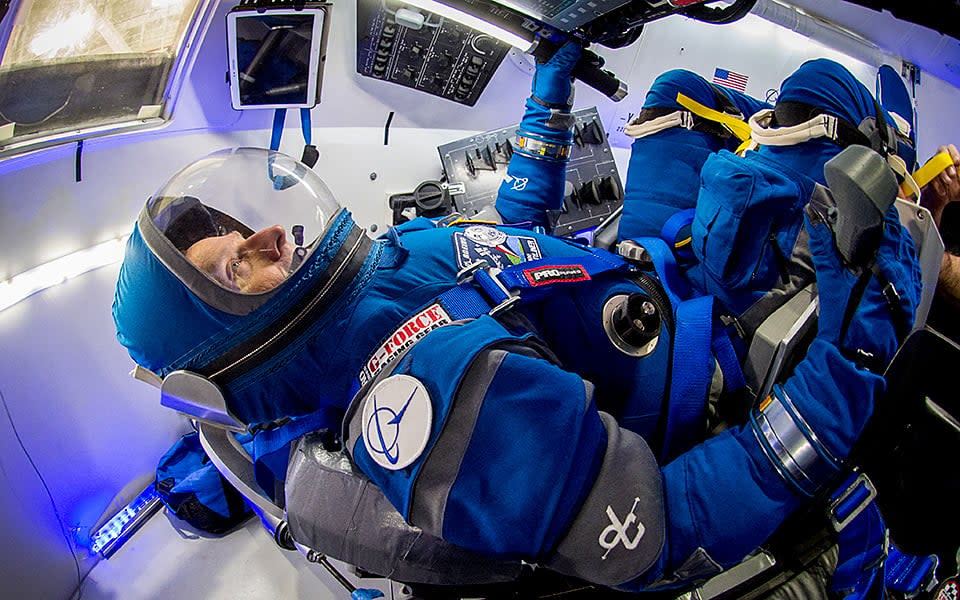
Image source: Boeing.
NASA's Assessment of Starliner
The newly released NASA document, titled "Starliner Propulsion System Anomalies during the Crewed Flight Test Investigation Report," spans 311 pages and details how technical flaws, organizational shortcomings, and cultural issues contributed to the failed 2024 crewed flight test.
NASA highlighted four major hardware problems with Starliner: five thrusters on the service module and one on the crew module malfunctioned; seven out of eight helium manifolds had faulty seals; and, most concerning, the propulsion system lacked sufficient redundancy, meaning multiple failures could have prevented a safe return to Earth. As NASA associate administrator Amit Kshatriya remarked, "We came dangerously close to a catastrophic outcome."
Additionally, NASA criticized Boeing for insufficient hardware testing and for misinterpreting issues encountered during previous Starliner missions. NASA also acknowledged its own inadequate oversight of Boeing's work.
As a result, NASA classified the crewed flight test as a "Type A mishap," a category that includes severe incidents such as the loss of a spacecraft or crew. In this case, the mission was labeled a "failure" after Starliner lost control during docking.
In response to the "critical vulnerabilities" found in both the spacecraft and the oversight process, NASA issued 61 formal recommendations to address the identified issues.
Despite these serious concerns, NASA has not yet terminated the Starliner program.
Starliner Gets Another Chance
NASA administrator Jared Isaacman emphasized the importance of competition and backup options, noting that the United States benefits from having more than one provider for ISS transportation. There are two main reasons NASA is keeping Starliner in the running:
- To avoid relying solely on SpaceX for ISS missions, which would leave NASA vulnerable if SpaceX's Falcon 9 rockets were ever grounded.
- To ensure SpaceX remains competitively priced, as Boeing's presence—even if only as a technical competitor—forces SpaceX to offer better contract terms.
However, this does not mean NASA is satisfied with the current state of affairs.
Isaacman stated, "NASA will not send another crew on Starliner until all technical issues are understood and resolved, the propulsion system is fully qualified, and all investigation recommendations are implemented." At best, Starliner may only be used for uncrewed cargo missions to the ISS—or not at all—until these problems are fixed.
Investors should also be aware of a possible worst-case scenario for the program.
The Clock Is Ticking for Starliner
When Boeing was awarded its $4.2 billion Commercial Crew contract in 2014, the agreement called for six crewed flights to the ISS. SpaceX received a similar contract for six missions, but at a lower price of $2.6 billion, and has already completed 13 flights (with another planned).
Given NASA's current pace of two crewed launches per year and the ISS's planned retirement after 2030 (possibly extended to 2032), there may only be time for nine more flights—or 13 if the ISS remains operational through 2032. If future missions are split evenly, Boeing will only be able to complete all six contracted flights (and receive the full $4.2 billion) if the ISS's lifespan is extended.
If the ISS is decommissioned in 2030, Boeing could lose at least $1 billion in anticipated revenue—potentially more if Starliner's issues aren't resolved quickly.
While Boeing is a massive corporation with nearly $90 billion in annual sales, a $1 billion revenue loss would still be significant, though not existential. More damaging, however, could be the blow to Boeing's reputation in the space industry.
Is Now the Time to Invest in Boeing?
Before considering an investment in Boeing, keep this in mind:
The Motley Fool Stock Advisor team recently identified their top 10 stocks to buy right now—and Boeing did not make the list. The selected stocks are expected to deliver substantial returns in the years ahead.
For example, when Netflix was recommended on December 17, 2004, a $1,000 investment would now be worth $508,607! Similarly, a $1,000 investment in Nvidia on April 15, 2005, would have grown to $1,122,746!
Currently, Stock Advisor boasts an average return of 933%, far outpacing the S&P 500's 188%. Don't miss the latest top 10 picks—join Stock Advisor and become part of a community built for individual investors.
See the 10 stocks »
*Stock Advisor returns as of March 14, 2026.
Rich Smith holds no positions in any of the mentioned stocks. The Motley Fool owns shares of and recommends Boeing. For more information, see The Motley Fool's disclosure policy.
Despite 311 Pages of Criticism, NASA Still Won't Cancel the Boeing Starliner was originally published by The Motley Fool.
Disclaimer: The content of this article solely reflects the author's opinion and does not represent the platform in any capacity. This article is not intended to serve as a reference for making investment decisions.
You may also like
BASF Exits Hydrosulfite Production, Setting Stage for Supply Tightening as Silox Consolidates Control
Devon-Coterra Merger Locks In Bet on Natural Gas Shortage With 2028 Pre-Sales
Minth’s Alabama Gamble: Building a Closed-Loop Supply Chain for Electric Vehicle Components
Trending news
MoreCrypto prices
More





