
Jet.AI's Power-Deal Breakthrough: A High-Risk Bet on the AI S-Curve

The investment case for Jet.AI is a classic bet on the fundamental infrastructure layer required for a technological paradigm shift. The company is deploying GPU infrastructure for AI cloud services, positioning itself as a provider of the compute power that will fuel the next generation of artificial intelligence. This isn't about selling AI applications; it's about building the rails. The timing is critical. The Canadian hyperscale data center market is projected to grow at a 22.1% CAGR, a trajectory driven by the insatiable demand for AI training clusters and the country's unique advantage in low-carbon grid access.
This growth is not theoretical. Jet.AI's recent milestone completion demonstrates tangible progress in securing the most critical bottleneck for data center development: power. The company, through its joint venture Convergence Compute, has advanced key steps for two major campuses. For the Midwestern site, this includes submitting a transmission power load study and securing natural gas supply. For the Maritime site, it means executing a letter of intent for power from hydro and a proposed wind farm, plus assigning property rights. These are not minor administrative tasks; they are the foundational engineering and regulatory work that unlocks the ability to build and operate these massive facilities.
Viewed through the lens of the S-curve, Jet.AI is attempting to establish a foothold in a market that is still in its early, steep-acceleration phase. The opportunity is immense, with the Canadian market expected to nearly triple in size by 2030. Yet the risks are equally high. Success hinges entirely on the company's ability to not just secure power, but to monetize it effectively. The path is fraught with known friction points, from lengthy power-interconnect permitting to acute skilled-labour shortages. This is a high-risk, high-reward play on the exponential adoption of AI, where the company's fate is tied to its execution on the most fundamental infrastructure challenge.
Data & Benchmarks: The Exponential Demand Curve
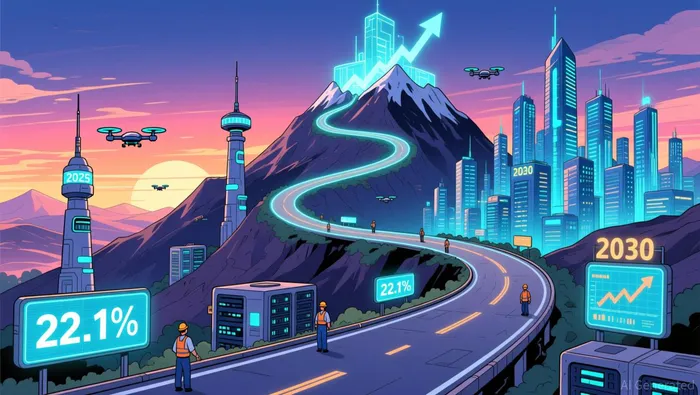
The opportunity Jet.AI is chasing is defined by an exponential demand curve, not a steady climb. The numbers paint a picture of a market accelerating into a new paradigm. The Canadian hyperscale data center market is projected to grow from $3.09 billion in 2025 to $9.96 billion by 2030, a compound annual growth rate of 22.1%. This isn't just growth; it's the steep part of the S-curve, where adoption rates begin to accelerate dramatically.
| Total Trade | 1 |
| Winning Trades | 0 |
| Losing Trades | 1 |
| Win Rate | 0% |
| Average Hold Days | 6 |
| Max Consecutive Losses | 1 |
| Profit Loss Ratio | 0 |
| Avg Win Return | 0% |
| Avg Loss Return | 9.98% |
| Max Single Return | -9.98% |
| Max Single Loss Return | 9.98% |
The driver behind this surge is the explosive rise in AI workloads. Globally, data center energy consumption is on a doubling trajectory, with the International Energy Agency projecting it will double by the end of 2026. By 2030, the cumulative increase could reach 160%. This isn't a linear trend. The adoption rate for AI training clusters is itself accelerating, with compute power demands doubling roughly every nine months. This creates a feedback loop: more AI models require more compute, which requires more data centers, which consume more energy, further fueling the need for more compute.
Canada is positioned to capture a significant share of this global shift. The country's existing infrastructure is already under strain. In 2022, data centers consumed an estimated 460 terawatt-hours globally, equivalent to roughly 71% of Canada's entire electricity generation that year. Projections show this demand will only intensify, with Hydro-Québec anticipating a 4.1 TWh increase in data center demand from 2023 to 2032. This is the fundamental metric that defines the opportunity. Jet.AI's bet is on being a provider of the physical infrastructure-specifically, the power and land-that will be required to meet this exponential energy draw.
The bottom line is that the Canadian market is riding this global demand wave. The 22.1% CAGR is a function of the underlying AI compute explosion. For a company like Jet.AI, the scale of the opportunity is clear. The challenge, as the earlier section noted, is not in the size of the curve but in the execution of building the rails to ride it.
Risks & Counterpoints: Power Bottlenecks and Execution
The path to monetizing Jet.AI's ambitious build-out is paved with significant operational and financial friction. The company's recent milestone completion is a positive step, but it only addresses the first layer of a complex problem. The real test lies in securing and delivering the massive, reliable power required to run AI training clusters. For the Midwestern campus, the company has secured natural gas supply for up to six turbines. For the Maritime site, it has signed a letter of intent for power from hydro and a proposed wind farm. These are essential, but they are not guarantees. The transition from a letter of intent to a fully contracted, long-term power supply is a known bottleneck, often involving lengthy permitting and interconnection processes that can stall projects for years.
This execution risk is compounded by the joint venture structure. Jet.AI's financial exposure and potential returns are directly tied to the success of Convergence Compute's power and construction execution. The company is not building these campuses alone; it is a partner in a venture that must navigate these complex regulatory and engineering hurdles. Any delay or cost overrun in securing power or constructing the facilities will pressure the joint venture's capital and, by extension, Jet.AI's own financial position. The company's ability to fund its share of future CAPEX without diluting shareholders will be a critical factor.
More broadly, the exponential growth thesis itself faces a fundamental counterpoint: the uncertainty of long-term demand. The market projections are compelling, but they assume a continued, unbroken acceleration in AI adoption and compute demand. A key risk is that energy efficiency improvements in AI hardware or software could slow the projected doubling of data center energy consumption. The International Energy Agency's forecast that global data center energy use will double by the end of 2026 is a powerful driver, but the trajectory beyond that point is less certain. If the adoption curve flattens or if alternative energy sources become more economical, the economic viability of these massive, power-hungry campuses could be questioned, particularly for projects extending beyond 2030.
The bottom line is that Jet.AI is betting on a technological S-curve that is still steepening. The company has cleared some early hurdles, but the path ahead is fraught with power bottlenecks, execution risks, and the inherent uncertainty of forecasting demand for a paradigm-shifting technology. The financial and operational challenges are not minor; they are the primary constraints that will determine whether this infrastructure play delivers on its exponential promise or gets stuck in the mud.
Timeline & Catalysts: The Path from Milestones to Build
The recent milestone completion is a necessary step, but it is not the signal that the market needs. The next catalysts are the construction start and power contract finalization for the Midwestern campus. These are the events that will validate the joint venture's ability to move from planning to exponential deployment. Securing a long-term, contracted power supply is the single biggest hurdle. The company has only secured natural gas supply for up to six turbines; a final power contract will demonstrate the ability to lock in the massive, reliable energy required to run AI clusters. Similarly, a formal construction start date will show the venture can transition from engineering studies to physical build-out.
The market's projected 160% cumulative energy consumption increase by 2030 underscores the long-term demand thesis. Yet this also highlights the scale of capital required to meet it. The stock trades at a low price of $0.095, reflecting high risk and early-stage development. With no current revenue from the Canadian projects, the valuation is purely a bet on future execution. The path from here is binary: successful construction starts and power contracts would signal the venture is on track to capture a share of this exponential demand. Delays or failures at this stage would likely invalidate the near-term build-out thesis and pressure the company's capital.
The bottom line is that the next six to twelve months are critical. The company must convert its completed milestones into binding contracts and physical ground-breaking. For a stock priced at this level, the market is waiting for proof that Jet.AI can build the infrastructure rails it has been talking about. The exponential demand curve is clear, but the company's ability to ride it depends entirely on its next set of operational milestones.
Disclaimer: The content of this article solely reflects the author's opinion and does not represent the platform in any capacity. This article is not intended to serve as a reference for making investment decisions.
You may also like
US Dollar Index (DXY) Price Forecast: Strengthens to 100.00; targets YTD peak ahead of Fed
REFI's High-Yield Dividend: Alpha Leak or 280E Risk Trap?

Travis Perkins Faces Double Challenge: Unprecedented Commodity Prices and Sluggish Construction Sector Recovery

Trending news
MoreCrypto prices
More





