
Nvidia’s Groq Bet Locks Inference Edge for Agentic AI’s Next Wave

Nvidia's $20 billion deal for Groq's intellectual property is a direct bet on the next exponential growth phase of artificial intelligence. This isn't about training massive models, where NvidiaNVDA-0.70% already holds a commanding lead. The strategic move targets the critical infrastructure layer for the market's next frontier: real-time, agentic AI systems. Inference-the computational process that turns trained models into live services-is the primary fuel for this new paradigm, and Nvidia is acquiring the specialized engine to dominate it.
The core of the deal is Groq's Language Processing Unit (LPU) IP. Unlike general-purpose GPUs, Groq's statically scheduled architecture and SRAM-based design are engineered for ultra-low latency, single-token inference workloads. This makes it exceptionally well-suited for applications like chatbot hosting and real-time agents, exactly the type of products that cloud vendors and startups are racing to scale. By integrating this technology, Nvidia is directly competing in the inference space, a market where its traditional GPU strengths in large-batch parallelism are less optimal.
This acquisition is not a standalone chip play. It is a key component in Nvidia's broader strategy to sell integrated "AI factories" rather than individual components. By combining Groq's LPU with its own Vera Rubin platform, Nvidia aims to offer complete, optimized racks where CPUs, GPUs, and LPUs work together. This system-level approach, unveiled at GTC 2026, is designed to "open the next frontier of agentic AI." It represents a shift from selling silicon to selling the entire production pipeline, a move that could solidify Nvidia's dominance as the infrastructure layer for the next paradigm shift.
The timing is critical. As the market for AI agents booms, the demand for low-latency inference will accelerate exponentially. Nvidia's bet secures its position at the heart of this growth, ensuring it captures not just the training market but the essential, real-time services that will define the next generation of AI applications.
Execution & Market Dynamics: The China Catalyst and Competitive Landscape
Nvidia's strategic pivot to China presents a clear near-term revenue catalyst, but it also highlights a critical gap in its long-term growth forecast. The company is restarting production of its H200 chip, designed to comply with US export restrictions, after halting it last year due to regulatory hurdles. This move, enabled by new U.S. export licenses, is a direct response to pent-up demand and regulatory evolution. CEO Jensen Huang confirmed the supply chain is "getting fired up" and that the company has taken orders. Yet, this China-focused revenue is explicitly excluded from the company's ambitious $1 trillion order projection for Blackwell and Vera Rubin chips through 2027. This separation underscores the operational and political friction that will persist, making China a source of steady but constrained cash flow rather than a driver of the exponential growth narrative.
The competitive landscape is being reshaped by the Groq LPU's unique architecture. Unlike general-purpose GPUs, the LPU's statically scheduled architecture and SRAM-based design are engineered for ultra-low latency, single-token inference. This is the core differentiator for latency-sensitive applications like real-time AI agents. By integrating this technology into its Vera Rubin platform, Nvidia is moving from selling individual chips to selling complete "AI factories." This system-level approach creates a potential gap in the market, as noted by analysts: the gap between Nvidia and its Chinese rivals is indeed widening, evolving from individual chip performance to system-level dominance. The LPU's specialized performance opens a new frontier in the inference arms race, particularly for the agentic AI workloads that are the focus of the new platform.
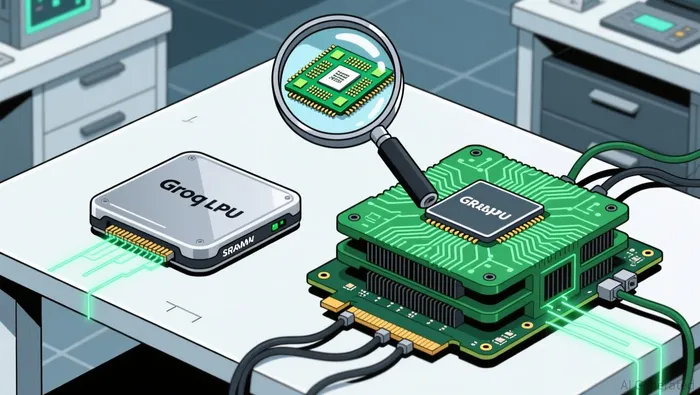
This technological lead, however, may inadvertently create an opening for Chinese chipmakers. The fragmentation of the AI inference market, where not all AI workloads will run in data centres, means that specialized, non-data-center applications could be served by domestic alternatives. As Nvidia consolidates its position in the high-performance, system-optimized inference space, Chinese companies may find niches in edge computing, specialized inference tasks, or other workloads that do not require the full power of Nvidia's integrated racks. The bottom line is that Nvidia's bet secures its position at the premium end of the inference stack, but it does not close the door on competition in the broader, more fragmented landscape.
Financial Impact and Valuation Scenarios
The $20 billion Groq deal is Nvidia's largest AI-related transaction since the Mellanox acquisition, representing a massive capital allocation to secure a future growth curve. This is not a minor R&D expenditure; it is a strategic bet on the exponential adoption of agentic AI, where inference will be the primary cost center. The financial implication is clear: Nvidia is paying a premium today to capture the infrastructure layer for tomorrow's dominant paradigm. The success of this investment hinges entirely on execution. The company has yet to officially confirm the final product roadmap or integration plan, despite multiple new hires for the LPU team. The primary valuation risk is therefore execution risk. Failure to accelerate inference adoption or to successfully integrate the LPU technology could delay the monetization of this massive investment for years.
The potential payoff, however, is a significant expansion of Nvidia's addressable market. By combining Groq's ultra-low-latency LPU with its own Vera Rubin platform, Nvidia aims to offer complete, optimized racks for agentic AI workloads. This system-level approach could command premium pricing and lock in customers, driving both revenue growth and margin expansion. The deal also neutralizes a key competitor in the inference space, protecting Nvidia's broader AI services business. Yet, the financial calculus depends on the company's ability to scale this new technology. The hiring spree and the upcoming GTC announcements are the first steps, but the real test will be whether Nvidia can translate Groq's specialized architecture into a commercially viable, high-volume product that developers adopt at the pace of the underlying paradigm shift.
In the near term, the deal adds a layer of complexity to Nvidia's financials. The $20 billion cost is a direct hit to cash flow, though it is structured as an IP license and team acquisition to avoid a full merger review. The long-term return will be measured in market share capture and pricing power within the inference stack. For now, the investment is a bet on a future where the demand for real-time, interactive AI services grows exponentially. If Nvidia can deliver on that promise, the financial impact will be transformative. If it cannot, the valuation premium built on the Blackwell and Vera Rubin order backlog may face pressure from the execution gap.
Catalysts and Key Watchpoints
The investment thesis now hinges on a series of forward-looking events that will validate Nvidia's bet on the inference infrastructure layer. The first major product catalyst is the official launch and shipping timeline for the Nvidia Groq 3 LPU, scheduled for the second half of 2026. This is the tangible proof point for the $20 billion acquisition. Success here means Nvidia can begin monetizing its specialized architecture for agentic AI workloads. Failure to meet this timeline or to achieve strong initial adoption would signal execution risk and delay the payoff on this massive capital allocation.
Beyond the product launch, the key indicator will be the adoption rate of the Vera Rubin platform and the integration of LPUs into cloud vendor offerings. The company's strategy is to sell complete "AI factories," not just chips. Therefore, the pace at which major cloud providers and enterprise customers adopt the integrated LPU+Vera Rubin racks will be the true measure of market penetration. Analysts note the widening gap between Nvidia and Chinese rivals is evolving from individual chip performance to system-level dominance. The first wave of cloud vendor integrations and customer deployments will be critical data points on whether this system-level approach gains traction.
Finally, investors must watch for U.S. policy clarity on legacy Hopper chip exports to China. While the restart of H200 production provides a near-term revenue catalyst, the long-term trajectory depends on regulatory stability. Recent signals suggest a potential segmenting of Nvidia's portfolio by region and performance tier, with older chips seeing looser export treatment while newer architectures remain tightly controlled. This policy environment directly impacts the near-term China revenue trajectory and the company's ability to serve a massive, regulated market. Any shift in licensing conditions will be a major catalyst for the stock, either unlocking pent-up demand or reinforcing the constraints that keep China revenue separate from the exponential growth forecast.
Disclaimer: The content of this article solely reflects the author's opinion and does not represent the platform in any capacity. This article is not intended to serve as a reference for making investment decisions.
You may also like
Technip Energies Share Buyback Misses Skin-in-the-Game Alignment as Insiders Sell, Raising Pump-and-Dump Flags

ANKR (ANKR) fluctuated 47.6% in 24 hours: Trading volume surged over 2500%, driving a 30.6% price rebound

Trending news
MoreCrypto prices
More





