
Adobe's AI Moat in Question as Market Prices in CEO Transition Risk

The market's reaction to Adobe's CEO transition was a classic "sell the news" event. On Thursday, the company announced that long-time CEO Shantanu Narayen will step down after a successor is named, with Narayen staying on as board chair. The news sent shares tumbling over 7% in extended trading. The key expectation gap is that this leadership change amplified existing fears, even as the company delivered strong financial results.
The immediate context makes the drop more striking. AdobeADBE+0.93% reported a solid first quarter, with revenue of $6.40 billion and adjusted earnings per share of $6.06, both beating analyst estimates. The company also raised its second-quarter guidance, calling for $5.80 to $5.85 in adjusted EPS on $6.43 to $6.48 billion in revenue. In other words, the operational news was positive. Yet the stock fell sharply on the leadership announcement.
This divergence points to a market that had already priced in significant uncertainty. The broader context shows Adobe's shares are down 23% year-to-date and around 22% so far this year. That steep decline is part of a broader selloff in software sparked by concerns about the impact of artificial intelligence. Investors have been worried about AI disruption to Adobe's core subscription model and its competitive moat. The CEO transition, coming at a critical inflection point for the company's AI strategy, acted as a catalyst that crystallized those fears.
The market's verdict was clear: the promise of strong earnings was outweighed by the amplified risk of a leadership change during a period of intense technological disruption.The AI Disruption Thesis: What the Market Fears
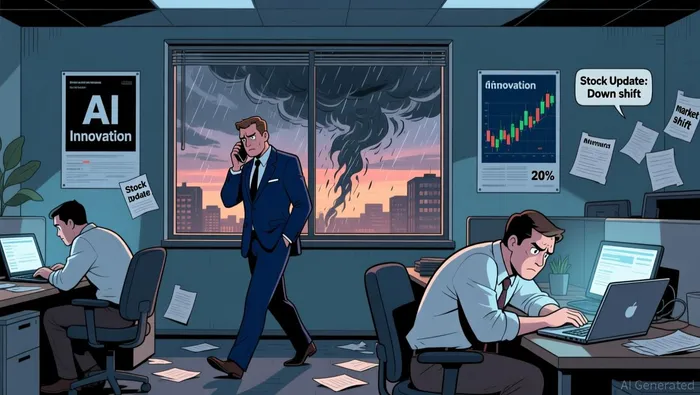
The market's deep skepticism isn't about Adobe's current execution; it's about its future moat. The core bear case is that artificial intelligence is democratizing design, empowering a new generation of rivals to chip away at Adobe's dominance. Analysts worry that tools from companies like Canva, Figma, and even OpenAI are lowering the barrier to entry, making Adobe's premium software less essential for everyday creators. This threat has crystallized into a decade-low analyst outlook, where the Street's confidence has visibly eroded.
The financial targets for the current fiscal year illustrate this tension. Management has set a projected 10%+ year-over-year annual recurring revenue (ARR) growth target for FY26. On the surface, that's solid growth. But the plan comes with a clear cost: the company expects non-GAAP operating margins to decline to 45%. In other words, the market is being asked to pay for growth that is simultaneously pressuring profitability. This is the expectation gap in a nutshell-growth is being monetized at a lower margin, raising questions about the sustainability and quality of that expansion.
This bearish view is reflected in the valuation. Adobe's stock trades at just 14x FY26 earnings per share (EPS), a steep discount to the 26x median of large-cap software peers. That discount is the market's verdict on the perceived risks. It suggests investors are pricing in significant uncertainty around Adobe's ability to maintain its pricing power and competitive edge in an AI-driven landscape. The valuation gap explains the skepticism: even with a strong beat on earnings, the market is looking past the present to a future where growth may be harder to achieve and less profitable to deliver.
The Reality Check: What the Numbers Say
The market's fears are starkly at odds with the underlying financial reality. While investors fret about AI disruption, Adobe's core business is demonstrating robust, if not explosive, growth. The first-quarter results show a clear beat on the top line. Total revenue came in at $6.40 billion, topping the $6.28 billion estimate. More specifically, the critical Creative & Marketing subscription segment, which drives the company's recurring revenue, delivered $4.39 billion, exceeding the $4.32 billion consensus. This isn't just a beat; it's evidence of resilient customer spending on Adobe's product suite.
Digging deeper, the Digital Media business is scaling effectively. The company's annual recurring revenue (ARR) for that segment hit $19.2 billion, growing 11.5% year-over-year. Crucially, over 75% of that new ARR came from existing customers upgrading or adding subscriptions-a powerful signal of product stickiness and successful cross-selling. This is the kind of organic, high-quality growth that typically commands a premium, yet it's being overshadowed by broader sector anxiety.
The expectation gap is most visible in the valuation. Despite this solid performance, the stock has been in a steep reset. Over the last 120 days, shares have fallen nearly 30% and recently hit a 52-week low of $244.28. The market is pricing in a future of harder growth and lower margins, as seen in the 14x forward P/E ratio, a deep discount to the software sector median. In other words, the market is looking past a quarter of strong execution to a future where the competitive moat is perceived as thinner.
The bottom line is that the financials are holding up. The business is growing its core subscription base and generating solid cash flow. The market's reaction, however, suggests that the whisper number for Adobe's future has been reset far lower than the current operational reality. The stock's plunge on the CEO news is a "sell the news" event amplified by pre-existing fears, not a reflection of the underlying business performance. For now, the expectation gap is wide, with the market pricing in a more challenging future than the numbers currently show.
The Succession Search and Strategic Continuity
The board's response to the leadership transition is a textbook attempt to manage risk. They have appointed Lead Independent Director Frank Calderoni to chair a special committee tasked with the search, with both internal and external candidates in the frame. This move is designed to ensure a rigorous, independent process. More importantly, the board has structured the handoff to minimize operational disruption. Shantanu Narayen will remain as Chair of the Board, providing continuity and support to the incoming CEO. The stated mission is clear: to select a leader who can make the "empower everyone to create" AI opportunity case convincingly.
This is a direct attempt to close the expectation gap. The market's fear is that the transition will delay or derail the critical AI pivot. By keeping Narayen on as Chair and launching a formal search, the board is signaling that the strategic direction is secure. The process itself is a near-term catalyst, offering a potential timeline for clarity. However, the lack of a stated timeline for the search introduces its own uncertainty. The board's actions mitigate the immediate shock of the news, but they do not eliminate the underlying question of whether the next CEO can execute the difficult task of converting AI's promise into premium, profitable revenue.
The board's focus on selecting a leader for the "next exciting chapter" of growth is telling. It acknowledges that the challenges ahead are different from those Narayen faced. As noted in the evidence, the incoming CEO must convert the large base of free or low-cost AI users into enterprise subscribers while fending off new competitors. The board's process is about finding someone who can navigate this specific inflection point. Whether it succeeds in reassuring skeptical investors will depend on the quality of the eventual candidate and how quickly they can demonstrate progress on the AI monetization front. For now, the board has managed the transition risk, but the market's verdict on the company's future will still hinge on the next CEO's ability to deliver on that ambitious AI vision.
Valuation and Catalysts: What to Watch
The steep valuation reset is the clearest signal that the market has priced in a worst-case scenario. Adobe's stock is down nearly 30% over the last 120 days and recently hit a 52-week low of $244.28. This plunge has compressed the forward P/E to just 14.8x, a deep discount to the large-cap software sector median of 26x. For context, the stock is also down 27% year-to-date. This isn't a minor correction; it's a fundamental reassessment of the growth story, with investors demanding a lower price for the perceived risks.
The next major catalyst is the second-quarter earnings report. That release will be the first major test of whether the market's fears are overdone. Investors will scrutinize the numbers for concrete evidence that Adobe's AI-driven growth is materializing. The company has already raised its Q2 guidance, calling for $5.80 to $5.85 in adjusted EPS on $6.43 to $6.48 billion in revenue. A beat on those targets would be a positive signal, but the real focus will be on the quality of growth-specifically, whether the company is successfully converting its massive user base into higher-value, AI-powered subscriptions. Any stumble here would likely widen the expectation gap.
Beyond the quarterly report, watch for updates on two other fronts. First, any progress on the CEO search timeline will be critical. The board has appointed a special committee, but the lack of a stated timeline for the search introduces its own uncertainty. A clear process could help reassure investors that strategic continuity is being prioritized. Second, monitor the board's and management's communications for emphasis on the AI strategy. The board's stated mission is to select a leader for the "next exciting chapter" of growth. The market will be listening for concrete details on how that chapter will be written, especially regarding monetization of AI features.
The bottom line is that the current setup is a high-stakes test of expectations. The valuation is deeply pessimistic, pricing in a future of harder growth and lower margins. The upcoming events-the Q2 earnings, potential search updates, and strategic messaging-are the catalysts that will either close that gap by proving the bear case wrong or widen it further by confirming the market's fears. For now, the stock's steep decline means the bar for a positive surprise is set very low.
Disclaimer: The content of this article solely reflects the author's opinion and does not represent the platform in any capacity. This article is not intended to serve as a reference for making investment decisions.
You may also like
AMD Forms HBM4 Partnership with Samsung and OpenAI, Posing a Challenge to NVIDIA's Dominance in AI Memory
Uplink Targets the Agentic AI Uplink Bottleneck with DePIN Infrastructure Play

Bloom Energy's standalone fuel cells address AI energy shortages as requirements are set to triple by 2030

AINBSC (InfinityGround) fluctuated 42.6% in 24 hours: Surge in trading volume driven by low-liquidity market
Trending news
MoreCrypto prices
More





