
Bitcoin’s Fed Tracker: Using Inflation and Jobs Reports to Gauge Liquidity

The Federal Reserve’s Dilemma: Balancing Employment and Inflation
The Federal Reserve is currently navigating a challenging environment as it tries to fulfill its dual mandate. The job market is showing signs of weakness, with unemployment climbing to 4.3% in January and further to 4.4% in February. Meanwhile, inflation remains persistent, with core PCE inflation running at 2.9% year-over-year—still above the Fed’s target. This puts policymakers in a tough spot: lowering interest rates could help employment but risks fueling inflation, while keeping rates high to curb inflation might further weaken the labor market.
Geopolitical Pressures and Inflation Risks
Complicating matters, geopolitical tensions have intensified. The closure of the Strait of Hormuz due to conflict in the Middle East has disrupted about 20% of the world’s oil supply. With oil prices now exceeding $100 per barrel, there is a significant risk of imported inflation. This scenario has made the Fed’s policy outlook highly uncertain—described by one official as a “coin toss”—since the conflict could both hinder economic growth and drive prices higher at the same time.
Market Expectations and Crypto Implications
Financial markets overwhelmingly expect the Fed to leave rates unchanged. According to the CME FedWatch Tool, there is a 98.1% chance that rates will remain at 3.50-3.75% this week. This expectation of no immediate policy change is a key signal for crypto markets, suggesting that the cost of capital will stay stable for now.
How Fed Signals Influence Crypto Markets
The uncertainty surrounding the Fed’s next steps directly impacts crypto liquidity. With markets assigning a 98-99% probability of a rate hold, the actual decision is largely anticipated. What matters more is the Fed’s forward guidance, which will shape investor risk appetite.
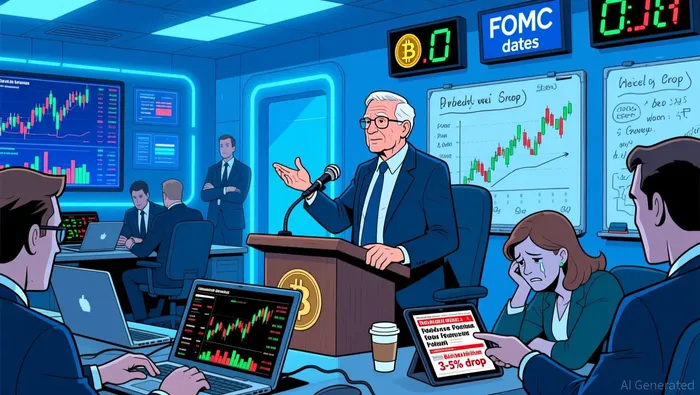
Historically, this setup has led to a predictable pattern in crypto. For example, Bitcoin experienced declines after seven out of eight FOMC meetings in 2025, not because of the rate decision itself, but due to Chair Powell’s commentary. Typically, when a widely expected outcome is confirmed, early investors take profits and leveraged positions are unwound, resulting in a “sell-the-news” reaction that often causes a 3-5% drop in the two days following the meeting.
BTCUSD MACD Crossover Long-Only Strategy Overview
- Entry Criteria: Buy when MACD (12,26,9) crosses above its signal line and the closing price is above the 20-day simple moving average.
- Exit Criteria: Sell when MACD crosses below the signal line, after 15 days, or if take-profit (+5%) or stop-loss (-3%) levels are hit.
- Risk Controls: Take-profit at 5%, stop-loss at 3%, maximum holding period of 15 days.
Backtest Results
- Strategy Return: 7.25%
- Annualized Return: 20.22%
- Maximum Drawdown: 0%
- Win Rate: 100%
| Total Trades | 1 |
| Winning Trades | 1 |
| Losing Trades | 0 |
| Win Rate | 100% |
| Average Hold Days | 5 |
| Max Consecutive Losses | 0 |
| Profit Loss Ratio | 0 |
| Average Win Return | 7.25% |
| Average Loss Return | 0% |
| Max Single Return | 7.25% |
| Max Single Loss Return | 7.25% |
What’s Needed for a Breakout?
For the market to move decisively, fresh capital must enter the space. This means that after the Fed meeting, a rise in open interest and trading volume is necessary—not just a knee-jerk reaction to the Fed’s statement. Without this influx, prices are likely to remain confined within the $70,000 to $76,000 range that has characterized recent trading. The crucial factor will be whether the Fed’s updated projections and commentary can inspire new buying activity.
Key Catalysts and Risks to Monitor
- Fed Guidance: The main driver for markets will be the Fed’s outlook, not the rate decision itself. With a 98-99% chance of a hold already priced in, attention will focus on Chair Powell’s remarks regarding future rate cuts. A more aggressive stance on inflation or hints at further tightening could trigger additional selling and liquidations.
- Potential Upside: If Powell signals a greater emphasis on supporting employment—given the softening labor market—this could be interpreted as dovish, potentially boosting risk appetite and increasing crypto market liquidity.
- External Shocks: Keep an eye on oil prices and geopolitical events. The ongoing conflict in the Middle East, which has closed the Strait of Hormuz and stranded a significant portion of global oil supply, continues to pose a risk of higher imported inflation. With oil trading above $100 per barrel, the Fed’s policy path remains highly uncertain as both growth and inflation risks persist.
Disclaimer: The content of this article solely reflects the author's opinion and does not represent the platform in any capacity. This article is not intended to serve as a reference for making investment decisions.
You may also like
WBD's $31 Merger: Examining the $887M Windfall and Market Movement

AMD Forms HBM4 Partnership with Samsung and OpenAI, Posing a Challenge to NVIDIA's Dominance in AI Memory

Uplink Targets the Agentic AI Uplink Bottleneck with DePIN Infrastructure Play

Trending news
MoreCrypto prices
More





