
Institutional Holdings Drop by 51.43% as Volkswagen's Efforts to Reassure Major Investors Fall Short

Board Re-Election: A Signal of Stability or a Temporary Fix?
The Supervisory Board’s decision to put forward Hans Dieter Pötsch for another term as Chairman is a textbook move to reassure stakeholders. This gesture is meant to convey steadiness during a period of significant internal challenges. The underlying message is one of maintaining the current leadership to navigate uncertainty. However, seasoned investors know that such signals only carry weight if they are matched by meaningful insider commitment. The real question is whether those with the most at stake are acting in line with this show of confidence.
This reassurance comes at a time when Volkswagen’s leadership is under intense scrutiny. CEO Oliver Blume has presided over a combined 48-billion-euro drop in market value for Volkswagen and Porsche. His recent initiatives—including a risky partnership with Rivian and a strategic pivot towards China—are now the focal point for investors. The pressure was evident in the latest financial results, where Volkswagen posted earnings per share of 3.39 EUR, well below the 5.99 EUR forecast. The board’s endorsement of Pötsch is therefore a public vote of confidence in the current leadership’s ability to steer the company through these challenges.
For institutional investors, however, a board vote is just one piece of the puzzle. The crucial issue is whether insiders are putting their own capital behind the narrative. Pötsch’s nomination, given his financial background, signals a focus on fiscal discipline—something that may appeal to large shareholders. Yet, with disappointing earnings and mounting pressure on the CEO, there’s a risk that this move is more about buying time than enacting real change. When headline numbers disappoint and leadership credibility is in question, continuity can sometimes serve as a smokescreen rather than a solution.
Ultimately, sending a message of stability is easy. The real test is whether institutional investors are increasing their stakes ahead of the June vote, signaling belief in a turnaround, or quietly reducing their exposure, interpreting the board’s actions as a last-ditch effort. Until insider trading data or 13F filings reveal a shift, the board’s nomination remains a gesture of hope rather than a guarantee. In the end, the market’s true sentiment will be reflected in trading activity, not in official statements.
Insider Commitment: Leadership Changes and Board Strategy
By nominating Hans Dieter Pötsch for another term, the board is signaling a preference for continuity and steady leadership. This suggests that those at the helm see no need for drastic change. Yet, for sophisticated investors, the real alignment of interests is found in actual trades, not in press releases. Recent developments involving CEO Oliver Blume add complexity to the story.
Absolute Momentum Long-only Strategy: VLKAF
- Entry Criteria: 252-day rate of change is positive and price closes above the 200-day simple moving average.
- Exit Criteria: Price closes below the 200-day SMA, after 20 trading days, or upon reaching a take-profit of +8% or a stop-loss of −4%.
- Backtest Period: March 20, 2024, to March 19, 2026.
- Results: Strategy Return: 0%, Annualized Return: 0%, Max Drawdown: 0%, Win Rate: 0% (No trades executed in the backtest period).
Blume’s recent five-year contract extension brings some stability, but it also marks a turning point. His departure from the dual CEO role at both Volkswagen and Porsche in January allows him to focus exclusively on Volkswagen’s recovery. The board’s trust in both Blume and Pötsch is evident. However, the market’s reaction suggests skepticism about the current direction.
Although there are no recent Form 4 filings for Blume, the sharp reduction in institutional ownership tells a different story. Data indicates a 51.43% decrease in institutional holders over the last quarter—a significant withdrawal. When major investors exit, it’s a strong signal that the company’s fundamentals or outlook are not convincing. This drop in institutional accumulation is a critical indicator that large investors are not buying into the current narrative.
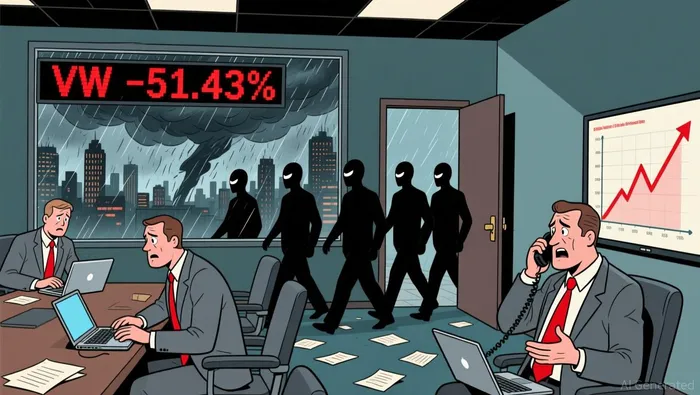
In this context, the board’s approach appears to be one of cautious consistency. By keeping Pötsch, who has been in place since 2015, they are emphasizing financial discipline and stable governance. However, with the company facing a 48-billion-euro loss in value and recent earnings disappointments, this preference for the familiar may be exactly what large investors are fleeing. The board is offering stability, but institutions are choosing to exit, suggesting that the market sees more risk than reassurance.
Institutional Investors: A Shift from Accumulation to Exit
The board’s message of continuity is clear, but the data on institutional ownership paints a different picture—one of significant withdrawal. Despite efforts to signal stability, major investors are not convinced. The numbers are stark: institutional ownership has dropped by 51.43% in the latest quarter, representing a substantial retreat rather than a minor adjustment.
A closer look at the shareholder structure reveals that the largest institutional investors are passive index funds, not active managers. The top holders include the Vanguard Total World Stock Index Fund ETF Shares and the Vanguard FTSE All-World ex-US Index Fund ETF Shares. These funds follow global benchmarks and are not making targeted bets on Volkswagen’s recovery. Their lack of active engagement means there’s no influential investor pushing for change or improvement. The so-called “whale wallets” are simply tracking the index, not expressing confidence in the company’s strategy.
In summary, while the board is promoting a narrative of stability and prudent management, institutional data shows that major investors are not buying in. The large-scale exit of passive funds signals a lack of confidence in the company’s future. This is a classic case of insider optimism clashing with the market’s decision to move on. For sophisticated investors, the real story is told by the trades—and right now, those trades are heading for the exit.
Financial Pressures and the Road to Recovery
The board’s endorsement of continuity is a strategic move, but the underlying financial situation remains challenging. Volkswagen’s recovery plan is built on the hope of improving profit margins, but the numbers reveal ongoing struggles.
The key metric is the operating margin. After a difficult 2025, when the margin was just 2.8%, the company is forecasting a modest increase to between 4.0% and 5.5% for 2026. While this represents progress, it’s still a recovery from a weak position, highlighting ongoing financial stress rather than strength. This fragile margin is the foundation of the turnaround story, but it remains under significant pressure.
Revenue figures tell a similar story. Volkswagen reported 322 billion EUR in revenue for 2025, nearly unchanged from the previous year. However, this apparent stability hides a sharp 64% drop in operating profit from the automotive division. While financial services helped offset some losses, the core car business is struggling, especially in key markets like China where Volkswagen’s dominance has waned. The company’s “in China for China” strategy is a critical test, and investors are watching closely to see if CEO Blume can deliver results. The margin recovery plan is directly tied to regaining momentum in these high-stakes markets.
Investors are waiting for a catalyst to confirm or refute the turnaround story. A crucial $1-billion investment in new technology is pending, and this year’s winter testing will be a significant milestone. For institutional investors, these events are not just routine—they are decisive moments for the Rivian partnership and the company’s broader software strategy. If these tests fail to show progress, the margin recovery plan will appear increasingly desperate. The ongoing institutional exodus suggests that confidence is low, and investors are waiting for concrete evidence of improvement before reconsidering their positions.
Key Events and Risks: What Investors Should Monitor
The board’s stabilization efforts are now set against a backdrop of upcoming events that will test the turnaround narrative. The first major milestone is the Annual General Meeting on June 18, where shareholders will vote on Pötsch’s nomination and Blume’s strategy. A strong endorsement would support the board’s approach, while significant opposition would signal skepticism among stakeholders and cast doubt on the stabilization story.
The most important metric to watch is the 2026 operating margin. Volkswagen aims for a margin between 4.0% and 5.5%, up from 2.8% in 2025. Achieving this target is crucial for the turnaround thesis. Falling short—especially if results are at the lower end—would confirm that margin pressures are structural, not temporary, and would validate the recent wave of institutional selling.
Finally, investors should watch for any significant insider buying as a potential sign of renewed confidence. While current trends show caution and large-scale selling, a notable increase in insider purchases could indicate that those closest to the company see value the market is missing. However, given the scale of recent withdrawals by passive funds and institutions, any insider buying would need to be substantial to reverse the prevailing sentiment. For now, the data suggests that major investors are waiting for proof of progress before making new commitments.
Disclaimer: The content of this article solely reflects the author's opinion and does not represent the platform in any capacity. This article is not intended to serve as a reference for making investment decisions.
You may also like

MLSS Surges 13% After Hours — But No News Explains It

Strive's Bitcoin Accumulation Faces Liquidity Test as GAAP Losses Hit $393.6M

Trending news
MoreCrypto prices
More





