
Enterprise Products Partners (EPD) Receives Overweight Rating Due to Favorable LPG Export Trends and Inflation-Resistant Expansion

Enterprise Products Partners: A Value Investor’s Fortress
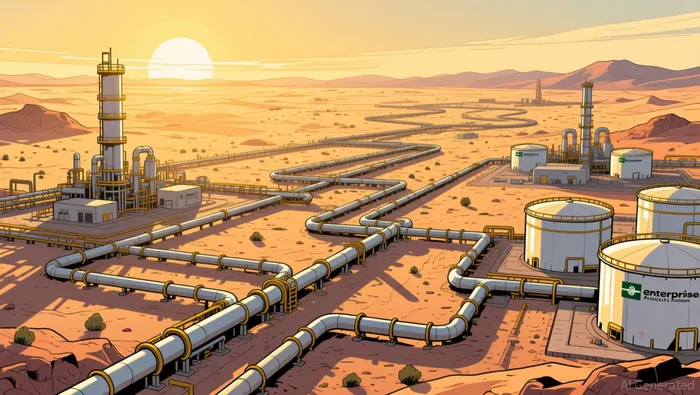
At the heart of value investing lies the pursuit of resilient, high-quality cash generation. Enterprise Products Partners (NYSE: EPD) exemplifies this principle with an exceptionally robust foundation. The company manages an extensive network of pipelines and storage facilities, stretching over 50,000 miles and accommodating more than 300 million barrels. This infrastructure underpins its steady cash flows, but the true strength lies in its business model: nearly 90% of its long-term contracts feature fee adjustment mechanisms, effectively insulating earnings from inflation. As costs rise, Enterprise can adjust its fees accordingly, preserving the real value of its cash flows.
In 2025, this resilience was evident. The partnership reported operational distributable cash flow (DCF) of $7.9 billion, matching the previous year’s result. While the figure remained stable, its quality stood out—this cash flow covered distributions by 1.7 times, providing ample flexibility for both growth and reinvestment. Enterprise retained $3.2 billion of this DCF to fuel expansion, laying the groundwork for future increases in cash generation.
Enterprise’s commitment to rewarding unitholders is equally noteworthy. The company has increased its distribution for 27 straight years, reflecting both financial strength and prudent management. These distributions are not speculative—they are reliable, compounding returns supported by a fee-based model. The inflation protection built into its contracts ensures that these returns retain their purchasing power over time, a rare advantage in today’s market. For value-focused investors, this combination of a wide economic moat and dependable cash generation is the ideal scenario: a business that can reinvest or return capital while remaining shielded from major economic risks.
The Moat and Growth Strategy
Long-term value is determined not only by current cash flows, but also by the competitive barriers that protect them and the mechanisms that drive future growth. Enterprise Products Partners has constructed a formidable fortress through scale and integration. Its network of over 50,000 miles of pipelines and more than 300 million barrels of storage creates a significant barrier to entry. This is more than just a collection of assets—it’s a highly integrated system that delivers operational efficiency and pricing power, securing stable, fee-based cash flows.
This competitive moat is continuously strengthened by a disciplined growth engine. Enterprise is not simply maintaining its infrastructure; it is expanding it. The partnership is set to generate additional cash flows from billions of dollars in strategic capital projects, many of which are already operational or nearing completion. By reinvesting its own cash flow, Enterprise compounds its intrinsic value—a virtuous cycle where stable cash supports growth, and growth, in turn, generates more stable cash.
Wall Street is taking notice. Wells Fargo recently upgraded Enterprise to “Overweight” with a $42 price target, citing the company’s strong position to benefit from global shifts in energy demand—especially the rise in U.S. liquefied petroleum gas (LPG) exports as Europe moves away from Russian energy. This is not a short-lived trend, but a multi-year demand driver that aligns perfectly with Enterprise’s export-oriented projects. The upgrade, announced just days ago, pushed shares higher, signaling that the market is beginning to recognize the company’s long-term advantages.

While some analysts remain cautious, value investors focus on the partnership’s enduring strengths rather than short-term market fluctuations. The evidence points to a company with a wide moat, disciplined capital allocation, and a robust growth pipeline that is starting to be acknowledged by major analysts. The real margin of safety lies not just in the current price, but in the quality and scale of Enterprise’s cash flow engine.
Valuation: Assessing the Margin of Safety
Enterprise’s attractive yield is a clear draw, but prudent investors look beyond the payout to the price paid for future cash flows. The partnership currently offers a yield of about 5.6% following its latest quarterly distribution—a compelling entry point for income-focused investors. However, the true margin of safety comes from comparing the price to the company’s intrinsic value, especially in light of its growth prospects and market expectations.
Analyst consensus is cautiously optimistic, with the stock carrying a “Moderate Buy” rating and an average price target near $37.20, suggesting limited upside in the near term. Yet, Wells Fargo’s recent upgrade to a $42 target implies nearly 10% potential appreciation, reflecting confidence in the company’s strategic projects and the long-term demand for U.S. energy exports. This demonstrates how the margin of safety can expand as the market begins to price in these advantages.
Recent insider purchases by the CEO and a director further reinforce management’s confidence. When the chief executive buys shares at an average price of $37.55, it signals alignment between leadership’s interests and the company’s intrinsic value—a classic indicator for value investors. With insiders holding about 32.6% of the stock, their commitment is significant.
For value investors, the margin of safety here is anchored not just in a favorable price, but in the combination of high-quality, inflation-protected cash flows and a valuation that is starting to reflect the company’s growth story. The current yield provides tangible returns while Enterprise continues to compound its value. Recent analyst upgrades and insider buying suggest the market is beginning to recognize this opportunity. For disciplined investors, this setup offers a wide moat, resilient cash flows, and a potential entry point supported by both income and growth prospects.
Key Catalysts, Risks, and Monitoring Points
For those focused on long-term value, the real test is not today’s share price, but the execution of Enterprise’s strategic plan. The main catalyst is the successful completion and cash flow contribution from the company’s multi-billion dollar project pipeline. These projects are not speculative—they are designed to drive future distribution growth. Enterprise’s ability to reinvest its own cash flow into these initiatives is what compounds its intrinsic value. Investors should monitor quarterly updates on project progress and the incremental cash flows they generate to confirm the growth trajectory remains intact.
One of the most significant tailwinds is the ongoing transformation of global LPG markets. Europe’s complete ban on Russian LPG by March 2026 has created a long-term opportunity for U.S. exporters. This is not a temporary shift, but a sustained increase in demand that directly benefits Enterprise’s export infrastructure. The company’s strategic positioning as a key player in this trend was central to Wells Fargo’s recent upgrade. Keeping an eye on export volume data and regulatory changes affecting U.S. energy flows will provide real-time confirmation of this advantage.
The primary risk remains a prolonged period of low commodity prices or reduced pipeline volumes. While Enterprise’s fee-based, inflation-protected model offers a strong buffer, it is not immune to sustained downturns in the energy market, which could pressure fees and slow project growth. The company’s reliance on its vast network means that any significant drop in utilization would impact cash flows—a vulnerability that value investors must watch closely.
Ultimately, Enterprise Products Partners offers a disciplined approach to compounding value amid a backdrop of geopolitical shifts. The margin of safety is rooted in the quality of its cash flows, but is also tested by the execution of its growth strategy. Recent analyst upgrades and insider buying highlight the tension between long-term advantages and short-term market sentiment. For patient investors, the priorities are clear: track the progress of key projects, monitor the evolving LPG export landscape, and remain alert to any signs that the company’s core business model is under threat.
Disclaimer: The content of this article solely reflects the author's opinion and does not represent the platform in any capacity. This article is not intended to serve as a reference for making investment decisions.
You may also like
SinoPac's Consolidation Sparks Concerns: Does Bigger Really Mean Better, or Just Higher Costs?
1000CATTRY Bounces From 0.067, But Volume Fails to Confirm Strength

CHOW's May 12 Lead Plaintiff Cutoff Triggers Market Fluctuations Amid Rising Fraud Accusations

Duolingo Faces Legal Overhang as Strategic Reinvestment Presses on Uncertain Path to 100M DAUs

Trending news
MoreCrypto prices
More





