
Bitget UEX Daily | Iran Denies Direct Talks; Oil Price Back Above $100; Nasdaq 100 Rule Change May Open Door for SpaceX (March 31, 2026)
 Bitget2026/03/31 01:38
I. Hot News
Federal Reserve Dynamics
Fed Chair Powell: Tends to Keep Rates Unchanged Amid Energy Shock Federal Reserve Chair Jerome Powell stated on Monday that, against the backdrop of energy price shocks triggered by U.S.-Israel military action against Iran, the Fed can temporarily disregard this impact and is inclined to maintain current interest rate levels. However, if rising prices begin to alter long-term public inflation expectations, the Fed may act. New York Fed President John Williams added that the current monetary policy stance is effectively balancing employment and price stability risks. Governor Adriana L. Kugler (noted as “米兰” in source) indicated she would remain in her role until a new chair is confirmed and supports roughly 1 percentage point of rate cuts this year. Powell’s remarks quickly eased market concerns over forced Fed tightening, prompting traders to raise bets on a small-probability cut later in the year and pushing short-term U.S. Treasury yields down more than 10 basis points at one point. Overall, the statement injected a degree of certainty into the market and helped stabilize investor expectations for the policy path.
International Commodities
U.S. Oil Returns to Triple-Digit Territory as Iran Conflict Elevates Global Energy Risks Since the outbreak of U.S.-Israel military operations against Iran, U.S. WTI crude futures surged more than 3.4% on Monday to close at $106 per barrel—the highest since July 2022—with gains continuing into Tuesday; Brent crude moved in tandem. The IMF warned that the conflict could trigger a “global but asymmetric” shock, driving prices higher and weighing on economic growth, particularly for oil-import-dependent nations. The oil price spike directly reflects heightened tensions in the Strait of Hormuz, compounded by President Trump’s threats of further strikes on energy infrastructure, keeping short-term supply concerns in the driver’s seat. Investors should monitor the duration of the conflict; a quick agreement could put downward pressure on prices.
Macroeconomic Policy
White House Says Trump Hopes for Iran Deal by April 6; Iran Denies Direct Negotiations White House Press Secretary Karoline Leavitt said U.S. military operations against Iran are proceeding as planned and are expected to last 4-6 weeks. She revealed that President Trump hopes to reach an agreement before April 6—the previously extended deadline for striking energy facilities. Iran has already allowed 20 oil tankers through the Strait of Hormuz and is expected to permit another 20 soon. Iranian Foreign Ministry spokesman Esmaeil Baghaei firmly stated that, 31 days since the war began, Tehran has held no direct talks with Washington and has only received proposals via intermediaries such as Pakistan. Iran’s parliament passed a bill imposing transit fees on the Strait of Hormuz and banning U.S. and Israeli vessels; the first vice president warned that any U.S. attack on Kharg Island would be a “one-way trip.” Geopolitical uncertainty is amplifying oil-price volatility. The IMF expects supply-chain disruptions to push up food and fertilizer costs, raising near-term global inflation risks—the long-term outcome hinges on how the conflict evolves.
II. Market Recap
Commodities & Forex Performance
- Spot Gold: Rose 0.37% to approximately $4,527 per ounce, oscillating for a second straight day; oil strength and a firmer dollar exerted some pressure, yet geopolitical safe-haven demand provided support.
- Spot Silver: Slipped 0.05% to around $70 per ounce, showing greater volatility as industrial demand and safe-haven traits competed.
- WTI Crude: Climbed more than 3.4% to settle at $106 per barrel, driven by supply-disruption fears stemming from the Iran conflict.
- Brent Crude: Rose approximately 2.37% to $109 per barrel, with a significant geopolitical risk premium.
- U.S. Dollar Index: Edged up 0.02% to around 100.51, supported by safe-haven flows and the oil-price linkage.
Cryptocurrency Performance
- BTC: Gained 0.92% over 24H to $66,945, remaining in a range-bound pattern; oil shocks and U.S. equity weakness weighed on sentiment.
- ETH: Advanced 1.75% over 24H to approximately $2,033.
- Total Crypto Market Cap: Rose 0.4% over 24H to about $2.38 trillion.
- Market Liquidations: Total liquidations reached approximately $216 million over 24H; long-side liquidations totaled $111 million and short-side $105 million.
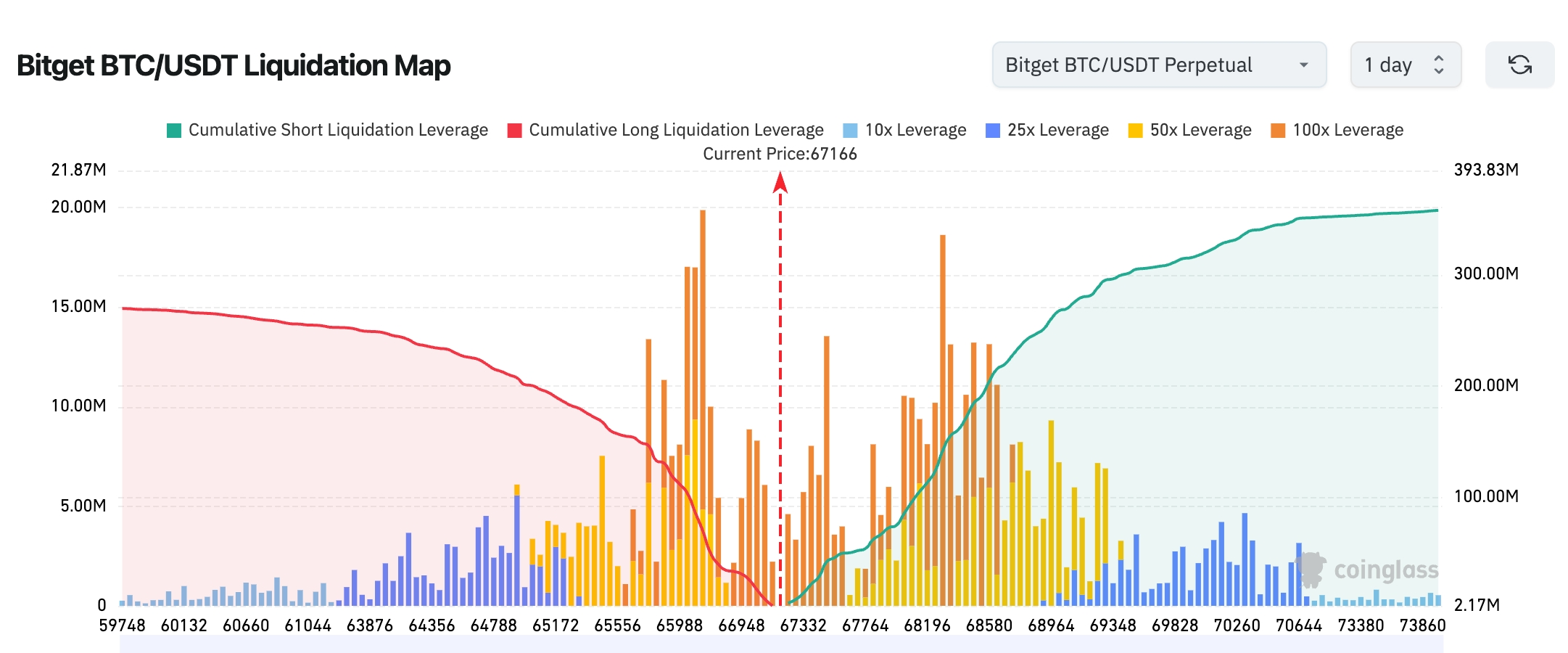
- Bitget BTC/USDT Liquidation Heatmap: Current price around $67,166. A clear cluster of short liquidations sits in the $66,800–$67,000 zone below, while a heavy concentration of 50x–100x leveraged long positions looms in the $68,000–$69,000 zone above. Any upside breakout could trigger cascading long liquidations. Overall structure tilts “heavier pressure overhead, firmer support underneath,” suggesting short-term high-level oscillation with repeated tests of the $67,000 support. A decisive directional move will require strong volume to clear $68,000.
- Spot ETF Net Flows: BTC spot ETFs recorded net inflows of about $61.9 million yesterday; ETH spot ETFs saw net inflows of about $10.6 million.
- BTC Spot Inflows/Outflows: BTC recorded inflows of approximately $2.334 billion and outflows of $2.274 billion yesterday, for a net inflow of about $60 million.
U.S. Equity Index Performance
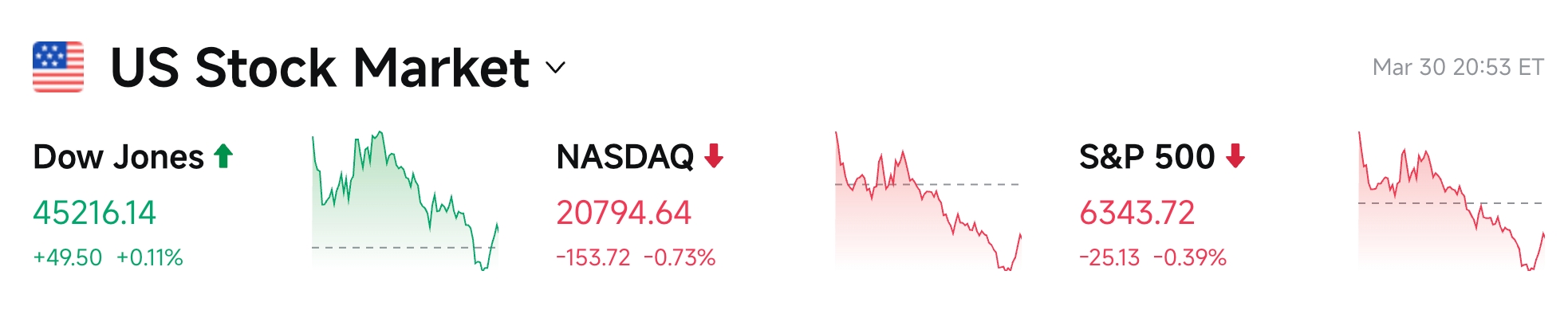
- Dow Jones: Rose 0.11% to close at 45,216 points, extending modest gains.
- S&P 500: Fell 0.39% to 6,343 points; energy-sector strength failed to fully offset technology weakness.
- Nasdaq: Declined 0.73% to 20,794 points; tech stocks led the drop, yet the overall decline narrowed.
Tech Giants Performance
- Apple (AAPL): –0.87% ($246.63), dragged by broader technology-sector weakness.
- Microsoft (MSFT): +0.61% ($358.96), supported by resilient AI business.
- Alphabet (GOOGL): –0.31% ($273.50), steady search and cloud operations.
- Amazon (AMZN): +0.81% ($200.95), solid e-commerce and cloud performance.
- NVIDIA (NVDA): –1.40% ($165.17), concerns over chip-cycle slowdown.
- Meta (META): +2.03% ($536.38), strong advertising momentum led the advance.
- Tesla (TSLA): –1.81% ($355.28), pressure from auto-delivery data. Overall, Meta and Amazon bucked the trend with gains driven by earnings resilience and defensive qualities; the remaining giants were weighed down by elevated oil prices and geopolitical risks.
Sector Rotation Highlights
Energy Sector +2.5%
- Representative stocks: Exxon Mobil (XOM) +3.2%, Chevron (CVX) +2.8%.
- Driver: Iran conflict lifted oil prices; supply-disruption fears dominated, making the sector a primary safe-haven play.
Semiconductor Sector –1.2%
- Representative stocks: NVIDIA (NVDA) –1.4%, AMD –1.8%.
- Driver: Rising inflation expectations from oil shocks raised fears of tighter Fed policy, pressuring growth-stock valuations.
III. In-Depth Company Analysis
1. Tesla (TSLA) – TERAFAB Super-Chip Factory Project
Event Overview: Tesla is accelerating the TERAFAB super-chip factory project, planning a $20–25 billion global-scale chip manufacturing base in deep strategic partnership with SpaceX and xAI. The facility is expected to deliver up to 1 TW of annual compute capacity, primarily for humanoid-robot training, autonomous-driving optimization, and broader AI infrastructure. This marks a pivotal step in Tesla’s transformation from traditional auto manufacturing to a full-stack AI ecosystem. In an environment where geopolitical conflict is driving up energy costs, the initiative not only bolsters internal compute self-sufficiency but also directly addresses the long-term global AI compute supply-demand imbalance. Once operational, it will further integrate Tesla’s hardware, software, and data-loop advantages into a distinctive competitive moat. Market Interpretation: Wall Street institutions broadly endorse the project as a major long-term boost to Tesla’s AI-hardware competitiveness. Goldman Sachs analysts note it will drive a valuation shift from auto-centric to high-margin AI services, though they caution investors to monitor capital-expenditure pacing and supply-chain stability to avoid near-term cash-flow strain. Investment Insight: Near-term project milestones are likely to act as a positive catalyst for the stock. Long-term investors should focus on capacity ramp timelines, humanoid-robot delivery benchmarks, and synergy with partners to capture core opportunities in the AI-hardware arena.
2. Apple (AAPL) – Major Redesign for Foldable iPhone
Event Overview: Apple’s next-generation foldable iPhone will undergo the largest redesign in company history: eliminating traditional Face ID in favor of a side-mounted Touch ID fingerprint solution, while comprehensively optimizing screen creasing and durability and improving overall feel. Launch is targeted for the second half of 2026. The changes stem from deep analysis of early foldable-device market feedback and aim to resolve user pain points, enhance experience, and stimulate replacement demand among existing iPhone owners. Against a backdrop of slowing global smartphone growth, this innovation is viewed as a key move to revive Apple’s premium consumer-electronics growth curve and further solidify its technological leadership in high-end foldables. Market Interpretation: Analysts generally believe the redesign will meaningfully lift the iPhone sales curve. Morgan Stanley and peers have upgraded Apple’s medium-to-long-term revenue and profit forecasts, while stressing the need to monitor short-term supply-chain adjustment costs—especially with elevated energy prices potentially amplifying raw-material and logistics volatility. Investment Insight: The opening of a new innovation cycle should support valuation repair. Investors may position early in related supply-chain partners and track pre-launch teasers and capacity updates to capture the potential replacement-cycle dividend.
3. Meta (META) – Instagram Premium Subscription Service Test
Event Overview: Meta Platforms has begun internal testing of an Instagram premium subscription tier that offers users exclusive content access, significantly reduced ads, and personalized AI tools. The test covers select key markets and represents Meta’s latest effort to diversify beyond its advertising-heavy revenue model. The goal is to spread risk, boost user stickiness, and raise ARPU through subscription income. With AI rapidly enhancing content creation and recommendation, the move optimizes the platform ecosystem and injects fresh momentum into Meta’s long-term growth in social and entertainment, complementing existing advertising and e-commerce businesses. Market Interpretation: Institutions note that the subscription model will further diversify Meta’s revenue mix, reduce reliance on advertising, and—when combined with deep AI integration—make the company’s growth trajectory clearer and more resilient. Analysts nevertheless urge close monitoring of user conversion rates and pricing strategy to ensure subscription revenue scales successfully. Investment Insight: Successful scaling of subscription income should materially strengthen Meta’s earnings resilience. Investors are advised to track test results, conversion metrics, and ARPU trends as key signals of platform monetization efficiency.
4. SpaceX and Other Unicorns – Nasdaq 100 Index Rule Change
Event Overview: Nasdaq has formally announced revisions to its “fast-track inclusion” index methodology, effective May 1, 2026. Under the new rules, newly listed shares need only reach the seventh trading day before eligibility assessment begins; if market capitalization meets the Nasdaq-100 threshold, inclusion can occur rapidly. The change directly benefits high-valuation unicorns such as SpaceX and OpenAI. It signals Nasdaq’s continued efforts to enhance index liquidity and inclusiveness, attract more innovative high-growth companies, and raise overall market vibrancy. In today’s environment of elevated geopolitical risk and energy-price volatility, the rule provides private and early-stage investors with a more efficient exit and valuation-realization channel while accelerating the capital-market maturation of quality tech assets. Market Interpretation: Multiple investment banks believe the optimization will markedly improve secondary-market liquidity and valuation premiums for high-quality tech firms, delivering long-term benefits to the innovation financing ecosystem. Analysts also highlight that market-cap thresholds will remain the core screening criterion and expect a swift rise in capital attention to related supply chains, while cautioning against short-term index volatility that could trigger valuation re-ratings. Investment Insight: Related industry chains are poised to attract incremental capital inflows. Investors should closely watch dynamic index-component adjustments and the listing timelines of unicorns such as SpaceX to seize opportunities around the rule-implementation window.
IV. Cryptocurrency Project Updates
- Bloomberg ETF analyst Eric Balchunas disclosed on X that LeverageShares has filed applications for three Bitcoin-volatility-related ETFs: the Leverage Shares Bitcoin Volatility Daily Bull ETF, the 2x Leverage Shares Bitcoin Volatility Daily Bull ETF, and the –1x Leverage Shares Bitcoin Volatility Daily Bear ETF. These products are analogous to the former XIV and TVIX but are based on Bitcoin.
- Jack Dorsey’s Square has begun automatically enabling Bitcoin payments for millions of U.S. merchants. Transactions are instantly converted to USD at checkout, allowing merchants to accept Bitcoin without extra setup, price-volatility risk, or custody responsibilities. The feature includes near-instant settlement and zero processing fees through 2026.
- Strategy disclosed in its latest regulatory filing that it made no new Bitcoin purchases in the week ended March 29, 2026, maintaining its holdings at 762,099 BTC—valued at more than $51.5 billion at the time. Separately, Bitmine Immersion Technologies (BMNR) reported purchasing 71,179 ETH last week and now holds 4,732,082 ETH, equivalent to approximately 3.92% of total ETH supply.
- U.S. Republican Senators Cynthia Lummis and Bill Cassidy introduced the American Mining Act, aimed at expanding the role of crypto mining in the U.S. economy and codifying President Trump’s executive order on establishing a strategic Bitcoin reserve. The bill directs the Department of Commerce to create a voluntary certification program for mining pools and facilities and requires certified operations to gradually phase out mining equipment manufactured by companies linked to foreign adversaries.
V. Today’s Market Calendar
Data Release Schedule
| 20:30 | U.S. | March Chicago PMI | ⭐⭐⭐ |
| 22:00 | U.S. | March Consumer Confidence | ⭐⭐⭐⭐ |
Key Event Preview
- Iran–U.S. indirect negotiation progress – Watch for any agreement before the April 6 deadline; outcome will directly influence oil prices and global risk appetite.
- Nasdaq-100 index rule revision observation period – Formal implementation begins May 1; focus on the likelihood of SpaceX and other unicorns joining the index.
April 1 (Wednesday)
- Tesla and other new-energy vehicle makers to release Q1 delivery figures; Tesla has already lowered its 2026 delivery guidance to 1.689 million units.
- 2028 FOMC voter and St. Louis Fed President Alberto Musalem to speak on the U.S. economy and monetary policy at 21:05.
- U.S. March ADP employment report at 20:15; February retail sales at 20:30; March S&P Global Manufacturing PMI final at 21:45; March ISM Manufacturing PMI at 22:00.
April 2 (Thursday)
- 2026 FOMC voter and Dallas Fed President Lorie Logan to speak at 23:00.
- U.S. initial jobless claims for week ending March 28 at 20:30.
April 3 (Friday)
- U.S. March unemployment rate and non-farm payrolls at 20:30; March S&P Global Services PMI final at 21:45.
- U.S. equities closed for Good Friday.
This week’s core themes center on Fed officials’ speeches, non-farm and ADP employment data, and Tesla delivery numbers. The combination of labor-market releases and policy signals is expected to heighten market volatility.
Institutional Views
Goldman Sachs and JPMorgan analysts concur that the Iran conflict will keep oil prices elevated in the $100–110 range in the near term. Resulting global inflation pressure may compel the Fed to maintain a “higher for longer” stance through 2026; however, Chair Powell’s “temporary disregard” comment has provided the market with a buffer. U.S. equities are therefore likely to trade in a range in the short run, with technology valuations under pressure while energy names find support. On the crypto front, Morgan Stanley notes that sustained BTC ETF inflows combined with the release of leveraged positions have laid groundwork for a potential rebound. Should geopolitical risks ease, Bitcoin could retest the $70,000 level; conversely, persistently high oil prices would continue to weigh on risk assets. Overall, geopolitical uncertainty remains the dominant variable—investors are advised to monitor upcoming Fed speeches and the latest Middle East developments closely.
Disclaimer: The above content is compiled through AI-assisted search and manually verified before publication. It does not constitute any investment advice.
Disclaimer: The content of this article solely reflects the author's opinion and does not represent the platform in any capacity. This article is not intended to serve as a reference for making investment decisions.
You may also like
Axon’s Software Moat Faces 300x P/E Test as Institutional Conviction Clashes with Valuation Risk


PFI’s Tactical Asset Sales Fuel High-Conviction Development Pipeline in a 99.9% Occupied Industrial Powerhouse

Tolu Minerals in Urgent Push to Convert Crucial Funding Into Gold Output Before Funds Are Depleted

Trending news
MoreCrypto prices
More





