
DMart Hits 500 Stores: Price Surge Fueled by Momentum

DMart Hits 500 Stores: Market Reaction & Growth Momentum
DMart's announcement of 12 new store openings, bringing its total to 500 locations, sparked a strong rally in its shares. The stock soared to an intraday peak of ₹4,294.80 and ended the day up nearly 8%.
This surge was fueled by a dramatic increase in trading volume on the BSE, which was over 3.5 times higher than usual. DMart became the top performer on the Nifty Next 50 index, underscoring investor enthusiasm for its expansion strategy.
The milestone of reaching 500 stores, achieved through swift and coordinated launches, has proven to be a powerful driver of investor confidence and liquidity.
Operational Model & Financial Performance
DMart's growth is anchored in a focused, cluster-based approach. By July 2025, the company operated more than 424 stores across 12 states, with over 90% of locations owned outright. This ownership and geographic concentration support robust financial results, including an 18.4% year-on-year revenue increase in the first quarter of FY2025-26.
Breakout Trading Strategy Overview
- Entry Criteria: Buy when the price closes above the 20-day high and trading volume exceeds 3.5 times the 20-day average.
- Exit Criteria: Sell when the price closes below the 20-day low, after 20 trading days, or when a take-profit of +8% or stop-loss of -4% is reached.
Backtest Results
- Total Return: -29.65%
- Annualized Return: -15.72%
- Maximum Drawdown: 37.83%
- Profit-Loss Ratio: 0.65
Trade Statistics
- Total Trades: 4
- Winning Trades: 1
- Losing Trades: 3
- Win Rate: 25%
- Average Hold Days: 2
- Max Consecutive Losses: 3
- Average Win Return: 13.16%
- Average Loss Return: 14.51%
- Largest Single Gain: 13.16%
- Largest Single Loss: 21.3%
DMart's operational efficiency stands out, with revenue per square foot at ₹33,896 and an inventory turnover rate of 13.6x, reflecting rapid stock movement and effective capital use. The company's "20-20-20" principle—targeting 20% market share, offering prices 20% lower, and achieving 20% higher margins—drives disciplined growth and top-line expansion.
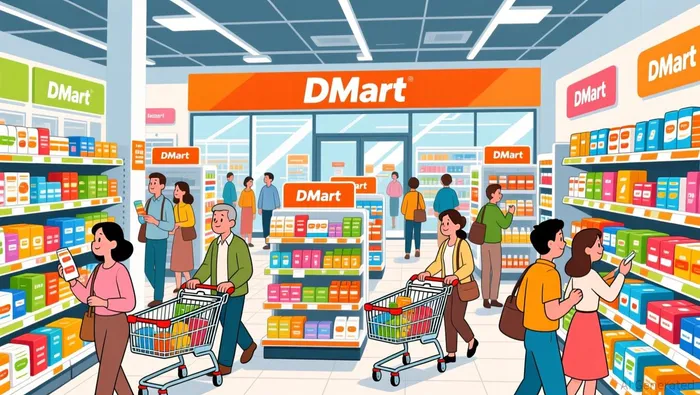
While DMart's core business remains strong, its online platform, DMart Ready, is still a minor contributor, accounting for only 6% of total revenue. This limited digital presence, combined with increasing competition from fast-delivery platforms, poses challenges for sustaining growth, particularly in the high-margin non-food categories.
Valuation Outlook & Future Catalysts
Brokerages continue to express confidence in DMart, with CLSA maintaining a 'high conviction outperform' rating and projecting more than 56% upside. This optimism is supported by steady earnings, including an 18% profit increase year-over-year in the latest quarter.
The next key challenge for DMart is to translate its 500-store network into sustained, high-margin revenue growth. Investors will closely monitor quarterly results for signs of accelerating EBITDA and consistent margin improvement, which are essential for validating the scalability of its business model.
Currently, DMart's stock performance is propelled by its expansion story. Going forward, the focus will shift to execution—demonstrating that each new store contributes meaningfully to profitability, not just to the company's footprint.
Disclaimer: The content of this article solely reflects the author's opinion and does not represent the platform in any capacity. This article is not intended to serve as a reference for making investment decisions.
You may also like
Ciena Jumps 6.8% as Supply Chain Disruptions and Regulatory Changes Shake the Market: What Drives This Uptrend?
Xiao-I Plummets 25.6% in Turbulent Day: Can This AI-Powered EV Play Stage a Comeback?

GE Aerospace Soars Over 2.5% as Analyst Hype and Production Upsides Ignite Investor Appetite

Else Nutrition ($ELVN) Is in a Regulatory Countdown While Insiders Sell Their Shares

Trending news
MoreCrypto prices
More





