
Halliburton’s Gamble on VoltaGrid: Will a Data Center Energy Move Spark a Strategic Comeback?

Halliburton’s Strategic Transformation: Embracing New Energy Solutions
Halliburton has embarked on a significant transformation, highlighted by its alliance with VoltaGrid, formalized in October 2025. This partnership signals a decisive move toward developing advanced energy infrastructure, particularly to meet the rising power needs of data centers. Halliburton is now targeting this rapidly growing sector with a comprehensive, ready-to-deploy solution, beginning with projects in the Middle East as its initial launchpad.
The collaboration leverages the unique strengths of both companies. Halliburton contributes its extensive global reach, established local facilities, and deep regulatory know-how—essential for executing complex projects across various regions. VoltaGrid brings its innovative QPac platform and engineering expertise, offering high-performance, modular, and scalable systems. Together, they plan to deliver distributed power generation tailored for data centers, utilizing turbines and reciprocating engines. This partnership not only expands VoltaGrid’s access to a worldwide operational network but also provides Halliburton with a sustainable technology platform for future growth.
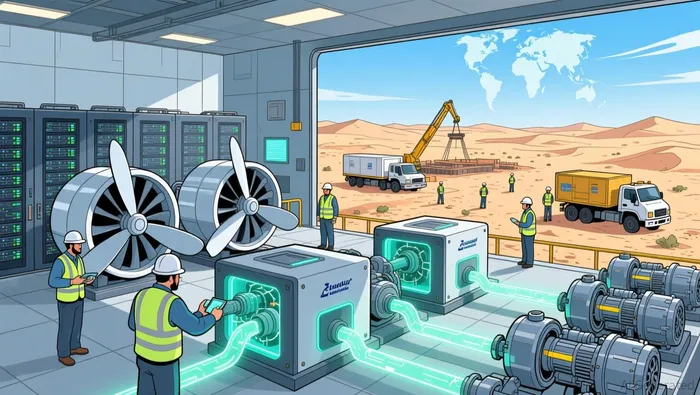
This initiative is part of a broader expansion strategy. Halliburton Labs recently welcomed four new early-stage energy tech startups, reinforcing the company’s commitment to fostering innovation. By offering mentorship, industry connections, and operational support, Halliburton is positioning itself as a leader in next-generation energy solutions. The VoltaGrid partnership stands as the flagship of this new direction, utilizing Halliburton’s scale to bring cutting-edge energy solutions to market.
Financial Overview: Q4 Momentum Amid Ongoing Challenges
Halliburton’s fourth quarter showcased strong operational results, capping off a difficult year. Net income soared to $589 million, or $0.70 per diluted share, a significant rebound from the previous quarter’s $18 million. This improvement was driven by an increase in adjusted operating margin to 15%, up from 13%, reflecting stronger profitability in core operations. The company also generated $1.2 billion in operating cash flow and repurchased $1 billion in shares over the year.
However, these quarterly gains contrast with the full-year picture. In 2025, total revenue reached $22.2 billion, a 3% decrease from 2024. Annual operating income also declined to $2.3 billion from $3.8 billion the year before. While Q4 results highlight effective execution and margin management, they do not fully offset the persistent pressures facing the oilfield services sector over the past year.

Regional performance further illustrates this dynamic. International operations saw a 7% sequential revenue increase in Q4, while North American revenue fell by 7%. This divergence underscores the uneven recovery, with Halliburton’s global presence providing some resilience but not fully countering domestic market headwinds. The annual revenue decline confirms that late-year operational improvements could not entirely reverse broader market softness.
In summary, Halliburton demonstrated its ability to deliver strong quarterly results when conditions are favorable, as seen in margin expansion and robust cash flow. Nevertheless, ongoing structural challenges from declining annual revenues remain a significant hurdle. The company’s strategy and its promise to deliver superior returns will be tested by its ability to turn short-term momentum into sustained growth as the market evolves.
Business Segments: Current Strength and Future Ambitions
Halliburton’s Completion and Production segment remains its primary financial driver, serving as the foundation for its strategic transformation. This division achieved the highest quarterly margins of the year, even as U.S. fracturing activity remained subdued. Its performance is backed by tangible successes, such as securing a major deepwater contract with Petrobras in Brazil for intelligent completions and safety valves, reinforcing Halliburton’s leadership in this field. Additionally, revenue in Europe, Africa, and the CIS grew by 12% sequentially in Q4, fueled by increased sales of completion tools.
This segment’s robust performance underpins the cash flow necessary for Halliburton’s transformation. The company projects $1.8 billion in free cash flow for 2026, a 6% increase year-over-year, providing the financial flexibility to invest in new ventures like the VoltaGrid partnership and its energy technology incubator, while also maintaining shareholder returns—evidenced by its commitment to return 85% of free cash flow in 2025.
Despite these strengths, the outlook is mixed. Analysts expect the completions and production segment to face a 7% to 9% revenue decline quarter-over-quarter in Q1 2026, reflecting near-term headwinds. The challenge for Halliburton is to allocate today’s cash flow wisely, ensuring it supports future growth rather than merely sustaining a segment facing cyclical downturns.
Ultimately, Halliburton’s present is powered by a high-margin, execution-focused business, while its future depends on the successful commercialization of new platforms like VoltaGrid and continued innovation. The company’s projected free cash flow offers a runway for transformation, but its ability to manage near-term pressures will determine how much it can invest in long-term growth.
Opportunities and Risks: Navigating Market Uncertainty
Halliburton’s path forward is defined by the balance between immediate challenges and long-term opportunities. The company’s success will depend on its ability to manage its core business while advancing new initiatives.
- Short-Term Risks: Analysts forecast a 6% sequential revenue decline in Q1 2026, with the completions and production segment expected to contract by 7% to 9%. This indicates that the downturn in oilfield services is ongoing. Margin compression is also anticipated, with operating margins potentially dropping by up to 300 basis points due to reduced activity and fixed costs. Rising corporate expenses add further pressure to profitability.
- Strategic Catalysts: The VoltaGrid partnership is central to Halliburton’s strategic pivot, aiming to deliver distributed power solutions for data centers, starting in the Middle East. The true measure of success will be the transition from agreement to revenue-generating projects, marking Halliburton’s entry into sustainable technology platforms.
- Financial Health: Halliburton’s net debt to EBITDA ratio remains steady at around 1.2x, providing a reasonable cushion. The projected $1.8 billion in free cash flow for 2026 supports the company’s strategic investments without overextending its balance sheet. However, any significant shortfall in cash flow or prolonged margin weakness could strain this position and limit flexibility.
In conclusion, Halliburton is equipped with the financial resources and a clear vision for the future, but must first navigate a period of operational softness. The VoltaGrid alliance represents a long-term growth opportunity, while maintaining financial discipline and managing debt and cash flow will be crucial as the company transitions through this challenging phase.
Disclaimer: The content of this article solely reflects the author's opinion and does not represent the platform in any capacity. This article is not intended to serve as a reference for making investment decisions.
You may also like
Sen. Tillis aims to release draft resolving Clarity Act's stablecoin yield dispute this week: report
Wegovy-maker Novo Nordisk partners with OpenAI to speed drug development
German wholesale prices in March 2026: an increase of 4.1% compared to March 2025
Factbox-Impact of Gulf crisis: Australian and New Zealand companies from airlines to banks experience pressure
Trending news
MoreCrypto prices
More





