
Perma-Fix’s Perma-FAS Technology May Lead the Way in the $200 Billion PFAS Remediation Industry as DOE Achievements Mark a Turning Point

Perma-Fix: Pioneering a New Era in Environmental Cleanup
Perma-Fix's investment strategy is anchored in its role as a trailblazer at the onset of a transformative technological wave. The company is establishing essential infrastructure for mandated environmental remediation, with its Perma-FAS technology poised to revolutionize how persistent "forever chemicals" are managed. Unlike conventional approaches—such as deep-well injection, which merely relocates contaminants, or incineration, which demands high energy and cost—Perma-FAS introduces a novel solution: chemical destruction at low temperatures.
This innovation is at the heart of Perma-Fix's promise. Perma-FAS stands alone in the market as the only technology capable of chemically breaking down PFAS pollutants and producing an organic effluent at temperatures no higher than 150°C. This water-based, energy-efficient process is engineered to permanently resolve disposal liabilities by targeting the resilient carbon-fluorine bond in PFAS, transforming it into mineralized fluoride. Rather than incremental progress, this represents a fundamental reimagining of waste treatment for compounds that have resisted traditional methods for decades.
Recently, Perma-Fix achieved a significant milestone by completing its first real-world project for a Department of Energy contractor. In April, Perma-Fix successfully treated approximately 1,500 gallons of legacy AFFF and contaminated liquids for Four Rivers Nuclear Partnership (FRNP), the DOE contractor overseeing environmental cleanup at the Paducah Site. This was not a laboratory experiment, but a comprehensive remediation project supporting a major government initiative. The accomplishment demonstrates Perma-Fix's operational readiness to manage complex, regulated waste—a crucial step toward commercial viability.
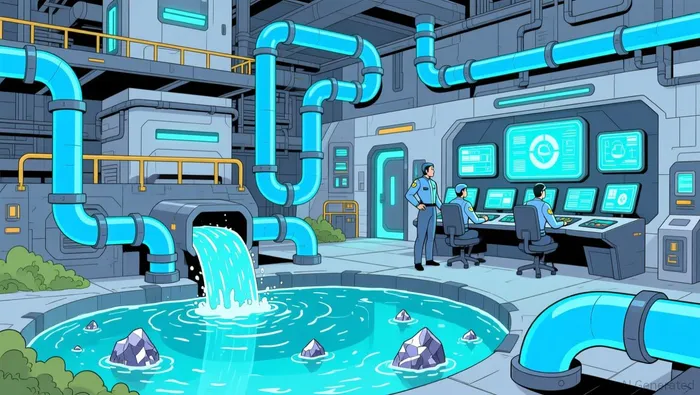
The company is now moving from research and development to scaling its technology. In early 2024, Perma-Fix completed pilot plant testing of its new, patent-pending PFAS destruction process. This pilot demonstrated the technology's effectiveness on commercial volumes and established parameters for the first commercial unit, following successful bench-scale tests across multiple media. Together with the DOE project, these achievements mark the transition from pure innovation to the initial phase of broader deployment.
Perma-Fix is laying the foundation for a future cleanup industry of enormous scale. Cleanup costs for PFAS contamination are estimated to surpass $200 billion. Although the company remains in the pre-commercial stage, with its first-generation processing unit located in Florida, widespread adoption will depend on regulatory requirements, cost efficiency at scale, and the ability to replicate its DOE project across numerous contaminated locations. While Perma-Fix is preparing for a paradigm shift, the path to commercial success is still unfolding.
Market Adoption and Financial Implications
The challenge for Perma-Fix is turning successful pilot projects into a scalable, profitable enterprise. The company is positioning itself for rapid adoption by targeting the primary source of PFAS waste: firefighting foams. Its new joint distribution agreement with Enforcer One streamlines the transition to PFAS-free solutions, combining Enforcer One's fluorine-free fire suppression technology with Perma-Fix's destruction services. This integrated approach offers fire departments, airports, and industrial facilities a comprehensive solution—from retiring old AFFF stockpiles to deploying safer alternatives. By securing both the supply of new foams and the disposal of legacy products, Perma-Fix is establishing itself as a critical infrastructure provider for an industry-wide shift.
This commercial strategy leverages Perma-Fix's existing operational strengths. Perma-Fix of Florida processes over 1,500 containers of non-radioactive, hazardous waste each month, including industrial, medical, and municipal streams. This proven capacity enables the company to extend its expertise to PFAS destruction, scaling up without starting from scratch. The recent DOE project, which treated 1,500 gallons of legacy AFFF, exemplifies how Perma-Fix can apply its established platform to high-value, emerging waste streams.

From a financial perspective, the market remains cautious. Perma-Fix's stock is trading at a 55.6% discount from its 52-week high, reflecting the uncertainty between demonstration and revenue generation. However, analysts see substantial upside, with a median price target suggesting a 48.5% increase. This gap highlights the tension: while exponential growth is anticipated, the foundational infrastructure is still being established. The company's ability to transform its initial processing unit into a network of commercial-scale facilities will determine its share of the estimated $200 billion market. For now, Perma-Fix is proving its operational and commercial capabilities, but the financial rewards will depend on regulatory momentum and the scalability of its unique destruction technology.
Key Drivers, Risks, and What Investors Should Monitor
Perma-Fix's investment outlook depends on progressing from successful pilots to commercial validation. The main catalyst is the operational launch of the first commercial Perma-FAS unit. With pilot testing completed and parameters defined for construction, the next steps are final design and fabrication. Once operational, this unit will set benchmarks for throughput, cost, and reliability, directly influencing the company's ability to scale and capture the vast cleanup market.
A significant risk is the substantial capital required for expansion. With a current market capitalization of about $212 million, building a fleet of commercial units to address a $200 billion market demands considerable investment. The challenge is whether Perma-Fix can secure enough funding—through operations or equity offerings—without diluting shareholders, a common dilemma for infrastructure ventures where the payoff is distant but upfront costs are high.
Investors should focus on two main indicators. First, look for announcements of additional government contracts beyond the DOE project, as ongoing mandates are essential for the business model. Second, monitor the commercial throughput of the new destruction capacity. Perma-Fix already processes over 1,500 containers of hazardous waste monthly in Florida; the critical metric will be how efficiently this platform adapts to large-scale PFAS treatment. Ultimately, Perma-Fix is constructing the framework for a paradigm shift, but the financial outcome will be shaped by the speed and cost of expanding this infrastructure.
Disclaimer: The content of this article solely reflects the author's opinion and does not represent the platform in any capacity. This article is not intended to serve as a reference for making investment decisions.
You may also like
Crypto's $100B Rebound: A Risk Appetite Trade, Not a New Trend

Wells Fargo Calls Tesla's FCF Burn a "Cash-Burning Reckoning"—Is the Market Pricing in a 93% Valuation Gamble?

Analyst to XRP Traders: Don’t Get Trapped in the Noise. Here’s the True Direction
SOLV (SOLV) fluctuates 44.4% in 24 hours: trading volume surges and smart money leads buying
Trending news
MoreCrypto prices
More





