
GDP downgraded, stepping on the brakes; PCE at the threshold! Amid the tug-of-war between bulls and bears, is this long lower shadow a bear trap or a support point?

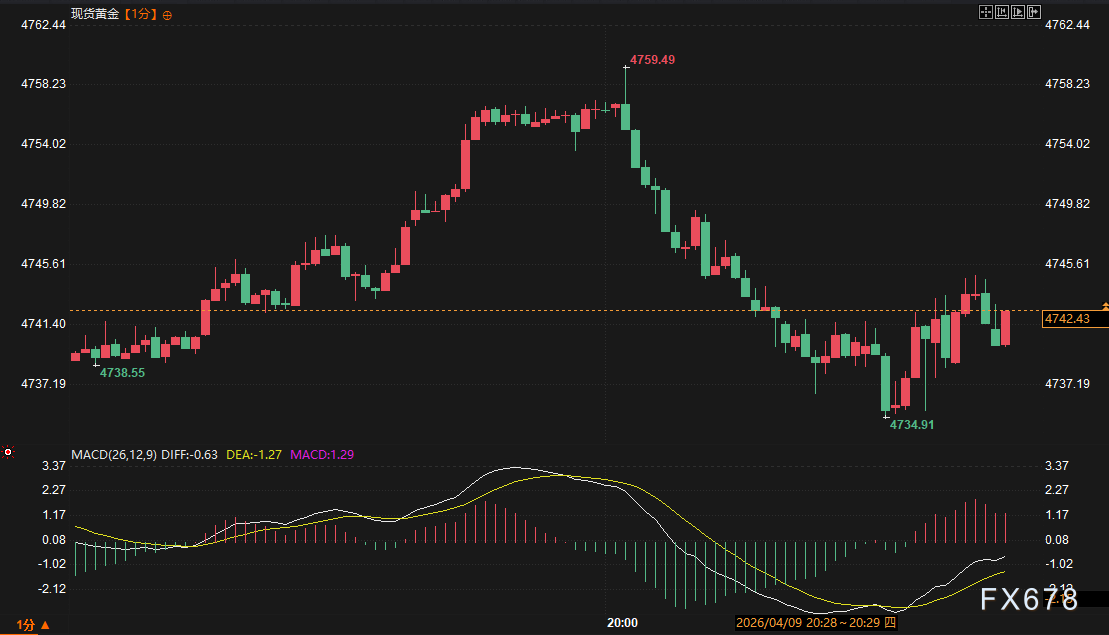
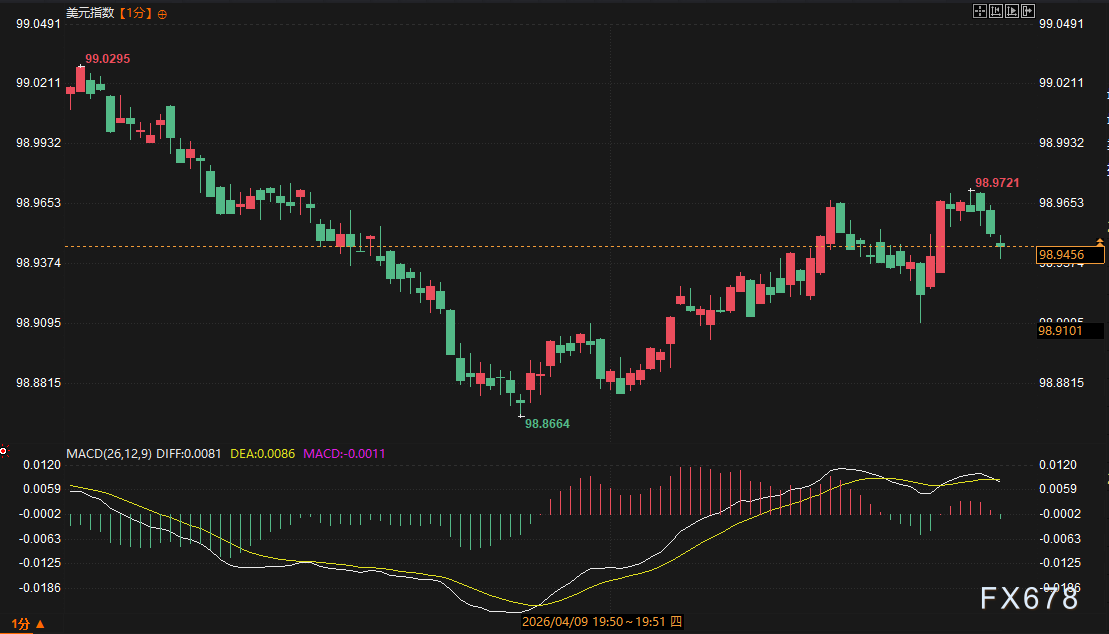
FX678, April 9th—— The US Department of Commerce released the final value of Q4 2025 GDP and personal income and expenditure data for February 2026 (including PCE). The US Dollar Index fluctuated slightly around the data release, briefly dropping 3 points before rebounding over 6 points, currently at 98.9509; spot gold rose by about $7 in the short term, with the overall market reaction remaining restrained.
On Thursday (April 9th), at 20:30 Eastern Time (UTC+8), the US Department of Commerce released the final value of Q4 2025 GDP and personal income and expenditure data for February 2026 (including PCE). The seasonally adjusted annualized final GDP growth rate was 0.5%, a downward revision from previous data; the February PCE price index rose 2.8% year-on-year, in line with market expectations, and core PCE increased 3.0% year-on-year, also as expected. At the same time, initial jobless claims rose to 219,000, higher than expected but still at a historically low level. Around the data release, the US Dollar Index fluctuated slightly, briefly dropping 3 points before rebounding over 6 points, currently at 98.9509; spot gold surged about $7 in the short term, with the overall market response remaining restrained.
Deep Network Analysis
After this GDP and PCE data release, both fundamentals and technicals provided mutual confirmation. From a fundamental perspective, the Q4 2025 GDP final value of 0.5% was a significant slowdown from Q3’s 4.4%, reflecting a shift from high growth toward normalization. At the same time, personal consumption expenditures grew 0.5% month-on-month in February, indicating continued consumption resilience; the PCE price index year-on-year increase of 2.8% and core PCE at 3.0% were both in line with expectations and have not clearly deviated from the Federal Reserve's 2% long-term target. Meanwhile, although initial jobless claims were slightly above expectations, the absolute level remains low—altogether pointing to stable economic performance with no dramatic volatility.
Compared with historical trends, this final GDP print at 0.5% is on the low to middle range for recent quarters and slightly below previous market-implied expectations, but it has not disrupted the trend of economic growth gradually returning to its potential rate over the past two years. Year-on-year PCE growth at 2.8% continues the modest downward path since mid-2025 and has narrowed significantly from the highs of 2024, indicating that inflationary pressures are gradually being brought under control. In terms of latest prices, the US Dollar Index quickly recovered to 98.9509 after the data, reflecting market risk appetite recovery upon interpretation; spot gold rose about $7 in the short term, corresponding to a mild boost in risk aversion, but failed to deliver a trend breakthrough.
From a perspectives comparison, prior to the data release, institutional and retail expectations were fairly consistent: most institutional accounts focused on whether February PCE would confirm inflation stickiness, with a consensus expectation for core PCE to rise about 3.0% year-on-year and GDP final value around 0.7%; retail traders discussed in pre-market hours how the data might affect the Federal Reserve’s policy observation window, with a generally cautious and observant stance focusing on the balance between consumption expenditure and prices. After release, institutional views turned to the interpretation that data was in line with expectations, believing that strong consumer spending and in-line PCE provided a clear observation window for subsequent policy; retail outlook focused more on the downward GDP revision, with discussion on changes in momentum for economic growth, but overall, there was no significant expansion in expectation deviations, and market consensus was to absorb the data neutrally.
Technically, the US Dollar Index’s short-term rebound mirrors fundamentals indicating economic resilience, while in the long term it remains in a high-level oscillation range; gold, though higher in the short term, lacks sustained upward momentum, showing that bullish and bearish forces reached equilibrium after the data. Overall, the data did not trigger systemic shocks, and both fundamentals and technicals indicate that the market's immediate reaction to the economic data was fairly rational.
Trend Outlook
Based on the combination of the GDP final value at 0.5% and PCE aligning with expectations, the US Dollar Index is expected in the near term to continue oscillating with a stronger bias within the 98.5–99.5 range, while gold may fluctuate slightly with changes in inflation expectations but is unlikely to establish a unilateral trend. The market appears to have fully digested the data, with both short- and long-term logic remaining internally consistent. Future performance will depend on continuous verification from subsequent economic indicators, with overall balanced trajectory likely to be maintained.
Frequently Asked Questions
Q: What are the main reasons for the GDP final value of 0.5% coming in below market-implied expectations?
The GDP final value came in slightly below previous estimates, mainly reflecting the final revision of some Q4 consumption and investment indicators. However, overall, it remains within the normalization range and does not change the continuity of the long-term growth path.
Q: What is the significance of the PCE data meeting expectations for Federal Reserve policy observation?
The PCE year-on-year at 2.8% and core at 3.0% matched expectations, showing inflationary pressures remain under control and providing the Federal Reserve with an objective basis to continue monitoring the labor market and economic growth. Policy decisions will be based on the cumulative verification of future data.
Q: The initial jobless claims figure increased but remains at a low level—what does this mean for the economy?
Initial jobless claims, though higher than expected, are still within historically low ranges, indicating a stable labor market without significant deterioration. Together with the GDP and PCE data, this supports continued economic resilience.
Q: What are the driving factors behind the US Dollar Index rebound after the data release?
The US Dollar Index rebounded quickly after a brief drop, mainly driven by rational absorption of in-line PCE data and the manageable degree of GDP revision, reflecting that the relative appeal of US dollar assets has not fundamentally changed in the current environment.
Q: With spot gold rising in the short term but failing to break out, what could be the follow-up evolution?
Gold's short-term rise of about $7 mainly corresponded to risk aversion at the time the data was released, but because PCE did not exceed expectations, there is a lack of sustained driver. Future movement may continue to be influenced by both inflation expectations and US Dollar performance, maintaining a range-bound characteristic.
Disclaimer: The content of this article solely reflects the author's opinion and does not represent the platform in any capacity. This article is not intended to serve as a reference for making investment decisions.
You may also like
IVVD Surges on Pipeline Expansion, Hinges on $1.6124 Breakout

AKAM Dips 5.24%—Is This a Breakdown or Just a Bounce?

Balfour Beatty’s Insider Sale Motivated by Tax Reasons Stands in Stark Contrast to Strong Buyback Commitment

SLB Inks Subsea Agreement with PETRONAS, Broadens Digital Activities in Angola
Trending news
MoreCrypto prices
More





