
VW’s Chattanooga Shift: How Moving from Electric Vehicles to Gas-Powered SUVs Alters the Investment Perspective

Volkswagen's Chattanooga Plant: From EV Ambitions to Gasoline Reality
Volkswagen's Chattanooga facility was once anticipated to spearhead the company's electric vehicle push in North America. Instead, it now represents a strategic withdrawal, highlighting the gap between investor expectations and actual market developments. While many anticipated continued growth in EV production, Volkswagen is shifting its focus back to gasoline-powered SUVs.
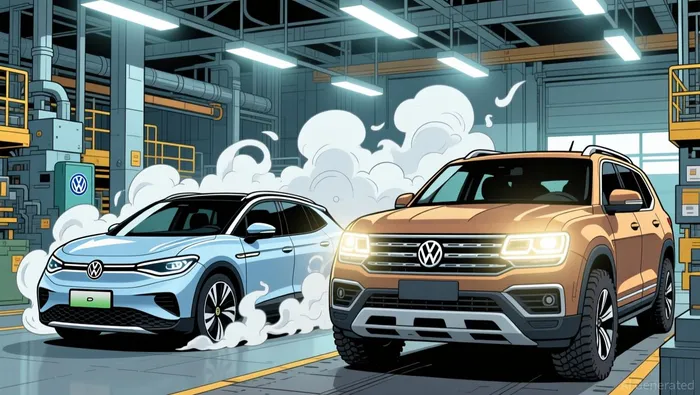
The automaker recently revealed that manufacturing of the ID.4 will cease in mid-April 2026, effectively ending EV production at its sole North American plant. The facility will pivot to producing the 2027 Atlas, a gasoline SUV that has consistently ranked as VW's second most popular model in the U.S. for three years. Rather than expanding electrification, Volkswagen is responding to consumer preferences by prioritizing models with proven demand.
This shift was triggered by a significant policy change: the removal of the $7,500 federal tax credit for EVs at the end of 2025. As a result, ID.4 sales plummeted 61.6% in the fourth quarter of 2025, with only about 250 units sold during that period. The ID. Buzz electric van had already exited production. What was once seen as a growth opportunity for EVs has now become a story of waning demand and underutilized capacity.
This adjustment isn't unique to Volkswagen; it's a broader industry trend. Major automakers like GM, Ford, Stellantis, and Honda have all scaled back their EV strategies following the same policy shift. The market had assumed federal incentives would persist long enough for EVs to become price competitive, but the abrupt end of support has fractured the sector's growth outlook.
For investors, the central question is whether this is a temporary pause or a lasting change in direction. Volkswagen's mention of a "future version" of the ID.4 for North America indicates the company hasn't fully abandoned electrification. However, the immediate emphasis on the Atlas—a high-volume, gasoline-powered vehicle—shows that short-term profitability is taking precedence over long-term EV goals. The expectation gap has narrowed, and current valuations reflect a more conservative approach.
Financial Impact: Profit Takes Priority Over EV Expansion
The transition from the ID.4 to the Atlas fundamentally alters Volkswagen's investment narrative in North America. This isn't simply a pause in EV efforts; it's a deliberate shift where immediate financial returns outweigh aspirations for EV market dominance.
Volkswagen is now focusing on "higher-volume models that support sustained growth in North America," according to company statements. The Atlas trails only the Tiguan in U.S. sales. By concentrating on established, popular models rather than betting on uncertain EV demand, VW significantly reduces execution risk. The market had anticipated ongoing EV expansion, but the reality is a return to gasoline SUVs that reliably generate sales.
Volkswagen's 2026 outlook reflects this shift, targeting 0-3% volume growth and a 4.0-5.5% operating return on sales. These margins now take precedence over EV market share, signaling a disciplined focus on cash flow amid a market where EV demand dropped sharply after the tax credit was removed.
The workforce strategy further underscores this pragmatic shift. No production employees will lose their jobs. Instead, ID.4 workers will be reassigned to Atlas production based on seniority, with an early retirement program available for those over 55. This approach avoids layoffs and maintains flexibility for future shifts between gasoline and electric models. The plant's approximately 3,000 hourly workers remain employed, giving Volkswagen a versatile workforce for future transitions.
For investors, the takeaway is clear: Volkswagen's North American operations are now focused on generating cash from vehicles with proven demand. While a "future version" of the ID.4 is still planned, it is no longer the main priority. The expectation gap has closed, and the new strategy is centered on margins and caution.
Valuation Considerations: Expectations vs. Reality
The market had previously valued Volkswagen's Chattanooga plant as the foundation for its North American EV growth. In reality, the company is stepping back, resetting its electrification timeline. This represents a classic "sell the news" scenario for those invested in Volkswagen's EV prospects.
Volkswagen's guidance—0-3% volume growth and a 4.0-5.5% operating return on sales—shows the company has already adapted to new market conditions. However, investors must consider whether the market has fully accounted for the implications of a product lineup dominated by gasoline vehicles, especially as regulatory pressures mount.
This decision signals Volkswagen's recognition that the U.S. EV market isn't ready for sustained growth. The ID.4 performed well through most of 2025, but sales dropped 61.6% in the fourth quarter after the tax credit ended. Combined with the earlier discontinuation of the ID. Buzz, it's clear that demand is lacking. This move will likely delay Volkswagen's North American EV timeline by two to three years—not due to technological limitations, but because consumers aren't buying.
For investors, the main tension is that while this pivot safeguards short-term margins, it may expose Volkswagen to long-term competitive risks. The company is betting that the Atlas will maintain sales and profitability, even as rivals continue to pursue electrification. This is a sensible short-term strategy, but it could leave Volkswagen vulnerable if regulations tighten or competitors capture renewed EV demand. The company's statement about a "future version" of the ID.4 offers some hope, but uncertainty remains regarding its availability for the 2027 model year. Is this a temporary pause or a strategic shift? The answer is still unclear.
Ultimately, the valuation question depends on whether this move is a smart adjustment or a delayed reckoning with the need for electrification. Volkswagen's guidance suggests the former, but industry and regulatory trends may eventually force the latter.
Key Catalysts and Risks Ahead
Volkswagen's new strategy is in place, but the market must now assess whether the focus on the gasoline-powered Atlas will succeed or prove premature. Several critical factors will shape this outcome over the next year to eighteen months.
- Atlas Sales Performance: The immediate test is whether the 2027 Atlas can deliver the high sales volumes needed to sustain the Chattanooga plant. The Atlas has been VW's second-best-selling U.S. model for three years, but actual sales and inventory turnover will determine if the strategy holds. If Atlas sales falter, Volkswagen could face the same demand issues it sought to avoid.
- ID.4 Next-Generation Plans: Confirmation or cancellation of the next-generation ID.4 will affect the company's EV flexibility. Volkswagen has indicated that a new version is planned for North America, but hasn't confirmed its availability for the 2027 model year. Investors should view this as a potential upside if EV demand rebounds, but it remains uncertain whether production will occur in Chattanooga or elsewhere.
- Labor Dynamics: The plant's roughly 3,000 hourly workers remain employed, with ID.4 staff reassigned to Atlas production. Early retirement programs help manage transition costs, but as the plant shifts to a single model, union negotiations could introduce new cost pressures. Any increase in labor costs would impact the company's operating margin targets.
- Industry-Wide EV Slowdown: GM, Ford, Stellantis, and Honda have all reduced their EV plans after the tax credit ended. If multiple automakers pause or exit, the competitive landscape shifts. Volkswagen's pivot may protect its market share against competitors focused on EVs, but if the sector as a whole lowers expectations for electrification, Volkswagen faces similar downward pressure.
- Federal Policy Uncertainty: The entire strategy hinges on the assumption that EV demand will remain weak without the $7,500 tax credit. If Congress reinstates incentives or tightens emissions regulations, Volkswagen's gasoline-heavy approach could become a disadvantage. The company maintains that Chattanooga "will continue to be a cornerstone of Volkswagen's strategy" in the U.S., suggesting flexibility, but the current focus is clearly on internal combustion.
In summary, Volkswagen has closed the gap between expectations and reality, but new uncertainties are emerging. Atlas sales will determine if the revenue replacement strategy succeeds. The timing of the next ID.4 will decide whether the EV option retains value. Policy changes could quickly alter the entire rationale. For investors, this is no longer a simple bet on electrification—success now depends on navigating a complex, evolving landscape.
Disclaimer: The content of this article solely reflects the author's opinion and does not represent the platform in any capacity. This article is not intended to serve as a reference for making investment decisions.
You may also like
Morgan Stanley's Crypto Push: Flow Analysis of a Latecomer's Strategy

TAG (Tagger) fluctuates 40.6% in 24 hours: driven by surging trading volume and net capital inflows
Wendy's Pretzel Burger Craze Conceals Organizational Departures and Turmoil Among Executives

New Tools Aim to Make AI 'Vibe Coding' Safer for Crypto
Trending news
MoreCrypto prices
More





