
Pacific Coast Oil Trust Faces Forcing Dissolution as Sponsor PCEC Lines Up Exit First

The trust is officially in a state of collapse. In a stark announcement last month, Pacific Coast Oil Trust revealed there will be no cash distribution to the holders of its units of beneficial interest of record on March 27, 2026. The reason is simple and dire: the trust lacks the cash to cover its basic expenses. The trustee, relying on data from the controlling entity PCEC, stated that any payments PCEC might make to the trust may not be sufficient to cover the Trust's administrative expenses and outstanding debt to PCEC. This sets the stage for a complete breakdown.
The numbers tell the real story. The trust's remaining properties, which include the Orcutt Diatomite and Orcutt Field, are not generating profit. In fact, they are running a deficit. The cumulative net profits deficit for the Remaining Properties decreased from approximately $132,000 in the Prior Month to approximately $111,000 in the Current Month. That's a net loss of over $100,000 on these assets. This persistent deficit, combined with the trust's own operational losses, means the underlying revenue stream is broken.
This isn't just a bad quarter; it's a structural failure triggering a forced exit. The trust agreement itself defines the path forward. Because the annual cash proceeds from the trust's interests totaled less than $2.0 million for each of 2020 and 2021, the agreement mandates dissolution. "Foreseeable dissolution" means the trust's assets are being liquidated. In this setup, the controlling entity, PCEC, gets first dibs on the proceeds. The unitholders are last in line, after PCEC settles its own debts and expenses. The smart money has long since seen this coming.
The Smart Money's Playbook: What Insiders Should Be Doing
The setup here is a classic conflict of interest. The sponsor, Pacific Coast Energy Company LP (PCEC), is the entity that must fund the trust's operations and debt. It also controls the flow of information and the dissolution process. In this arrangement, the sponsor is the only party with real skin in the game. The public unitholders are left with a claim on the scraps.
The dissolution plan makes this clear. Because the trust's annual cash proceeds fell below $2 million for two consecutive years, the trust agreement mandates winding up. The trust's assets are being liquidated, but the proceeds flow to the sponsor first. The sponsor (PCEC) and its affiliates get paid for their debts and expenses before any remaining value is considered for unitholders. In other words, the sponsor is the beneficiary of a swift, low-cost dissolution. The unitholders are last in line.
So, what should the smart money do? The playbook is straightforward. Any insider with a real alignment of interest would be selling. The sponsor's management has no incentive to keep the trust afloat; they want to close the book and move on. The whistleblower lawsuit alleging PCEC provided false data to the trust's auditor adds a layer of risk and potential liability that insiders would want to avoid. The smart money isn't buying into a failing trust with a broken revenue stream and a sponsor that stands to gain from its liquidation. This is a pump and dump scenario where the sponsor is the only player with a motive to hold. The only rational action for aligned capital is to exit.
Market Metrics and the Whale Wallet: What the Price Action Tells Us
The market is giving a clear verdict. Pacific Coast Oil Trust's stock trades at a deep discount to its net asset value, a discount that reflects the high probability of total loss. The distribution halt and the mandated dissolution plan have shattered the trust's value. The long-term trend of declining distributions shows asset depletion, not recovery. The data is a straight line down from peak payouts in the early 2010s to the current zero distribution. This isn't a cyclical dip; it's the final chapter of a resource that has been fully extracted.
Institutional sentiment is captured in the price action. The stock's whale wallet is telling a story of avoidance. When a trust's NAV is eroding and its sponsor is structuring a liquidation to its own benefit, the smart money stays away. There is no institutional accumulation here. The discount is the market's way of pricing in the sponsor's first claim on any proceeds. For the unitholder, the NAV is a ghost. The only real value is what remains after PCEC settles its debts and expenses-a figure that is likely to be negligible.
This sets up a clear signal for insider selling. The sponsor's interest aligns perfectly with a quick, low-cost liquidation. Any insider selling would be a negative signal, confirming the sponsor's lack of skin in the game for the unitholder. The whistleblower lawsuit alleging PCEC provided false data to the auditor adds a layer of potential liability that insiders would want to distance themselves from. The playbook is simple: if you're an insider, you sell before the final settlement. The market's deep discount is the smart money's verdict on the trust's future.
Catalysts and Risks: What to Watch for the Thesis
The thesis here is clear: Pacific Coast Oil Trust is a failing asset with a sponsor that has no incentive to support unitholders. The smart money has already exited. The key is to watch for concrete signals that confirm the financial freefall and the sponsor's alignment of interest.
First, watch for any Form 4 filings from PCEC insiders or affiliates. These are the direct signals of smart-money exits. The absence of such filings would be notable, but the real story is in the actions. If PCEC executives or their affiliates are selling their stakes in the trust, it would be a negative confirmation of the sponsor's lack of skin in the game for the unitholder. The whistleblower lawsuit alleging PCEC provided false data to the auditor adds a layer of potential liability that insiders would want to distance themselves from. The SEC's EDGAR database is the source for these filings, and the lack of recent records for the trust itself is telling.
Second, monitor the trust's quarterly reports for updates on the net profits deficit and dissolution timeline. These reports, provided by PCEC, are the only financial data available. The trend is already clear: the cumulative net profits deficit for the Remaining Properties decreased from approximately $132,000 to $111,000
, but the Developed Properties are deep in the red with a deficit of $11.8 million. Any further deterioration in these numbers would confirm the financial freefall. More importantly, watch for any updates on the dissolution process itself. The trust agreement mandates winding up, but the timeline and the sponsor's claims on proceeds are the real variables. The trustee's independent investigation into the whistleblower allegations could also yield new information that impacts the settlement.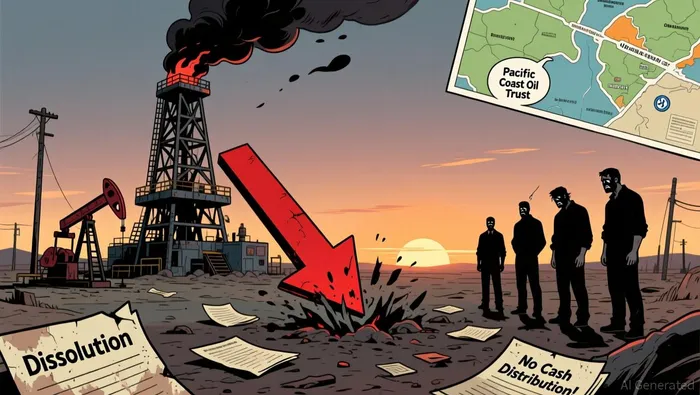
Finally, compare the trust's performance and dissolution progress to other oil royalty trusts. The market is pricing in a total loss for Pacific Coast, but what about peers? Cross Timbers Royalty TrustCRT-1.70% (CRT) and Hugoton Royalty Trust (HGTXU) are other publicly traded trusts. Their performance, distribution histories, and any dissolution plans would provide a relative benchmark. If other trusts are also facing asset depletion but are not in mandated dissolution, their valuations and investor sentiment could highlight whether Pacific Coast's situation is an outlier or part of a broader sector trend. The key difference is the sponsor's control and the mandated liquidation path, which creates a unique risk for unitholders.
The bottom line is that the catalysts are all about confirming the thesis. Any Form 4 filing from PCEC insiders would be a direct signal of an exit. Quarterly reports will show if the financial freefall is accelerating. And comparing the trust's forced liquidation to peers will underscore the extreme risk of being last in line. For the smart money, the thesis is already proven. The only remaining question is how quickly the final settlement will confirm it.
Disclaimer: The content of this article solely reflects the author's opinion and does not represent the platform in any capacity. This article is not intended to serve as a reference for making investment decisions.
You may also like
Sen. Tillis aims to release draft resolving Clarity Act's stablecoin yield dispute this week: report
Wegovy-maker Novo Nordisk partners with OpenAI to speed drug development
German wholesale prices in March 2026: an increase of 4.1% compared to March 2025
Factbox-Impact of Gulf crisis: Australian and New Zealand companies from airlines to banks experience pressure
Trending news
MoreCrypto prices
More





