
Texas Pacific Land's Margin of Safety Tested by Horizon Uncertainty and Permian Volatility

The recent plunge in Texas PacificTPL-- Land's stock price is a direct reaction to a personal and professional loss. On April 7, Murray Stahl, CEO of Horizon Kinetics Holding and a Texas Pacific board member, died suddenly. His passing introduces a layer of uncertainty, particularly given his significant influence as the largest shareholder. Horizon Kinetics and its affiliates hold approximately 15% of Texas Pacific's shares, a stake that has long been a source of stability and aligned interests. The market's sharp 15.6% drop to a two-month low reflects concern over what this change means for the company's future direction.
Yet, for a value investor, the immediate volatility is noise. The core question is whether the underlying business and its governance can weather this transition. The answer points to continuity. The board, chaired by Rhys J. Best, remains intact and experienced. This is not a board being reshuffled; it is a board providing steady stewardship. The company's fundamentals-its vast land portfolio, recurring royalty income, and disciplined capital allocation-do not change with the passing of a single board member, however influential.
The current price, therefore, presents a test of the margin of safety. The uncertainty around Horizon's future engagement is real, but it is offset by the board's proven experience and the enduring strength of the asset base. The market is pricing in fear of the unknown, while the intrinsic value of the land and its cash flows remains anchored in the present. For patient capital, the focus should remain on that enduring value, not the temporary turbulence caused by a leadership change.
Financial Resilience and the Competitive Moat
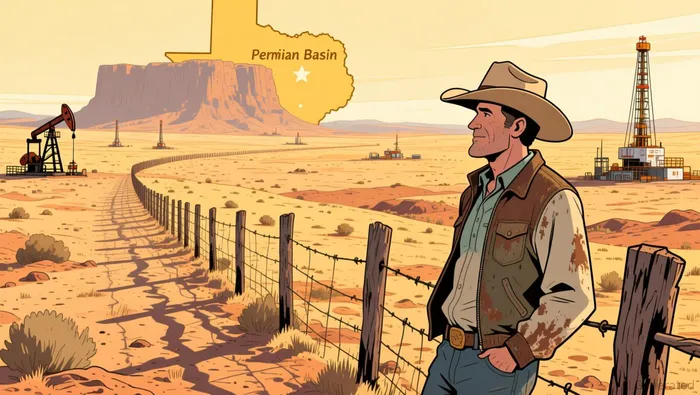
Texas Pacific Land's business model is the definition of a wide economic moat. The company owns mineral rights across the Permian Basin, a position that generates a high-margin, low-capital-expenditure revenue stream. This isn't a capital-intensive operator; it's a landowner collecting royalties as oil and gas are produced from beneath its acreage. This structure provides durable cash flows with minimal operational risk, creating a defensive and predictable income stream that compounds over decades. The moat is reinforced by the permanence of mineral rights and the company's vast, concentrated land base in one of the world's most prolific basins.
This operational strength was on full display in February, when TPLTPL-- reported its fourth-quarter results. The company delivered an EPS of $1.79, beating analyst expectations. Yet, the market's reaction was counterintuitive, with the stock experiencing a swift 6.9% decline that day. This unusual move suggests investors had already priced in the positive news, or that other concerns-perhaps the recent volatility or valuation-overshadowed the beat. The subsequent pullback, with shares falling 14.3% over the past month, looks like a classic correction after a nearly 60% surge over the previous three months. The earnings beat, coupled with a 12.5% boost to its quarterly dividend, points to management quality and financial discipline. But the market's skepticism highlights the challenge of sustaining momentum when a stock has run so far, so fast.
<| Total Trade | 12 |
| Winning Trades | 9 |
| Losing Trades | 3 |
| Win Rate | 75% |
| Average Hold Days | 7.83 |
| Max Consecutive Losses | 3 |
| Profit Loss Ratio | 1.76 |
| Avg Win Return | 9.87% |
| Avg Loss Return | 5.05% |
| Max Single Return | 21.15% |
| Max Single Loss Return | 7.04% |
Zooming out, the long-term compounding power is undeniable. Over the past five years, Texas Pacific LandTPL-- has delivered a total shareholder return of 148%. That's the kind of performance that builds intrinsic value over long cycles. It reflects the company's ability to consistently generate cash and return it to shareholders, even amid the volatility of the energy sector. The recent earnings reaction, therefore, is a test of that durability. The high valuation multiples-like a P/E ratio of 58.7x-demand flawless execution. For a value investor, the key is whether the company's wide moat and proven ability to compound can justify those premiums over the next decade. The recent price action introduces short-term noise, but the five-year return shows the system works. The question now is whether the margin of safety has widened enough to absorb the market's current skepticism.
Valuation: A Premium for Quality or a Risk?
The current price for Texas Pacific Land presents a classic value investor's dilemma. On one hand, the trailing P/E ratio of 63.64 as of early April is a premium that demands perfection. It sits 74% above its 10-year average of 36.47, suggesting the market is pricing in exceptionally high growth expectations. This is not a bargain; it is a bet on sustained, flawless execution from a company already trading at a rich multiple. The historical context is clear: the stock has touched even higher valuations, with a peak of 72.98 in March 2021. Yet, the current level leaves little room for error, making the recent volatility a direct reflection of that elevated risk.
That volatility has been severe. The stock has swung sharply, first plunging 15.6% to a two-month low following the sudden passing of board member Murray Stahl. Then, on April 10, it fell another 10.1% during mid-day trading to $402.8370. These moves are not random noise. They are the market's way of reassessing the premium when new uncertainties arise. The sharp declines highlight the vulnerability of a high-multiple stock to any perceived threat to its growth narrative or governance stability.


Analyst sentiment mirrors this tension between quality and risk. The consensus average price target stands at $639.00, with a mix of ratings including a "hold" from some firms and a bullish $639 "overweight" rating from KeyCorp. The wide gap between the current price and that target suggests a significant belief in future upside. Yet, the "hold" consensus also acknowledges the valuation challenge. For a value investor, the key is to separate the noise of these swings from the long-term worth of the asset.
The bottom line is that the premium is justified only if the company's wide moat and compounding ability can consistently exceed those lofty expectations. The financial resilience and dividend growth are real strengths. But at a P/E over 60, the margin of safety has compressed dramatically. The recent volatility, while painful, may have been a necessary correction to reset expectations. The risk now is that any stumble in execution or a shift in the Permian Basin outlook could force a painful re-rating. The stock's quality is undeniable, but the price for that quality has become a significant risk.
Catalysts, Risks, and What to Watch
For an investor assessing the margin of safety, the focus now shifts from the past volatility to the specific events that will determine if the thesis holds. Three key areas demand close monitoring: the stability of a major shareholder's strategy, the direct link to oil prices, and the consistency of capital returns.
First, the Horizon Kinetics stake is not just a large block of shares; it is a signal of alignment. The company's board, while intact, includes a major investor whose leadership has been a known quantity. The recent passing of CEO Murray Stahl introduces uncertainty about the future engagement of this 15% holder. As one observer noted, the question is whether the new co-CEOs share Mr. Stahl's interest. Any shift in Horizon's investment strategy or a change in board representation could alter the dynamic of governance and capital allocation. For now, the board's experience provides continuity, but the market will watch for any signs of a strategic pivot from its largest shareholder.
Second, and most directly, Texas Pacific Land's financial health is inextricably tied to the Permian Basin's activity, which is driven by oil prices. The recent selloff was triggered by a historic collapse in crude oil prices, with West Texas Intermediate futures falling more than 15% in a single session. This crash was the primary catalyst for the stock's decline. The company's revenue is a direct function of production volumes and commodity prices, making it a pure-play proxy for Permian activity. Therefore, the stability of oil prices is the single biggest external risk. Investors must watch for signs of a durable recovery in crude, as a prolonged low-price environment would pressure royalty income and test the resilience of the business model.
Finally, the dividend policy serves as a critical barometer of management's confidence. The company's recent 12.5% boost to its quarterly dividend was a clear signal of strong cash flow. Any future change-whether a pause, a reduction, or another increase-will be scrutinized as a leading indicator of the underlying cash generation. A consistent increase, like the one just announced, reinforces the thesis of a durable moat. A break in that pattern would be a red flag, suggesting the high-margin royalty stream is under pressure.
The bottom line is that the margin of safety is being tested on multiple fronts. The Horizon uncertainty adds a governance variable, the oil price crash introduces a fundamental risk, and the dividend is the ultimate test of cash flow quality. For a value investor, the path forward is to watch these catalysts unfold, using them to assess whether the intrinsic value of the land and its cash flows can withstand these pressures.
Disclaimer: The content of this article solely reflects the author's opinion and does not represent the platform in any capacity. This article is not intended to serve as a reference for making investment decisions.
You may also like
Sen. Tillis aims to release draft resolving Clarity Act's stablecoin yield dispute this week: report
Wegovy-maker Novo Nordisk partners with OpenAI to speed drug development
German wholesale prices in March 2026: an increase of 4.1% compared to March 2025
Factbox-Impact of Gulf crisis: Australian and New Zealand companies from airlines to banks experience pressure
Trending news
MoreCrypto prices
More





