
Fortinet Faces a Critical Turning Point: Will SASE Expansion Bridge the Expectations Divide Before Profit Margins Decline?

Fortinet: Navigating Market Uncertainty
Investor sentiment toward Fortinet (FTNT) remains cautious, with the stock hovering near $82.50—about 24% below its 52-week peak and trading under its 200-day moving average. This is despite the company reporting a record $2.21 billion in projected free cash flow for 2025 and surpassing the "Rule of 45" for the sixth year in a row. The disconnect between Fortinet’s strong financial performance and its lagging share price highlights a gap in expectations, as the market appears to be factoring in short-term risks and discounting future growth.
Analysts reflect this uncertainty, assigning Fortinet a consensus "Hold" rating and an average price target close to current levels, around $89.12. This stance signals a wait-and-see approach, suggesting that recent declines have already accounted for many known risks. However, it also means that if the company fails to accelerate its growth, there is little margin for disappointment.
This cautious outlook is not unfounded. The company faces real challenges: its reliance on hardware appliances exposes it to risk as more security spending shifts to cloud-based solutions. Additionally, management’s guidance for Q1 2026 operating margins of 30-32% marks a decline from the previous quarter, raising concerns about profitability. Even a significant product launch last month failed to excite the market, as investors remain skeptical about its immediate impact.
In summary, while Fortinet trades at a discount to its peers based on revenue and EBITDA, and the valuation case for a rebound is strong, the market remains unconvinced. The consensus "Hold" and technical underperformance suggest doubts about whether the company’s Unified SASE growth can offset near-term margin pressures and increased competition. The stock’s future performance will depend on Fortinet’s ability to close this expectations gap.
Bullish Perspective: SASE Growth and Financial Resilience
Optimists point to two main strengths: Fortinet’s accelerating SASE (Secure Access Service Edge) momentum and its robust cash flow. Unified SASE has emerged as a key growth driver, with billings rising 40% in the fourth quarter—more than double the industry average. Even more impressive, FortiSASE’s annual recurring revenue soared by over 90%. CEO Ken Xie has emphasized that the company’s Sovereign SASE solution has doubled its addressable market, offering deployment options that cloud-only competitors cannot match.
This surge in SASE is mirrored by strong product revenue, which climbed 20% year-over-year in Q4—the fastest growth in several quarters. Since Fortinet’s hardware and software appliances lay the groundwork for future subscription sales, this uptick signals healthy demand and a successful shift to a platform model. With a commanding 55% share of the firewall market, Fortinet has a vast customer base to target for its new cloud services, a competitive advantage that pure-play SASE providers lack.
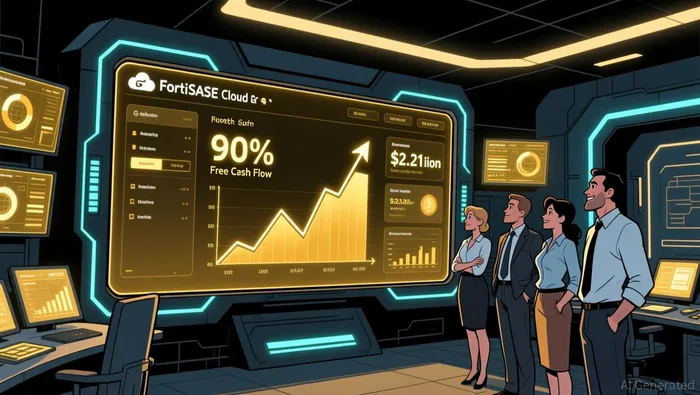
Financially, Fortinet is on solid ground. Its record-setting $2.21 billion in free cash flow for 2025 is a testament to its integrated platform and disciplined management. This financial strength supports an expanded $1 billion share repurchase program and underpins the company’s 2026 revenue guidance of $7.50–$7.70 billion, targeting around 10% growth fueled by both hardware refresh cycles and SASE expansion.
Ultimately, the bullish case rests on the belief that the market is looking beyond short-term margin pressures to Fortinet’s long-term growth engine. The combination of rapid SASE adoption, strong cash generation, and a clear path to revenue growth could justify a higher valuation—provided these strengths aren’t already fully reflected in the current share price.
Bearish Perspective: Margin Compression and Competitive Threats
On the other hand, skeptics highlight two immediate challenges that justify the stock’s discounted valuation. First, Fortinet’s profitability is set to decline, with management projecting Q1 2026 operating margins of 30-32%, down from 37.3% in the previous quarter. This drop is attributed to planned infrastructure investments, which will pressure earnings in the near term and make the path to future growth less certain.
Second, Fortinet’s heavy reliance on physical appliances is increasingly seen as a liability as the cybersecurity market shifts toward cloud-native solutions. This concern was central to a recent analyst downgrade by Freedom Capital Markets, which cited both competitive risks and valuation issues. While the company’s integrated platform and hardware refreshes may support short-term revenue, the long-term trend favors cloud-focused rivals.

Adding to these challenges is a lack of strong insider support. In February, both the CEO and a vice president sold substantial amounts of stock—over 175,000 and 343,000 shares, respectively—shortly after the earnings report. Although insiders still control about 17% of the company, these sales may signal doubts about near-term price performance and add to investor unease.
In essence, the bear case is less about Fortinet’s financial stability and more about the imbalance of risks. With margin pressure and competitive threats now clearly acknowledged by management and analysts, the market is waiting for evidence that SASE growth can accelerate enough to offset these headwinds. Until then, the discounted valuation reflects a prudent response to a challenging transition.
Valuation and Upcoming Catalysts: A Delicate Balance
Fortinet’s current valuation mirrors the market’s cautious stance. The stock trades at lower revenue and EBITDA multiples compared to peers, a gap that bulls argue is unwarranted given the company’s record free cash flow. However, the recent decline has already factored in many of the known challenges, and the muted response to a recent product launch suggests investors want to see tangible financial results before rewarding innovation. This leaves little margin for error unless SASE growth can significantly exceed expectations and drive a re-rating of earnings multiples.
All eyes are now on the Q1 2026 earnings call scheduled for May 6, which will be a crucial test for Fortinet. Investors should focus on two main indicators: whether Unified SASE billings can maintain their 40% growth rate, and if margin pressures are indeed limited to Q1 without further downward revisions. The company’s 2026 revenue target of $7.50–$7.70 billion, implying about 10% growth, depends on SASE scaling up as hardware sales fluctuate.
The main risk is that Fortinet falls short on either front. If SASE growth slows or margin pressures persist beyond Q1, the bear case will gain traction and the stock may face further downside. With the consensus still at "Hold" and technical indicators weak, the market is not yet convinced of a smooth turnaround. For Fortinet to earn a higher valuation, it must prove that its new growth engines can overcome the current headwinds. Until then, investors should expect a cautious approach to prevail.
Disclaimer: The content of this article solely reflects the author's opinion and does not represent the platform in any capacity. This article is not intended to serve as a reference for making investment decisions.
You may also like
Courtside's Expanded Equity Plan: A Talent Bet or Hidden Dilution Risk?


AUCTIONUSDC Drops Near $4.70 as Sellers Maintain Resistance at the Top

Remitly's Strategic Move: Expanding the International Payments System with an Experienced Technology Executive

Trending news
MoreCrypto prices
More





