
Iran Strait Blockade: An Examination of Oil Supply Disruptions and Their Impact

U.S. Navy Enforces Blockade on Iranian Ports
On Monday at 7 a.m. Pacific time, the U.S. Navy began restricting all maritime traffic entering and leaving Iranian ports, abruptly ending a delicate two-week ceasefire. This decisive action reversed previous market optimism that had driven oil prices downward. The blockade specifically targets vessels paying fees to Iran and is intended to assert control over the Strait of Hormuz, a critical passageway for roughly one-fifth of the world’s energy shipments.
The immediate effect on oil prices has been dramatic. Brent crude surged to $102.35, marking a 7.51% increase, offsetting the 16% decline that followed the ceasefire announcement just days earlier. This rapid rebound highlights the market’s shift from a brief period of stability to renewed supply concerns, creating a classic “oil shock” scenario driven by military intervention.
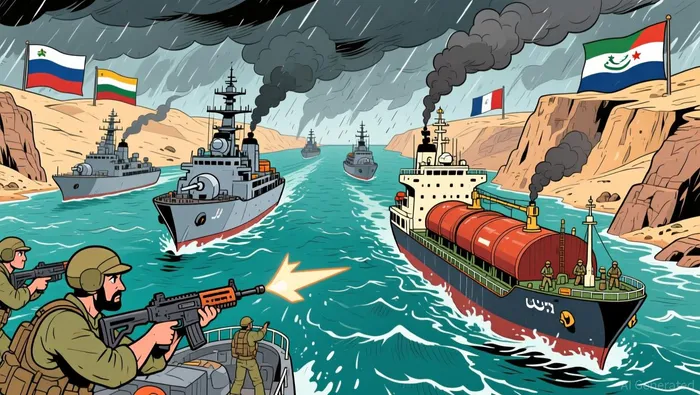
The blockade is being applied uniformly to all ships, but vessels not affiliated with Iran are still permitted to transit the strait. However, Iran’s Revolutionary Guards have cautioned that any ship approaching Iranian ports will be viewed as violating the ceasefire, escalating the situation from a market disruption to a potential military confrontation and increasing uncertainty for traders.
Blockade Details: Who Is Affected?
The blockade creates a new bottleneck, strictly preventing ships from entering or leaving Iranian ports while allowing passage for vessels traveling between non-Iranian ports through the Strait of Hormuz. As a result, Iran’s crude exports are effectively halted, but global oil shipments via the strait remain theoretically unobstructed. The main disruption is the loss of Iran’s direct maritime revenue stream.
The U.S. strategy is to cut off Iran’s oil income, a classic financial sanction designed to deprive the regime of funding. However, the timing is complicated. Just last week, the Treasury Department lifted restrictions on 140 million barrels of Iranian oil already loaded onto ships. While this move was meant to stabilize prices, it also provided Iran with a substantial cash injection, potentially fueling its military efforts and undermining the blockade’s intended effect.
This situation has become a high-stakes contest over oil flow. The U.S. aims to block Iran’s new crude shipments while permitting the movement of oil that was already loaded and sanctioned, creating confusion and possible loopholes. The critical question is whether Iran can redirect or sell this stockpile before the blockade is fully enforced, or if the blockade will successfully freeze new shipments and leave the existing oil unsold.
ATR Volatility Breakout Strategy (Brent Crude)
- Entry: Buy when ATR(14) exceeds its 60-day average and price closes above the 20-day high.
- Exit: Sell when price closes below the 20-day low, after 20 trading days, or when take-profit (+8%) or stop-loss (−4%) is triggered.
- Instrument: Brent crude (CO1), tested over the past two years.
Backtest Summary
- Strategy Return: 34.74%
- Annualized Return: 16.12%
- Maximum Drawdown: 7.01%
- Profit-Loss Ratio: 2.79
Trade Statistics
- Total Trades: 7
- Winning Trades: 5
- Losing Trades: 2
- Win Rate: 71.43%
- Average Holding Period: 14.29 days
- Maximum Consecutive Losses: 1
- Average Win Return: 7.48%
- Average Loss Return: 2.79%
- Largest Single Gain: 15.48%
- Largest Single Loss: 4.65%
The blockade’s structure introduces a targeted restriction, blocking Iranian crude exports while allowing other global shipments to continue. This effectively severs Iran’s direct access to maritime oil revenue.
Market Outlook and Key Events
The main trading strategy is to exploit the Brent/WTI spread, anticipating that geopolitical tensions will increase the global premium for seaborne oil. If conflict intensifies around the Strait of Hormuz or the Red Sea, Brent is expected to react more strongly to shipping risks than WTI, which is less exposed to international transport issues. Traders are betting on a scenario where WTI reaches $105, with Brent leading due to heightened transport risk.
Brent faces significant resistance at the $100 mark. If the blockade continues or escalates, a move above this threshold is likely. The market has already responded with a sharp reversal, as Brent climbed to $102.35 following the breakdown of the ceasefire. This price level serves as a technical barrier; breaking through it would signal a transition from a tentative truce to a full-scale supply disruption.

The next pivotal event is the expiration of the two-week ceasefire on April 24th. If no new agreement is reached, another significant price spike is expected. Markets are already factoring in this risk, with Polymarket traders assigning high probabilities to WTI hitting $105 this month. The outcome depends on whether the U.S. and Iran can negotiate a new deal before the deadline.
Disclaimer: The content of this article solely reflects the author's opinion and does not represent the platform in any capacity. This article is not intended to serve as a reference for making investment decisions.
You may also like
Sigma Lithium Rallies 41.97% as Big Money Holds Back

Institutional Money Buys SMCI as Analysts Disagree

Dimon's 2026 Risk Forecast: Institutional Implications of the "Skunk at the Party" Scenario

Sovereign Cloud Hype vs. Weak SPIR.N Chart: What’s the Play?

Trending news
MoreCrypto prices
More





