
A low-key battle for aluminum is unfolding

The London aluminum market is sending out the strongest signals of supply tightness in nearly two decades.
On Monday, the price of aluminum futures on the London Metal Exchange (LME) surged to a four-year high. At the same time, a key spread indicator measuring spot supply tightness widened sharply—the premium of spot over three-month futures jumped 37% to $91.50 per ton, marking the largest backwardation since 2007. This indicates that traders are scrambling for spot supply and willing to pay steep premiums.
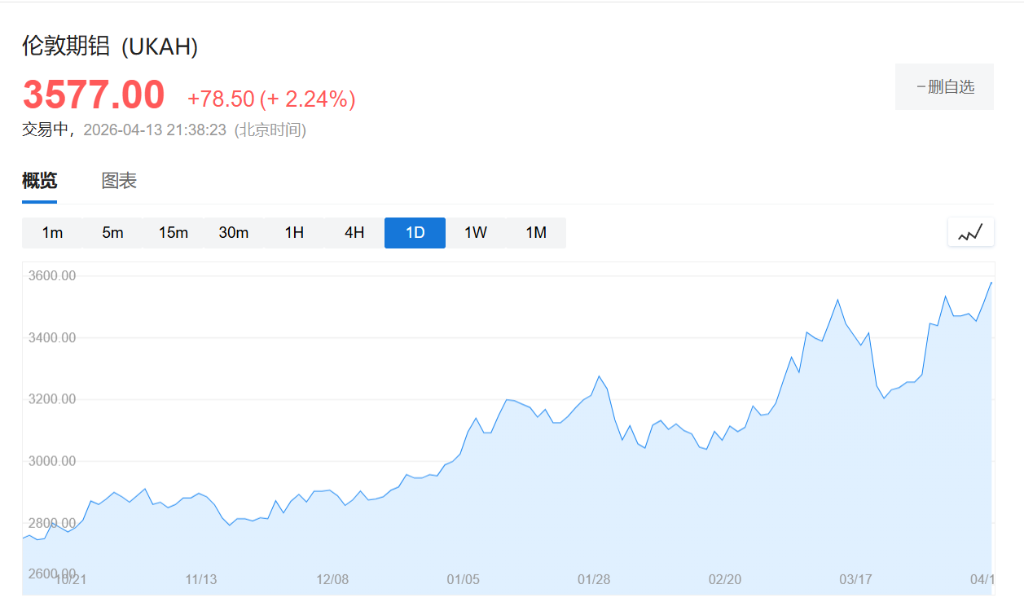
The direct trigger for this market upheaval was the formal imposition on Monday morning of the Hormuz Strait blockade measures announced by the Trump administration, coupled with an announcement from Emirates Global Aluminum (EGA), the largest aluminum producer in the Gulf, declaring force majeure on certain contracts. These dual shocks have exacerbated the pressure on an already fragile global aluminum supply chain.
Dual Shocks Trigger Supply Crisis
According to U.S. President Trump, who spoke to the media after arriving at Andrews Air Force Base in Maryland aboard Air Force One, the U.S. military will implement a blockade on Iran at 10:00 a.m. Eastern Time on April 13, which corresponds to 10:00 p.m. (UTC+8). Meanwhile, EGA announced over the weekend that its Al Taweelah smelter was forced to shut down due to Iranian missile and drone attacks, and the company has invoked force majeure on some contracts. According to documents obtained by Bloomberg, the official statement was issued on Saturday.
EGA is jointly owned by Abu Dhabi’s Mubadala Investment Company and Dubai Investment Company, with cast metal sales of 2.83 million tons in 2025, accounting for about 4% of global aluminum production. The entire Middle East region contributes around 9% of global aluminum supply.
Spread Signal: Most Extreme Supply Squeeze in 19 Years
The dramatic changes at the front end of the LME aluminum market curve are the most direct reflection of the current supply pressure.
The spot-to-three-month futures spread jumped 37% from $66.70 per ton last Friday to $91.50 per ton, reaching the largest backwardation since 2007. In a normal market condition (Contango), forward prices are higher than spot prices to cover storage and financing costs; the current significant backwardation means traders are willing to pay high premiums to obtain spot material immediately, reflecting an assessment of severe spot market shortage.
The last time this level of spread occurred was at the peak of the global commodities supercycle in 2007. The current front-end squeeze shows market liquidity is extremely fragile, the convenience yield of holding physical inventory has surged, but even so, the supply gap remains difficult to fill.
Price up 18% Year-to-Date, Analysts Warn of Intense Supply Shock
On Monday, LME aluminum rose over 2% to $3,577/ton (UTC+8), extending a rally in industrial metals driven by war risks and supply concerns since the start of the year—with aluminum prices now up about 18% year-to-date.
Goldman Sachs commodities analyst James McGeoch said in a client report earlier this month: "It's hard to imagine a bigger metal supply shock. The market already had high expectations for developments, but the initial reaction yesterday was to avoid uncertainty—if history is any guide, this attitude should be replaced by new long positions."
The current situation indicates that, with Middle Eastern geopolitical risks continuing to escalate, the aluminum market’s tight supply will be hard to ease in the short term, and both traders and industrial users will continue to face increasing cost pressures.
Disclaimer: The content of this article solely reflects the author's opinion and does not represent the platform in any capacity. This article is not intended to serve as a reference for making investment decisions.
You may also like
RAVE (RaveDAO) 24-hour amplitude at 68.7%: Sharp fluctuations driven by short squeezes and thin liquidity
Trending news
MoreCrypto prices
More





