
The market hasn't ignored the war; it has just decided to stop betting on the worst-case scenario.
Goldman Sachs researcher Dominic Wilson believes that the recent resilience of the US stock market is not a disregard for risk; rather, the market is starting to bet on an easing of conflict. However, with the situation in Iran remaining volatile, tail risks have not disappeared, and investors must remain cautious.
On April 14, Dominic Wilson, a researcher at Goldman Sachs, discussed the Iran conflict on the Goldman Sachs “Exchanges” podcast with host Allison Nathan, including the impact of the US blockade of the Strait of Hormuz on global markets.
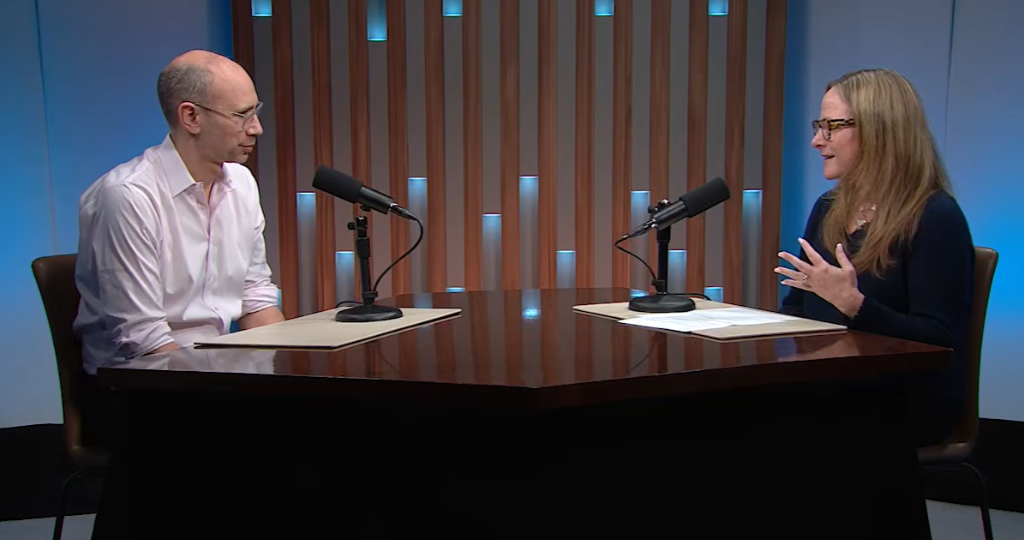 (Left: Dominic Wilson, Right: Allison Nathan)
Last week, the news of the Iran ceasefire deal led to a substantial market rebound, only to be overshadowed by the US announcement of the blockade of the Strait of Hormuz. Nevertheless, the S&P 500 has already recovered all the losses it sustained before the conflict, while oil prices remain high.
Wilson stated that this market reaction is not surprising. Historically, in every crisis, the market tends to start recovering even before the situation on the ground improves, which is similar to the patterns observed during the Covid-19 pandemic and the tariff shocks.
Wilson pointed outthat the market has already made its judgment, believing that current negotiations allow people to stop worrying excessively about extremely severe military consequences. However, he believes that while investors regain core long positions, they should also actively build hedging positions.
Specifically, he believes that current focuses include AI-related assets, cyclical and commodity-related emerging market assets, as well as markets such as Japan and South Korea, which were strong before the conflict. But he particularly emphasized:
You must always be aware of risk scenarios and have a clear understanding of how your positions perform in the worst-case scenario.
Meanwhile, there is an obvious divergence between the interest rate market and the stock market, with the former pricing in a more hawkish outlook. Wilson pointed out that markets worry that inflationary pressures will prompt central banks to pause or even tighten policies, and the interest rate market may have over-priced hawkish expectations of central banks.
Logic Behind the Stock Market Rebound: Extreme Risks Are Already Priced In
Wilson explained that the stock market's recovery comes from the market's re-pricing of extreme negative scenarios.
In the first few weeks of the conflict, the market was worried that the situation might deteriorate for a long time, with more aggressive military solutions.As negotiations began, the market judged that the probability of those "worst-case scenarios" had dropped significantly, thus putting more weight on the path toward eventual reconciliation.
He cited the Covid-19 pandemic as an example, noting that the stock market rebounded before the infection and death rates truly peaked. He said:
For an asset with a long discounting cycle, short-term economic damage is bearable; what truly frightens the market is uncertainty about the future.
As long as the market believes that the current tensions will be resolved within weeks, whether this tug-of-war lasts two or eight weeks makes little difference to the valuation of multi-year assets.
However, Wilson emphasized that this judgment does not mean downside risk has been eliminated:
Extreme risks still exist, and we cannot confidently say that the scenarios that worried us before will not return. As the market lets down its guard, tail risks start to look underpriced.
Interest Rate Markets May Have Overpriced Hawkish Central Bank Expectations
The trajectory in the interest rate markets is in stark contrast to the stock market.
Wilson pointed out that since the conflict began, the rate market has been more concerned about central banks' hawkish responses.According to Goldman Sachs' measurements, the market has largely priced in expectations of medium-term growth impairment, but the expectation that central banks will remain cautious for a long time persists.
He believes this is partly due to path dependence on inflation memory. The "scars" left by previous high inflation have made the market more alert to central bank reactions.
In addition, before the conflict, the market was already pricing in two and a half rate cuts from the Federal Reserve this year, which was somewhat excessively dovish, so this correction has some justification.
But based on the distribution of Goldman's forecast scenarios, Wilson believes:
There are more paths where rates end up below market pricing than above,indicating that the market overall is still priced on the hawkish side.
He adds that the probability of rate hikes in Europe is higher than in the US, but even so, most central banks are more likely to stand pat than to actively tighten.
Short-Term US Dollar Support Strengthened, Medium-Term Weakening Logic Unchanged
Wilson said that the support for the US dollar from the oil price shock is consistent with historical patterns.
The dollar benefits from safe-haven inflows and improved terms of trade due to the US’s position as an oil exporter. Currently, the USD trade-weighted index is only slightly lower than at the start of the year, and the earlier weakness has basically been reversed.
He believes this conflict has reminded the market:
In the face of certain shocks, holding the US dollar is an effective hedge, rather than reducing dollar holdings to reduce risk.
This has made some investors more cautious about betting against the US dollar.However, Wilson emphasized that the structural logic for a weaker dollar in the medium term remains intact.
The US dollar remains overvalued, the Federal Reserve is still more likely than other major central banks to cut rates, and the geopolitical and institutional shifts that have previously driven capital outflows from the US have not been fundamentally reversed. He said:
Short-term, this event has provided unexpected support for the dollar; but in the medium term, the case for a weaker dollar may still hold.
AI Trend Makes a Strong Comeback: Strategies Need Both “Offense and Defense”
Although geopolitical conflict remains the number one focus for investors, previous market-leading trends have not disappeared, and capital is quicklyflowing back. Wilson pointed out:
The AI theme is returning rapidly, not just in discussions but in market action itself.
Wilson has observed that semiconductor stocks have not only recouped their pre-conflict losses—some have reached new highs—while software stocks remain under pressure.
Wilson emphasized that institutional investors are highly reluctant to give up their core positions. Once the market stabilizes, funds quickly return to the AI sectors they believe add value.
Facing ongoing uncertainty, Wilson suggests that investors maintain a dual-track strategy of “selective long positions and active hedging.”
He believes that when the market rises on negotiation progress and sentiment relaxes, it is the time to add tail-risk hedges; when the market falls on new negative news, it's an opportunity to increase core risk exposure at lower prices.
Specifically,when the market drops and hedging tools are effective, it’s possible to add to technology, cyclical commodities, and structurally favored assets in emerging markets (such as Japan and South Korea) at lower prices. And whenthe market rallies and relaxes, one should immediately reinforce downside protection.
Wilson says:
Never leave yourself unprotected against deep tail risks. If you do not increase your protections at the same time, I do not advise increasing your risk exposure again.
Full Interview Transcript (AI-assisted translation):
Allison Nathan: Last week, news of the Iran ceasefire agreement provoked a very strong market reaction, but this week the US announced the blockade of the Strait of Hormuz—a chokepoint crucial to global energy flows.
So how does the market find direction in this uncertainty, and how should investors respond? I’m Allison Nathan. Welcome to the Goldman Sachs Exchanges podcast. Today’s guest is Dominic Wilson, Senior Markets Advisor in the Goldman Sachs Research Division. Dom, welcome back.
Dominic Wilson: Thank you, it’s great to be back on the show.
Allison Nathan: Dom, the situation surrounding the Iran conflict has been anything but steady. Frankly, the blockade I just mentioned is the latest development, making a quick resolution seem unlikely. But looking at the market, especially the S&P 500, valuations are almost back to pre-conflict levels. So first: Are you surprised? Is the market really underestimating downside risks?
Dominic Wilson: Actually, that’s a question with two layers, and I think they need to be looked at separately.
First, “are you surprised?” We keep reminding ourselves: whenever you go through a crisis, the market typically experiences a lot of worry, and then the first stage of relief often comes when people start lowering their weighting of extreme negative scenarios. So a rebound happening while a lot of issues are unresolved isn’t unusual. Think back to Covid, think to the tariff shocks—the market often rebounded before things got really bad on the ground.
I think that’s essentially the market’s posture: oil is still high, oil flows aren’t normalized, but the market has made a judgment—several weeks ago, people were confronting a very wide distribution of probabilities, including a long, drawn-out deterioration, or dire military scenarios. Now the market—right or wrong—assumes that as long as negotiations are ongoing (even though far from finished), the weight of those extreme negatives has dropped significantly. Even if the medium-term outlook isn’t great and short-term activity data is weak, the stock market can “look through” that weakness thanks to its long-term discounting.
Of course, the key question is: is this judgment correct? Based on how things have evolved, the direction seems right—compared to a few weeks ago, when neither side even knew how to start negotiations and the military scenarios being discussed were far more severe than anything we’ve since seen, it’s fair to say we’re in a better place. So the market lowering its weighting of downside tail risk is reasonable.
Personally, I’m not too surprised by the rebound. But as for whether tail risks are underestimated—I think those risks have receded and the threshold to shake market confidence is higher, but the risks themselves still exist. Can we confidently say the extreme scenarios feared at the start won’t return? The answer is no, but we can be a bit more confident than before. That deep tail risk is what worries me. As the market relaxes, the tail risk starts to look underpriced.
Allison Nathan: I totally agree, but to clarify—we’re now said to be facing a full blockade. A little oil was moving before, not much, but something; now reportedly nothing can get through.
Dominic Wilson: Yes. Interestingly, my experience with this crisis—shared by many, I’m sure—was: at first, commodity experts were extremely pessimistic, while the market stayed relatively calm. The commodity experts were saying, “You don’t understand how serious a blockade will be.” And they were right. So in the initial weeks, the market fell, woke up to the downside risk, and realized the situation was serious and not easily resolved.
However, some things have shifted at the margin. If you now tell people the strait remains closed—potentially for several months, oil prices will keep rising, and the economy will suffer—most already know all that. On the other hand, as long as people believe it will ultimately be resolved, for a long-term stock market, the short-term pain can be absorbed. What truly hurts is a lack of confidence about “what things look like after it’s resolved.”
So there’s this tension between spot and forward-looking markets—which doesn’t mean the stock market is necessarily right, but if the market logic is: this is just one episode in negotiations, it’s severe, parties might walk away, make threats, new conflict could break out, but in the end it’ll be resolved in a matter of weeks—then for a multi-year asset, whether it takes two, six, or eight weeks to resolve doesn’t change much.
Of course, there are some assumptions here, and they can be challenged. But I’d say the logic isn’t outlandish—it just appears that way, but it actually reflects the stock market’s forward nature. It’s like with Covid: the market started moving on before infection and death rates peaked. This tension between spot reality and future expectations makes this type of risk hard to manage.
Allison Nathan: Absolutely. What’s especially interesting is that despite resilience in the S&P 500 and the stock market, pricing in rates markets is very different. How do you interpret this?
Dominic Wilson: It’s really notable. From the start of this crisis through now, when we look at rate markets, the market is much more worried about central banks turning hawkish due to inflation than about growth downturns.
We do see some growth concerns, but our metrics show that most of the medium-term growth loss people feared has been repaired with the rebound; what isn’t going away is the expectation that central banks will be much more hawkish than they would have been before this crisis began.
Part of this is everyone expecting a spike in inflation that makes central banks cautious—even though from a medium-term path, it shouldn’t matter much. The recent bout of high inflation has accentuated the market’s sense that “central banks will be more cautious.” Another part is that previous market pricing was already unreasonable—we were expecting a continued rate-cutting cycle, which in hindsight is almost absurd: in February, the market was worried about AI-driven job losses, expecting two-and-a-half US rate cuts with high confidence. That pricing was already dovish. Now the market is correcting that, and the current environment makes a more cautious central bank easier to accept for the market.
But there’s a strange sort of tension—the market thinks this shock is serious enough for central banks to worry about inflation, but not so severe that a hit to growth will override the inflation concern. That’s what surprises me—that the market has moved so far in this direction and stayed there.
Allison Nathan: So you think the market’s skepticism has swung too far here, that expectations of hikes shouldn’t be this high?
Dominic Wilson: I think so. Of course, there are country differences—Europe is more likely than the US to hike. But overall, when we look at our forecasts, and Yarn and the team’s scenario analysis, we see a greater likelihood for rates to fall than to rise. In other words, our probability distribution is broadly more dovish than market pricing.
Still, things are much better than two weeks ago. Two weeks ago, front-end rates markets were severely stressed—Europe was priced for continued hikes, US hikes were priced in, and it looked excessively stretched.
Now there’s more scope for debate. I think for most central banks, the easiest action in this environment is to do nothing—neither hike nor cut. That “do nothing” path is probably where we end up, which is already more hawkish than pre-crisis. But overall, I still think the market is, on average, a bit too hawkishly priced.
Allison Nathan: So where does that leave the US dollar? Just a reminder, at the start of the year we had a moderately bearish stance toward the dollar; as conflict broke out, the dollar got a lot of support; and now it looks to be weakening again. How do you see this?
Dominic Wilson: It’s a more complicated picture. We were bearish the dollar at the start of the year, but in a fairly mild way. Compared to last year, we’ve emphasized that besides the dollar itself, other forces matter in FX—cyclical and carry currencies have performed well and trades along that axis could dominate. We then saw the dollar weaken in January and February—much more than we’d forecast. Now, that weakness has basically fully reversed.
In big-picture terms, the oil price shock’s FX effect is as expected—supportive for the dollar. The US benefits in two ways: safe-haven flows and its own oil export position. So at the moment, the dollar trades only mildly weaker than at the start of the year—this year’s move out, then back in.
For the dollar going forward, I think it’s more complicated. On one hand, as we better digest oil risks—and we expect higher oil prices to persist longer—this supports the dollar; and this event is a reminder that for certain shocks, the dollar can appreciate, acting as a hedge. We’ve seen this before, but it’s been reinforced. So I think the market will be more hesitant about shorting the dollar, and that won’t surprise me.
On the other hand, from a structural, strategic angle, over a longer horizon the dollar is still overvalued—now even more so post-rebound; even if US growth remains solid, the Fed is still more likely to cut rates than other majors; and previously existing currency outflow drivers—geopolitical and institutional factors, plus AI concentration risk—haven’t gone away either.
So, I still think the medium-term story arguing for dollar weakness holds. Just in the short run, this event supports the dollar more than if it hadn’t happened.
Allison Nathan: Let me broaden the question a bit. At the start of the year, there was a narrative that capital would shift out of the US to the rest of the world and to other global assets. Amid these big swings around the conflict, where does this trend stand now?
Dominic Wilson: Honestly, I think it’s complicated. I don’t think the trend has reversed, nor am I certain it will fail. But this event is a reminder that these sorts of shocks hit some major non-US markets—especially Europe, North Asia, and developed non-US markets—harder than the US, and their fundamentals are weaker and positioning is heavier. We were starting to see a reallocation process, but this shock came completely at odds with the main market trend, causing a lot of pain.
And these risks aren’t likely to disappear suddenly; they’ll hang over the market for quite some time—unless the oil supply crunch can be resolved very rapidly and thoroughly, which seems unlikely. So I think investors will be more cautious and selective when allocating capital outside the US, and slower to act.
Allison Nathan: As we discussed previously, the main market themes at the year’s start were AI and the labor market, among others. Now, are there other themes vying with the Iran conflict for attention? What are investors telling you they’re focusing on?
Dominic Wilson: No question, the Iran conflict remains number one. In that sense, despite the market’s relief rally, no one is saying, “It’s over, let’s move on”—the topic is still highly focused, and the resolution path, and whether it’s really resolved, are still the top issues.
But the other themes you mentioned are absolutely back. If you’d asked me two or three weeks ago, at the height of the tension, I’d have said they were almost entirely off the table; but as things have calmed, they’ve returned to investors’ radar quite quickly.
There’s a sequence to these themes. Private credit never really disappeared, just receded into the background; but in terms of direct impact, I’m not sure we’ve seen much truly new information. The concerns persist, people keep bringing them up, and we’re broadly optimistic on that front, but the debate isn’t settled.
More notable is the AI theme—it’s rapidly back not just in conversation, but in market performance. Semiconductor stocks are leading again: within AI and tech, there was a clear divergence, with hardware like memory chips outperforming, while software struggled over fears of new AI app competition. Now, this is back—software has lagged in the rebound, semiconductors have hit new highs, surpassing all pre-conflict peaks—making it one of the few segments to break out during this turmoil. The theme is back with strength.
We hear, across the board, that investors are highly convinced by their core themes in equity portfolios—they’re protecting index and beta exposure, but are reluctant to give up core holdings. The speed with which people return to what they believe in has been impressive.
Allison Nathan: Looking ahead over the coming weeks and months, with this uncertainty unresolved, how should investors position? Negotiations may be underway, but visibility is limited. Do you expect the current state to persist?
Dominic Wilson: These events are extremely complex by nature. We’ve broadened the range of outcomes—narrowed from the most tense moments, but still much wider than normal, and all scenarios are on the table.
In some sense, it’s a continuation and variant of our view on the US from the start of the year—hold selectively high-conviction longs, but actively hedge, because downside risk is still significant and can re-escalate at any time.
In practice—easier said than done—our strategy is to look for opportunities on both sides as the market swings. When you have solid hedges and the market falls, hedges pay off and you might add to favored assets at the lows; when the market rallies and sentiment eases, you should think about reinforcing your hedges.
Right now, with the market relaxing, to answer your question—I do think downside risk is underestimated. The corresponding response should be to add deeper downside hedges in equities and credit—it’s worth doing, and no one should leave themselves exposed to extreme tail risks. The worst scenarios can be hedged.
Of course, markets may just chop sideways with the negotiation back-and-forth, but the real tail risk is there; the market’s focus on those risks has faded, making this the right moment to add hedges and ensure you’re protected.
At the same time, you must consider what happens if it really does resolve. I don’t think the answer is to give up all positive risk assets. When the market corrects, it’s a good idea to selectively add structural longs—like favored tech names, cyclical and commodity-tied emerging markets, and strong markets like Japan and South Korea. But only if you’ve also strengthened your protections; don’t add exposure without adding hedges. Always respect tail risks, and know how your holdings will behave if the worst case does happen.
Allison Nathan: Dom, thank you so much for this deep dive in such a fast-changing situation.
Dominic Wilson: Thank you. I’m sure things will look different in a week or two.
Allison Nathan: I believe so, too. We’ll have you back then. Thank you, and thanks for listening. This episode was recorded on April 13, 2026.
Disclaimer: The content of this article solely reflects the author's opinion and does not represent the platform in any capacity. This article is not intended to serve as a reference for making investment decisions.
You may also like
TOWN's 24-hour volatility reaches 46.1%: price rebounds from $0.0003366 to $0.0004917 amid active trading
Gold Price Outlook: XAU/USD slips under $4,800 as US Dollar strengthens
USD: Attention turns to Beige Book – TD Securities
BIO (BioProtocol) fluctuates 42.0% in 24 hours: Surge in trading volume by 340% drives price rebound
Trending news
MoreCrypto prices
More





