
Escalating tensions in Iran and expectations of high interest rates suppress safe-haven demand; gold sees a slight adjustment

FX168 News April 20—— Pressured by renewed tensions in the Middle East and expectations that the Federal Reserve will maintain high interest rates, the price of gold has fallen back to around $4,775. Although geopolitical risks should generally support safe-haven demand, sustained high interest rates have diminished gold’s appeal. The market is now focused on the upcoming U.S. retail sales data to gauge the impact of inflation and potential policy changes on gold prices.
International gold prices weakened notably during Monday’s Asian session, with XAU/USD retreating towards $4,775 before rebounding back near $4,800, highlighting renewed contest between bulls and bears in a complex macro environment. Despite escalating tensions in the Middle East, gold failed to extend its earlier safe-haven rally and instead underwent a pullback, reflecting a shift in prevailing market drivers.
From the background of events, Iran announced the closure of the Strait of Hormuz and stated it will take action against vessels approaching the area until the United States lifts the maritime blockade. Meanwhile, market surveys show that Iran denies participating in a new round of negotiations, forming a clear contrast with diplomatic signals from the U.S. This uncertainty has raised concerns over energy supply and regional stability.
However, gold has not benefited from these developments, mainly due to shifting macro-financial conditions. Market expectations for Federal Reserve policy have clearly moved towards “higher interest rates for longer,” mainly driven by persistent inflation pressures and geopolitical risks pushing up energy prices. Against this backdrop, real yields in the U.S. remain high, significantly increasing the opportunity cost of holding a non-yielding asset like gold, thereby pressuring gold prices.
Meanwhile, the U.S. dollar remains relatively firm, which also puts downward pressure on dollar-denominated gold. In a high-interest-rate environment, capital tends to favor dollar assets over safe-haven assets like gold, and this shift in capital flows is a key factor behind the recent pullback in gold prices.
Currently, the market’s focus is shifting to the upcoming U.S. retail sales data. Market expectations are for a month-on-month increase in March retail sales of about
Overall, gold is currently in a tug-of-war between its “safe-haven property” and its “interest rate sensitivity.” While geopolitical risks offer potential support, interest rate conditions are dominating short-term price movements, leading gold to face near-term pressure.
From a technical perspective, the daily chart structure shows gold pulling back from high levels, failing to effectively break through the key resistance at
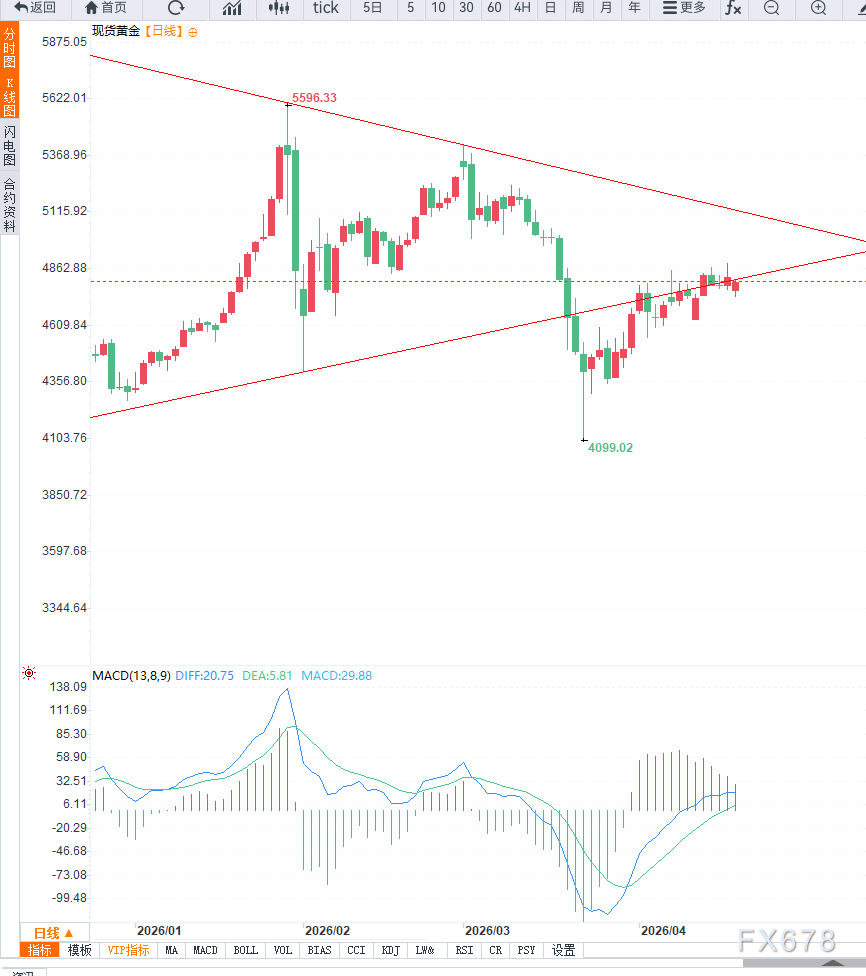
In summary, the core contradiction in the current gold market is the offsetting relationship between safe-haven demand driven by geopolitical risk and a high interest-rate environment. In the short-term, as the Federal Reserve maintains a tightening bias, gold’s upside is constrained—even with rising tensions, a sustained rally is hard to materialize. The future trend will depend on U.S. economic data and shifts in rate expectations; if inflation pressures ease and monetary policy pivots, gold could regain its strength, but continued dollar strength remains a risk that could suppress gold.
Disclaimer: The content of this article solely reflects the author's opinion and does not represent the platform in any capacity. This article is not intended to serve as a reference for making investment decisions.
You may also like
IRYS (IRYS) fluctuates 41.3% in 24 hours: Trading volume surge drives speculative price volatility
Gold struggles to extend recovery beyond 100-hour SMA as rising US bond yields cap gains
SPK (Spark) sees 41.4% volatility in 24 hours: Trading volume surges nearly 200%, driving price rebound
Weekly Market Pulse: Stop Paying Attention to Headlines
Trending news
MoreCrypto prices
More





