
It is already a consensus that the Bank of Japan's "hawkish pause" in April, so what is USD/JPY waiting for in the tug-of-war at the 159 level?

Huitong Finance, April 20 — On Monday, the USD/JPY pair remained in a narrow range around the 159 mark, with intermittent safe-haven buying in yen due to fluctuations in the geopolitical landscape. The fundamental core contradiction lies in the Bank of Japan's high probability "hawkish pause" in April, with real policy suspense postponed to June, causing the market to repeatedly weigh between the disadvantage in interest rate differentials and rate hike expectations. As Golden Week approaches, shrinking liquidity may amplify intraday volatility.
On Monday (April 20), the USD/JPY pair showed a narrow range fluctuation from the Asian to European sessions, with bulls and bears fiercely contesting near the 159.00 level. The day's core driver was the global geopolitical situation's series of twists and turns. Although positive signals emerged regarding mediation efforts in Islamabad, the subsequent lukewarm response to a second round of talks reignited safe-haven sentiment. As a result, yen saw a slight appreciation on the back of safe-haven demand, while
Overall, the market displayed a "cautious and wait-and-see" attitude. Although the yen has recently faced devaluation pressure, its traditional safe-haven attribute has partly come into play due to unresolved
In-depth Analysis of Macroeconomic Fundamentals and Technicals
From a fundamental logic perspective,
The current macro environment shows a complex "hawkish pause." Although the BOJ may delay a rate hike in April, its internal logic is not turning dovish but rather buying time for observation. With the transmission of oil price volatility, domestic inflationary pressures in Japan remain robust, prompting widespread market expectations that the central bank will release clearer rate hike signals at the June meeting. Notably,
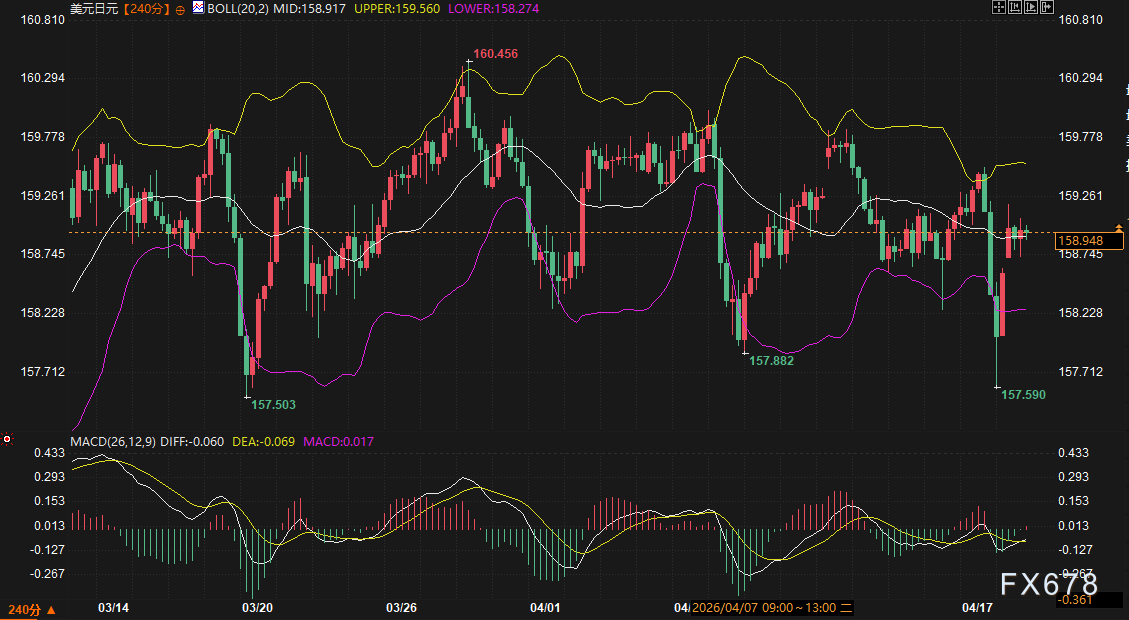
In combination with the 4-hour technical chart, USD/JPY is now in a corrective recovery phase after a high-level consolidation.
1.
2.
3.
Future Trend Outlook
Looking ahead, USD/JPY will enter a stage driven by "expectations differentials." On one hand, if the BOJ not only keeps rates unchanged in April but also fails to sufficiently hint at a June rate hike, yen could face renewed selling pressure due to interest rate differentials. On the other hand,
Before Japan enters the "Golden Week" holiday next week, market liquidity may gradually shrink, often amplifying intraday price swings. Technically, if the exchange rate can remain stable above the mid-band at 158.90, it may retest the 160.00 round mark; conversely, if it breaks below the 158.20 level, the downward trend since April will further extend, searching for buying interest near 157.50. Overall, the yen will likely maintain a low consolidation in the short term, awaiting further fundamental catalysts.
Frequently Asked Questions
1. Why might the Bank of Japan choose to keep rates unchanged in April despite inflationary pressures?
Mainstream market opinion is that the current external instability has resulted in very low economic outlook visibility. As Japan is highly dependent on energy imports, sharp fluctuations in oil prices can both push up inflation and suppress real consumption. The BOJ tends to use a "hawkish pause" to buy more time for data assessment, evaluating the real effects of energy shocks on economic growth, and wants to avoid excessively tightening monetary policy in an uncertain environment.
2. What is the direct impact of a flattening Japanese government bond yield curve on the exchange rate?
A flattening yield curve usually reflects market caution toward long-term economic growth or a surge in demand for long bonds. The obvious decline in 20-year and 40-year JGB yields today shows robust institutional support for JGBs before "Golden Week." This bond market strength will, in the short term, attract capital back to the yen, forming resistance as the USD/JPY approaches the 160 mark.
3. What is the technical significance of USD/JPY in the 157.50-157.60 range?
Looking at candlestick patterns, the rapid rebound in mid-April after USD/JPY dipped to 157.590 generated a long lower shadow. In technical analysis, this is a clear "demand zone," indicating strong demand for currency settlement by Japanese importers or protective long closing near that level. As long as this area is not broken by a substantial bearish candlestick, USD/JPY's overall pullback logic remains within a controllable oscillation.
4. What risks does the "Golden Week" holiday pose to yen traders?
During Japan's "Golden Week," Tokyo's forex market will be closed, and liquidity will drop sharply. With thin liquidity, even small trading volumes could trigger sharp exchange rate swings, potentially leading to "flash crashes" or spikes. Additionally, if geopolitical events change suddenly, the yen, lacking domestic buy-side support, may experience irrational, wide fluctuations.
5. If the BOJ confirms a rate hike in June, will yen immediately enter a strong appreciation trend?
This depends on the extent of Japan-US yield contraction at the time. Even if the BOJ raises rates to around 1.0%, the yen remains a low-yielding currency compared to the US dollar. Post-hike yen performance will depend more on market expectations regarding the frequency of subsequent hikes. If the BOJ only makes a symbolic adjustment and external uncertainty persists, the yen’s appreciation potential may be constrained by carry trade positioning.
Disclaimer: The content of this article solely reflects the author's opinion and does not represent the platform in any capacity. This article is not intended to serve as a reference for making investment decisions.
You may also like
IRYS (IRYS) fluctuates 40.9% in 24 hours: trading volume surge triggers extreme price swings
Gold: Longer-term support from softer Dollar – HSBC
Canada: Core inflation trend cools as energy lifts headline – RBC
Agnico Eagle moves to consolidate Finland's gold district in nearly C$4B deal
Trending news
MoreCrypto prices
More





